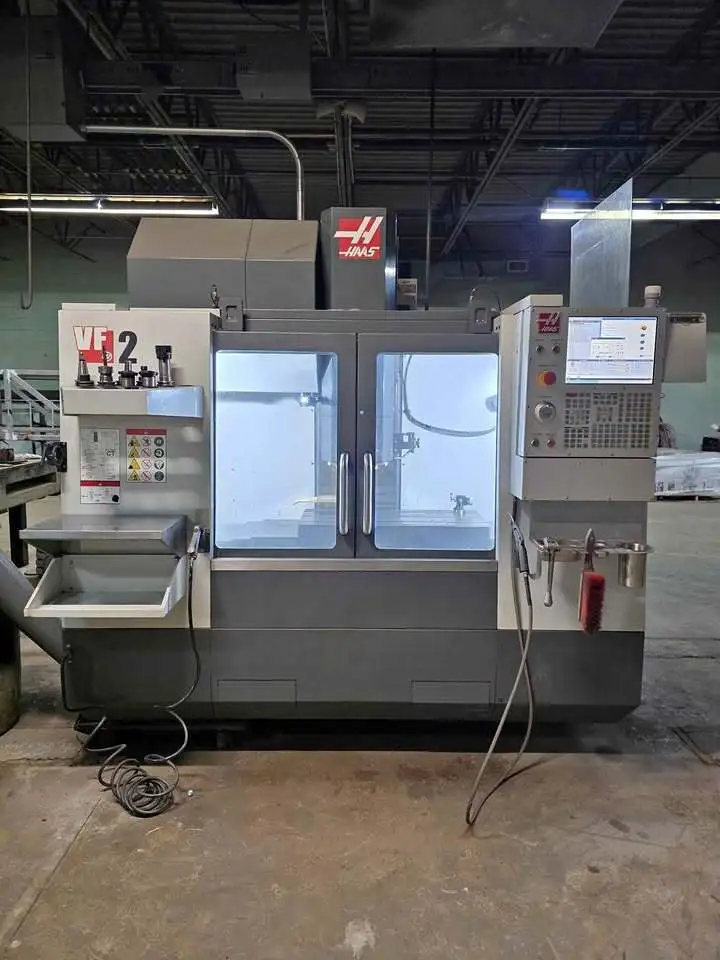
USED HAAS VF2 2023
The 2023 HAAS VF2 is one of the most popular 3-axis Vertical Machining Centers (VMCs) in the world, designed to deliver exceptional precision, reliability, and productivity for both prototype and high-volume production environments. As the flagship model of the Haas VF Series, the VF2 combines a rigid cast-iron construction, powerful inline direct-drive spindle, precision linear guideways, and the latest Next Generation Haas CNC Control to provide outstanding machining performance across a wide range of industries. The 2023 HAAS VF2 is widely used in aerospace, automotive, medical, mold making, energy, electronics, and general manufacturing facilities where consistent accuracy and dependable operation are essential.
The machine offers 30 inches of X-axis travel, 16 inches of Y-axis travel, and 20 inches of Z-axis travel, providing an ideal work envelope for machining fixtures, tooling plates, production components, molds, aerospace parts, and precision assemblies. Its heavy-duty cast-iron frame minimizes vibration during aggressive cutting operations, while oversized ballscrews and precision linear guideways ensure excellent positioning accuracy and repeatability. Whether machining aluminum, stainless steel, titanium, cast iron, engineering plastics, or hardened alloys, the 2023 HAAS VF2 consistently delivers superior surface finishes and tight machining tolerances.
Powering the machine is a 30 HP, 8,100 RPM CAT40 inline direct-drive spindle capable of producing approximately 90 ft-lb of torque. The standard 20-pocket automatic carousel tool changer provides dependable tool changes, while rapid traverse rates of 1,000 IPM on all three axes help minimize non-cutting time and maximize productivity. The 2023 HAAS VF2 also benefits from the latest Haas technologies, including Wi-Fi connectivity, HaasDrop, HaasConnect remote monitoring, 1 GB program memory, Ethernet networking, rigid tapping, and numerous automation-ready options. Many machines are also equipped with factory-installed options such as through-spindle coolant (TSC), chip conveyor, probing systems, fourth-axis preparation, and programmable coolant nozzle.
The latest Haas Next Generation Control provides faster processing, an intuitive widescreen interface, advanced tool management, USB connectivity, and simplified programming, allowing operators to maximize productivity while reducing setup times.
Today, the 2023 HAAS VF2 continues to be one of the most desirable vertical machining centers available in both new and used CNC markets because of its proven reliability, modern technology, affordable ownership costs, and exceptional resale value.
HAAS VF2 SPECIFICATIONS
HAAS VF2 – AXIS
| Specification | Value |
|---|---|
| Number of Axes | 3 Axis |
| X-Axis Travel | 30 in |
| Y-Axis Travel | 16 in |
| Z-Axis Travel | 20 in |
| Rapid Traverse (X/Y/Z) | 1,000 IPM |
HAAS VF2 – AXIS TRAVELS / WORK ENVELOPE
| Specification | Value |
|---|---|
| X Travel | 30 in (762 mm) |
| Y Travel | 16 in (406 mm) |
| Z Travel | 20 in (508 mm) |
| Spindle Nose to Table (Maximum) | 24 in |
| Spindle Nose to Table (Minimum) | 4 in |
HAAS VF2 – TABLE
| Specification | Value |
|---|---|
| Table Size | 36 × 14 in |
| Maximum Table Load | 3,000 lbs |
| T-Slots | 3 |
| T-Slot Width | 5/8 in |
HAAS VF2 – SPINDLE
| Specification | Value |
|---|---|
| Maximum Spindle Speed | 8,100 RPM |
| Spindle Power | 30 HP |
| Maximum Torque | 90 ft-lb @ 2,000 RPM |
| Spindle Taper | CAT40 |
| Drive Type | Inline Direct Drive |
HAAS VF2 – TOOL CHANGER
| Specification | Value |
|---|---|
| Tool Capacity | 20 Tools |
| Tool Changer Type | Automatic Carousel |
| Maximum Tool Diameter | 3.5 in |
| Maximum Tool Length | 16 in |
| Maximum Tool Weight | 12 lbs |
| Tool-to-Tool Time | 4.2 sec |
| Chip-to-Chip Time | 4.5 sec |
HAAS VF2 – CONTROL SYSTEM
| Specification | Value |
|---|---|
| CNC Control | Haas Next Generation Control |
| USB Interface | Standard |
| Ethernet Connectivity | Standard |
| Wi-Fi Connectivity | Standard |
| HaasDrop | Standard |
| HaasConnect | Standard |
| Rigid Tapping | Standard |
| Program Memory | 1 GB |
| Fourth-Axis Ready | Optional |
HAAS VF2 – COOLANT / CHIP MANAGEMENT
| Specification | Value |
|---|---|
| Flood Coolant | Standard |
| Coolant Tank Capacity | 55 gal |
| Through-Spindle Coolant | Optional |
| Programmable Coolant Nozzle | Optional |
| Chip Washdown | Standard |
| Chip Auger | Optional |
| Chip Conveyor | Optional |
HAAS VF2 – POWER REQUIREMENTS
| Specification | Value |
|---|---|
| Electrical Supply | 220V / 440V 3-Phase |
| Air Requirement | 100 PSI |
| Main Disconnect | Included |
HAAS VF2 – DIMENSIONS
| Specification | Value |
|---|---|
| Machine Footprint | Approx. 101 × 99 in |
| Machine Height | Approx. 101 in |
| Machine Weight | Approx. 7,800 lbs |
HAAS VF2 – GENERAL INFORMATION
| Specification | Value |
|---|---|
| Manufacturer | Haas Automation |
| Model | VF2 |
| Year | 2023 |
| Machine Type | Vertical Machining Center |
| Spindle Taper | CAT40 |
| CNC Control | Haas Next Generation Control |
| Primary Application | Precision Milling, Drilling & Tapping |
WHY BUY USED HAAS VF2 2023
Purchasing a used 2023 HAAS VF2 allows manufacturers to acquire one of the newest generations of Haas machining centers while saving substantially compared to purchasing a brand-new machine. The latest Next Generation Control, modern connectivity features, automation compatibility, and proven mechanical platform provide exceptional value for machine shops of every size.
Many used machines include premium factory-installed options such as through-spindle coolant, Wireless Intuitive Probing System (WIPS), chip conveyor, rotary tables, and fourth-axis preparation, allowing manufacturers to improve productivity while reducing setup time. Combined with Haas’ worldwide service network and readily available replacement parts, the 2023 HAAS VF2 represents an excellent long-term investment.
HOW MUCH DOES A USED HAAS VF2 2023 COST?
The value of a used 2023 HAAS VF2 depends on spindle hours, machine condition, installed options, tooling packages, automation equipment, and maintenance history. Machines equipped with through-spindle coolant, WIPS, rotary tables, chip conveyors, and documented maintenance records typically command the highest resale values.
Before purchasing, buyers should inspect spindle condition, linear guideways, lubrication system, tool changer operation, CNC diagnostics, machine geometry, and maintenance documentation. Because these machines are relatively new, many still retain excellent mechanical condition and low operating hours.
A used 2023 HAAS VF2 typically sells between $70,000 and $95,000, depending on spindle hours, tooling, installed options, machine condition, and service history.
INDUSTRIES THAT USE HAAS VF2
- Aerospace Manufacturing
- Automotive Manufacturing
- Medical Device Manufacturing
- Mold & Die Industry
- Tool & Die Shops
- Industrial Equipment Manufacturing
- Electronics Manufacturing
- Energy Equipment Manufacturing
- Contract Manufacturing
- Precision Engineering
- General Manufacturing
- Research & Development
TYPICAL PARTS HAAS VF2 CAN PRODUCE
- Aerospace Components
- Medical Device Components
- Mold Inserts
- Tooling Plates
- Precision Fixtures
- Hydraulic Manifolds
- Automotive Components
- Electronic Housings
- Prototype Parts
- Production Fixtures
- Precision Machine Components
- Custom Machined Parts
WHY CHOOSE HAAS VF2 2023
The 2023 HAAS VF2 combines a rigid cast-iron structure, 30 HP inline direct-drive spindle, modern Haas Next Generation Control, and proven mechanical reliability into one of the industry’s most versatile vertical machining centers. Its ability to deliver consistent accuracy, simple operation, and compatibility with numerous productivity-enhancing options makes it an excellent choice for both job shops and high-volume manufacturers.
Manufacturers continue to choose the HAAS VF2 because of its outstanding reliability, low operating costs, excellent parts availability, and strong resale value. Whether machining aerospace components, tooling, molds, medical parts, or production assemblies, the used 2023 HAAS VF2 delivers exceptional productivity, precision, and long-term return on investment.
HAAS VF-2 VS HAAS VF-1 – WHICH CNC VERTICAL MACHINING CENTER IS BETTER?
The HAAS VF-2 and HAAS VF-1 are both widely recognized CNC vertical machining centers, but their capabilities make them suitable for somewhat different production requirements. The VF-1 is generally positioned as a compact machining solution for smaller workpieces, limited floor space, and applications where a smaller work envelope is sufficient. The VF-2 provides a larger machining envelope, giving operators more flexibility when working with bigger components, multiple setups, or parts requiring greater movement along the machine axes.
One of the main differences between the two models is available working space. The VF-2 offers approximately 30 inches of X-axis travel, while the VF-1 provides approximately 20 inches. This additional travel can be particularly valuable for job shops machining larger plates, fixtures, housings, molds, and general industrial components. The VF-2 also provides a larger overall work area, making it easier to position tooling and fixtures for more demanding jobs.
Both machines are designed around the straightforward operating philosophy associated with HAAS CNC equipment. Their controls are familiar to many machinists, replacement components are relatively accessible, and a large installed base means technicians often have experience servicing these machines. Depending on configuration and production year, spindle specifications, tool capacity, control features, and options can differ considerably.
Choosing between the VF-1 and VF-2 should therefore depend on the work rather than simply selecting the larger machine. The VF-1 can be an excellent choice where compact dimensions and smaller components are priorities. The VF-2 becomes more attractive when additional axis travel and workspace are important.
For used-machine buyers, condition can be just as important as model designation. A well-maintained VF-1 may provide better value than a heavily worn VF-2. Buyers should evaluate spindle condition, axis movement, backlash, control operation, tool changer performance, lubrication history, and overall machine condition before purchasing.
HAAS VF-2 SPINDLE NOT TURNING – CAUSES AND TROUBLESHOOTING
A spindle that refuses to turn on a HAAS VF-2 can stop production immediately, but the cause is not always a failed spindle motor. The problem may originate in the control system, spindle drive, electrical circuit, safety interlock, tooling condition, lubrication system, or command being entered by the operator. Proper troubleshooting should therefore begin with basic checks before replacing expensive components.
First, verify whether the control is displaying an alarm. HAAS machines use diagnostic and alarm information to help identify conditions preventing spindle operation. Record the exact alarm number and message before resetting the machine. Repeatedly clearing an alarm without determining its cause can make troubleshooting more difficult and may allow an underlying electrical or mechanical problem to remain unresolved.
Next, confirm that the spindle command is being issued correctly. Check the programmed spindle speed, direction command, operating mode, and feed-hold or cycle-start conditions. If the spindle operates manually but does not start during a program, the problem may be related to programming, machine settings, interlocks, or another commanded function rather than the spindle itself.
If there is no spindle response at all, technicians should inspect relevant electrical connections, spindle-drive indications, and control diagnostics according to the machine’s electrical documentation. A malfunctioning spindle drive, damaged wiring, failed contactor or related electrical component can prevent rotation.
Mechanical conditions should also be considered. Excessive resistance, a damaged toolholder, bearing problems, contamination, or a mechanical obstruction can prevent the spindle from operating normally. Unusual noises, vibration, overheating, or changes in spindle sound can provide useful clues.
On older used VF-2 machines, age-related electrical and mechanical wear should receive particular attention. Troubleshooting should be performed by qualified personnel familiar with CNC equipment and appropriate electrical safety procedures. Avoid bypassing interlocks or working inside energized electrical cabinets.
A systematic diagnosis is more effective than immediately replacing the spindle motor. Checking alarms, commands, electrical systems, drive feedback, and mechanical condition in sequence can help identify the actual failure and prevent unnecessary repair costs.
HAAS VF-2 MAINTENANCE AND PREVENTIVE CARE GUIDE
Regular maintenance is essential for keeping a HAAS VF-2 reliable, accurate, and productive. Preventive maintenance is particularly important for used VF-2 machines because previous operating conditions, production hours, coolant exposure, and maintenance practices can vary significantly between machines. A consistent maintenance routine can help identify developing problems before they become expensive failures.
Daily care should begin with general housekeeping. Remove chips from the work area, table, enclosure, and chip-management system. Accumulated chips can interfere with moving components, contaminate coolant, and make it harder to identify leaks or mechanical problems. Check coolant concentration and condition and replenish it when necessary according to the manufacturer’s recommendations.
The lubrication system should also be monitored regularly. Verify that the machine has the correct lubrication level and investigate warnings promptly. Insufficient lubrication can contribute to premature wear of bearings, ballscrews, and other moving components. Coolant systems should be inspected for contamination, clogged lines, damaged hoses, and poor flow.
Periodic maintenance should include inspection of way covers, door mechanisms, chip conveyors where equipped, toolholders, drawbar operation, and automatic tool changer components. The spindle should be monitored for abnormal noise, vibration, heat, or changes in operating behavior. Early detection of these symptoms can prevent a minor issue from developing into a major spindle repair.
Axis performance deserves particular attention on older machines. Operators and technicians should watch for unusual backlash, inconsistent positioning, rough movement, servo alarms, or changes in cutting accuracy. These symptoms may indicate wear or adjustment requirements.
Electrical cabinets should be inspected according to appropriate safety procedures. Dust, coolant mist, loose connections, damaged wiring, and overheating components can create reliability problems.
A maintenance log is valuable because it provides a history of lubrication, repairs, inspections, and replaced components. For businesses operating multiple machines, documented maintenance also helps establish consistent service intervals.
Preventive maintenance should follow the specific machine’s documentation and configuration because options and components vary by production year. Good maintenance does not eliminate every failure, but it can significantly improve machine reliability and help preserve the long-term value of a VF-2.
WHAT IS THE HAAS VF-2?
The HAAS VF-2 is a CNC vertical machining center designed for a broad range of metal-cutting applications. It belongs to the VF Series produced by HAAS Automation and has become a familiar machine in job shops, production facilities, educational environments, and general manufacturing operations. Its combination of useful work envelope, relatively compact footprint, CNC control, and broad application range has made the VF-2 a popular choice for both new and used equipment buyers.
The machine uses a vertical spindle arrangement, meaning the cutting tool approaches the workpiece from above. This configuration is well suited to machining components such as brackets, plates, housings, fixtures, molds, tooling components, and many other industrial parts. Depending on configuration, the machine can be equipped with different spindle speeds, tool changer capacities, coolant arrangements, probing systems, fourth-axis equipment, and other production options.
A key characteristic of the VF-2 is its approximately 30-inch X-axis travel, which gives it considerably more working space than smaller VF models such as the VF-1. The available Y- and Z-axis travel also allows the machine to accommodate a wide variety of workpieces while maintaining a practical footprint for many manufacturing environments.
The HAAS control system is another important part of the VF-2’s appeal. Operators familiar with HAAS equipment can often move between different models without having to learn an entirely different control philosophy. This can simplify operator training and make the machine attractive to shops that already operate HAAS equipment.
VF-2 specifications can vary by year and configuration, so buyers should not assume that every machine has identical capabilities. Older examples may have different spindle packages, control generations, tool changers, coolant systems, or installed options.
In the used CNC market, the VF-2 is often considered a versatile general-purpose machining center. Its suitability for prototyping, short-run production, repair work, and repeat manufacturing makes it useful for businesses that need a capable vertical machining center without requiring an exceptionally large machine footprint.
WHAT ARE THE MOST COMMON PROBLEMS WITH THE HAAS VF-2?
The HAAS VF-2 is generally regarded as a practical and versatile CNC machining center, but like any machine tool, it can develop problems through normal wear, heavy production use, inadequate maintenance, electrical aging, or improper operation. The specific issues found on a VF-2 can vary significantly depending on its production year, operating hours, configuration, and maintenance history.
Spindle-related problems are among the issues that deserve close attention. Symptoms can include unusual noise, excessive vibration, overheating, poor surface finish, inconsistent speed, or failure to start. These symptoms do not automatically indicate spindle replacement because the underlying cause may involve the spindle drive, bearings, wiring, feedback system, tooling, or another component.
Axis-related wear is another concern on older machines. Ballscrews, linear guides, bearings, servo systems, and associated components can experience wear over time. Backlash, positioning errors, rough axis movement, or servo alarms may indicate that an axis requires further inspection.
The automatic tool changer can also develop operational problems. Tool-change failures may result from mechanical wear, sensor issues, incorrect adjustment, contamination, or problems with the tool changer’s drive mechanism. Because tool changes occur repeatedly during production, this system can experience substantial use.
Coolant and lubrication systems require regular attention as well. Clogged lines, contaminated coolant, leaks, failed pumps, or inadequate lubrication can affect machining performance and accelerate component wear.
Electrical issues can become more common as machines age. Worn switches, damaged cables, loose connections, cooling problems, and aging electronic components may produce intermittent alarms or unexpected machine behavior. Proper diagnostic procedures are important because intermittent electrical faults can be difficult to isolate.
Door interlocks, limit switches, encoders, and sensors may also cause operational problems if they become damaged or contaminated.
When evaluating a used VF-2, buyers should inspect the machine under actual operating conditions whenever possible. Test spindle operation, axis movement, tool changes, coolant, lubrication, control functions, and alarm history. A thorough inspection can reveal issues that are not obvious from photographs or a machine’s basic specifications.
Related Products
-
HAAS - VF2D
VIEW MACHINE -
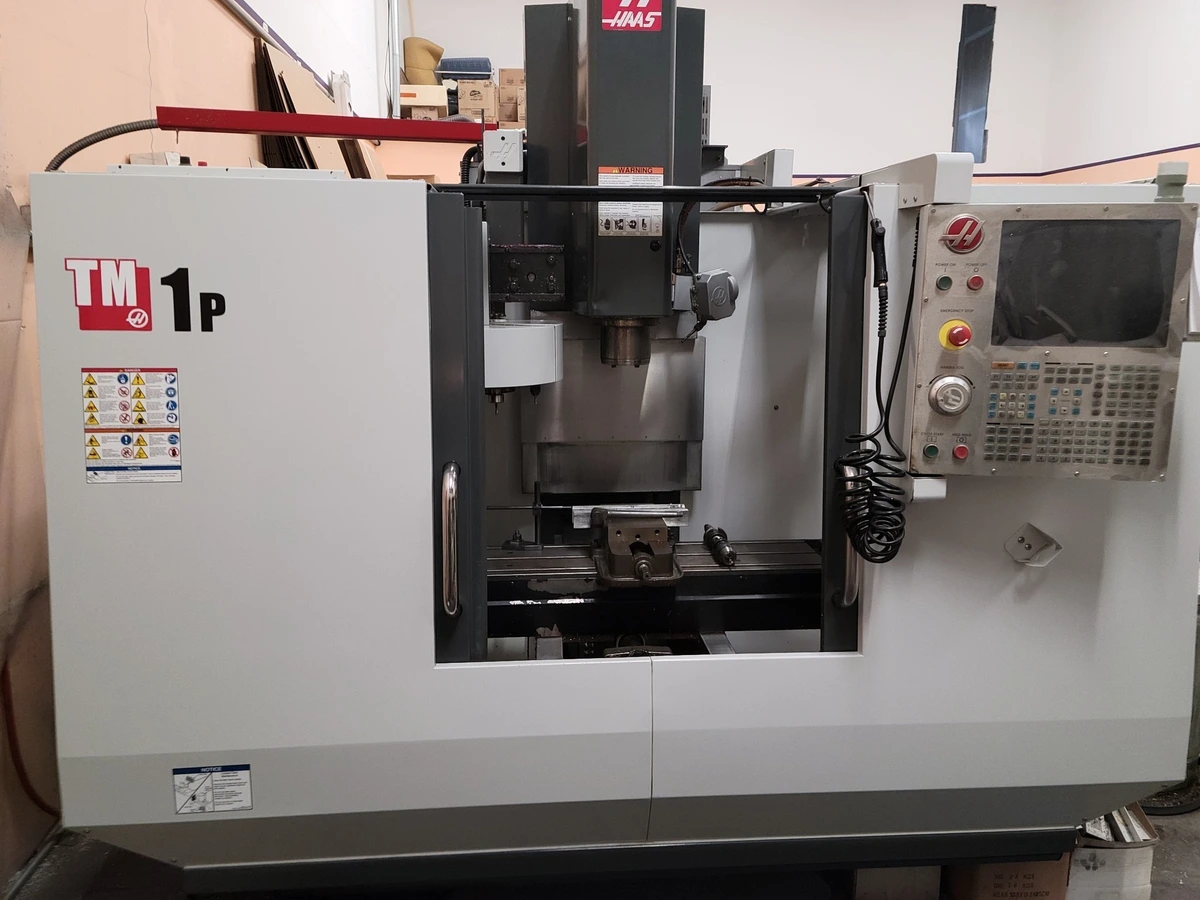
HAAS - TM1P
VIEW MACHINE -
HAAS - ST40T
VIEW MACHINE -
HAAS - VF2SS
VIEW MACHINE