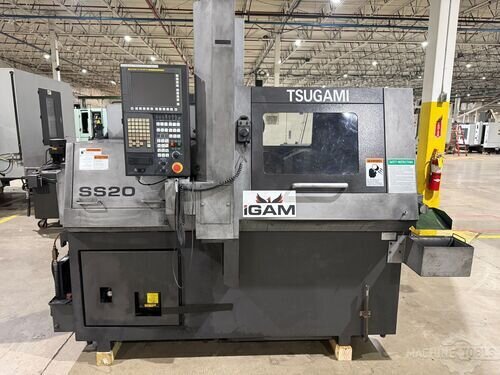
USED TSUGAMI SS20 – 2008
The 2008 TSUGAMI SS20 is a compact CNC Swiss-type automatic turning machine designed for high-precision production of small-diameter components. Tsugami’s SS-series machines are built around the Swiss turning principle, where the workpiece is supported close to the cutting tool through a guide bushing. This arrangement minimizes workpiece deflection and allows manufacturers to maintain dimensional control when machining small, slender, and intricate parts. The SS20 platform is particularly relevant to manufacturers producing components from bar stock in applications where precision, repeatability, and efficient cycle times are important.
The SS20 is designed around a 20 mm-class bar capacity, making it substantially more compact than conventional CNC turning centers intended for large workpieces. Its operating concept is different from that of a standard 2-axis CNC lathe. Instead of simply clamping the workpiece at the spindle and moving the tool along the outside diameter, Swiss machining allows the material to be supported through a guide bushing while the cutting tools operate close to the support point. This makes the machine well suited to long, narrow components that could otherwise experience significant deflection during machining.
The machine’s compact working area allows multiple tools to be positioned around the workpiece, enabling a variety of turning, drilling, threading, grooving, and other operations to be completed within a single production cycle. Depending on the exact SS20 configuration, the machine can be equipped with tooling for frontworking and backworking operations. The specific tooling arrangement, number of tool positions, and machine capabilities should be verified on the individual 2008 machine because equipment and options can vary by configuration.
The Swiss-type machining principle is one of the primary reasons manufacturers choose the TSUGAMI SS20. When machining small shafts, pins, screws, fittings, medical components, and electronic hardware, even small amounts of material deflection can affect dimensional accuracy. By supporting the bar near the cutting zone, the Swiss configuration helps maintain cutting stability. This makes the machine especially useful for small-diameter parts with long length-to-diameter ratios.
The SS20 can machine a broad range of engineering materials, including aluminum alloys, brass, copper alloys, stainless steel, carbon steel, alloy steel, and other machinable materials. Material selection and cutting parameters depend on the specific application, tooling, coolant, and machine condition. For production environments, the machine can be used to manufacture thousands of repeatable components from bar stock when properly equipped with a bar feeder and automated chip-management system.
The machine can also reduce the number of secondary operations required for suitable parts. By combining multiple machining operations in one setup, manufacturers can turn, drill, thread, groove, and perform other operations without repeatedly removing and repositioning the workpiece. This can improve production consistency and reduce opportunities for errors caused by multiple setups.
A used 2008 TSUGAMI SS20 can therefore be an attractive option for manufacturers that need a compact Swiss-type CNC machine for small precision components. Its relatively small bar capacity is not a limitation for the applications it was designed for; rather, it allows the machine to focus on high-precision small-part production. The machine is particularly valuable where repeatability, small-diameter machining, automation, and reduced setup requirements are important.
The SS20 is commonly associated with industries that manufacture large quantities of small precision components. Medical devices, electronics, automotive components, connectors, instrumentation, industrial hardware, and precision engineering are all potential applications. When matched with the correct tooling and material, the machine can produce intricate components with tight dimensional requirements while maintaining an efficient automated production process.
For manufacturers searching for a used Swiss-type CNC lathe, the 2008 TSUGAMI SS20 offers a combination of compact machine design, small-diameter bar machining, guide-bushing support, multi-tool capability, and automated production potential. Its value is particularly apparent in applications where conventional CNC lathes struggle with small, slender, or intricate components.
TSUGAMI SS20 – AXIS
| Specification | Details |
|---|---|
| Machine Configuration | CNC Swiss-Type Automatic Turning Center |
| Machine Type | Swiss-Type CNC Lathe |
| Primary Machining | Turning and Small-Part Production |
| Main Axes | X and Z |
| Crossworking | Configuration Dependent |
| Backworking | Configuration Dependent |
| Guide Bushing | Swiss-Type Guide Bushing System |
| Main Spindle | Yes |
| Sub Spindle | Configuration Dependent |
| C-Axis | Configuration Dependent |
| Y-Axis | Configuration Dependent |
| Tailstock | Not Typical of Swiss-Type Configuration |
| Workpiece Support | Guide Bushing |
| Automation | Bar-Feed Production |
The TSUGAMI SS20 uses the Swiss turning principle, with the bar supported close to the cutting area through a guide bushing. This is particularly useful when machining long, small-diameter components where conventional chucking can allow excessive deflection.
The exact number and combination of axes on a 2008 SS20 depends on the machine’s specific configuration. Buyers should verify whether the individual machine includes additional crossworking, backworking, C-axis, or other driven-tool functions.
TSUGAMI SS20 – AXIS TRAVELS / WORK ENVELOPE
| Specification | Details |
|---|---|
| Maximum Bar Diameter | Approximately 20 mm Class |
| Maximum Material Diameter | Configuration Dependent |
| Machining Length | Configuration Dependent |
| Guide Bushing Capacity | Approximately 20 mm Class |
| X-Axis Travel | Configuration Dependent |
| Z-Axis Travel | Configuration Dependent |
| Cross Slide Travel | Configuration Dependent |
| Backworking Capacity | Configuration Dependent |
| Workpiece Type | Small-Diameter Components |
| Production Length | Application Dependent |
| Part Geometry | Short and Long Slender Components |
The SS20 is designed primarily around small-diameter bar stock rather than large workpieces. Its approximately 20 mm-class capacity makes it appropriate for precision components such as pins, shafts, screws, fittings, bushings, connectors, and medical-device components.
One of the machine’s important advantages is its ability to machine slender parts while maintaining support near the cutting area. The exact maximum turning and machining length should be verified against the individual machine’s specifications.
TSUGAMI SS20 – CAPACITY / WORKHOLDING
| Specification | Details |
|---|---|
| Maximum Bar Capacity | Approximately 20 mm Class |
| Workholding Principle | Guide Bushing / Collet |
| Main Spindle Workholding | Collet-Based |
| Guide Bushing | Yes |
| Bar Stock | Round Bar |
| Bar Feeder | Configuration Dependent |
| Collet System | Machine-Specific |
| Workpiece Diameter | Small-Diameter Production |
| Remnant Management | Automatic Production Dependent |
| Long-Part Support | Guide Bushing |
The workholding system is fundamental to the SS20’s Swiss-type design. Rather than relying only on a chuck to support the workpiece, the guide bushing provides support close to the cutting zone. This can significantly improve stability when producing long, slender components.
A bar feeder can further automate production by continuously supplying material to the machine. The exact feeder installed on a used 2008 SS20 should be verified separately because it may not be included with every machine.
TSUGAMI SS20 – SPINDLE
| Specification | Details |
|---|---|
| Spindle Type | CNC Swiss-Type Main Spindle |
| Main Spindle | Yes |
| Maximum Speed | Configuration Dependent |
| Spindle Motor | Configuration Dependent |
| Spindle Bore | Small-Diameter / 20 mm-Class Configuration |
| Collet Chucking | Yes |
| C-Axis | Configuration Dependent |
| Spindle Orientation | Configuration Dependent |
| Bar Stock | Approximately 20 mm Class |
| Primary Application | Precision Small-Part Machining |
The main spindle is designed for the high-speed production of small components. Because the SS20 works with relatively small diameters, spindle speed can be significantly higher than on large heavy-duty CNC turning centers.
The exact spindle motor rating and maximum RPM should be confirmed on the individual 2008 machine. Used SS20 machines can differ according to production configuration, control generation, and installed options.
TSUGAMI SS20 – TOOL CHANGER / TOOLING
| Specification | Details |
|---|---|
| Tooling System | Multi-Tool Swiss-Type Configuration |
| Turning Tools | Supported |
| Grooving Tools | Supported |
| Threading Tools | Supported |
| Drills | Supported |
| Boring Tools | Supported |
| Crossworking Tools | Configuration Dependent |
| Driven Tools | Configuration Dependent |
| Backworking Tools | Configuration Dependent |
| Tool Capacity | Machine-Specific |
| Tool Setup | Application Dependent |
The SS20 is designed to accommodate multiple tools around the workpiece. This allows manufacturers to perform several operations during a single automated cycle.
A typical production setup may include an OD turning tool, cutoff tool, grooving tool, threading tool, drills, boring tools, and crossworking tools. The exact tool arrangement depends on the individual SS20 configuration and the type of components being manufactured.
TSUGAMI SS20 – CONTROL SYSTEM
| Specification | Details |
|---|---|
| CNC Control | Machine-Specific |
| Control Generation | 2008 Configuration |
| Programming | CNC Programming |
| EIA/ISO | Configuration Dependent |
| Operator Interface | CNC Control Console |
| Tool Offset Management | Supported |
| Program Storage | Machine-Specific |
| Diagnostics | Supported |
| Production Monitoring | Configuration Dependent |
| Communications | Machine-Specific |
The CNC control provides the programming and machine-management functions required for automated Swiss-type production. Because the machine dates from 2008, the exact control generation and communication hardware should be confirmed before purchase.
This is particularly important for shops that intend to transfer programs electronically from modern CAM systems or network the machine with current production-management equipment.
TSUGAMI SS20 – COOLANT / CHIP MANAGEMENT
| Specification | Details |
|---|---|
| Coolant System | Integrated CNC Coolant System |
| Coolant Delivery | Tool-Directed |
| Chip Removal | Production-Oriented |
| Chip Conveyor | Configuration Dependent |
| High-Pressure Coolant | Configuration Dependent |
| Coolant Filtration | Machine-Specific |
| Coolant Recirculation | Yes |
| Chip Management | Automated / Configuration Dependent |
| Application | Continuous Small-Part Production |
Swiss machining can generate continuous streams of small chips, particularly during turning and drilling operations. Effective coolant delivery and chip management are therefore important for maintaining consistent production.
The exact coolant pump, filtration system, chip conveyor, and high-pressure coolant options should be verified on the individual 2008 machine.
TSUGAMI SS20 – POWER REQUIREMENTS
| Specification | Details |
|---|---|
| Main Spindle Motor | Configuration Dependent |
| Electrical Service | Industrial 3-Phase |
| Voltage | Machine-Specific |
| Transformer | Installation Dependent |
| Auxiliary Loads | Coolant, Lubrication and Accessories |
| Bar Feeder Power | Separate / Configuration Dependent |
| Total Connected Load | Machine-Specific |
| Installation Requirement | Industrial Electrical Service |
The SS20 is substantially smaller than large CNC turning centers, but it still requires an appropriate industrial electrical connection. The exact voltage, amperage, phase requirements, transformer specifications, and connected load should be confirmed from the machine’s electrical documentation.
If a bar feeder, high-pressure coolant system, or other peripheral equipment is included, those devices should also be considered when planning installation.
TSUGAMI SS20 – DIMENSIONS
| Specification | Details |
|---|---|
| Machine Footprint | Compact Swiss-Type Configuration |
| Machine Length | Configuration Dependent |
| Machine Width | Configuration Dependent |
| Machine Height | Configuration Dependent |
| Machine Weight | Configuration Dependent |
| Bar Feeder Footprint | Additional Space Required |
| Chip Conveyor Footprint | Additional Space Required |
| Installation | Industrial Floor |
| Rigging | Machine-Specific |
| Production Layout | Designed for Compact Footprint |
The compact design of the SS20 makes it suitable for production environments where floor space is important. However, a complete production cell can require substantially more space once a bar feeder, chip conveyor, coolant system, parts catcher, and other accessories are included.
The exact dimensions and weight of the 2008 machine should be confirmed from the machine identification plate or original documentation before transportation and installation.
TSUGAMI SS20 – GENERAL INFORMATION
| Specification | Details |
|---|---|
| Manufacturer | Tsugami |
| Model | SS20 |
| Year | 2008 |
| Machine Type | CNC Swiss-Type Automatic Lathe |
| Primary Application | Precision Small-Part Production |
| Bar Capacity | Approximately 20 mm Class |
| Workholding | Guide Bushing and Collet |
| Main Spindle | Yes |
| Sub Spindle | Configuration Dependent |
| C-Axis | Configuration Dependent |
| Y-Axis | Configuration Dependent |
| Driven Tooling | Configuration Dependent |
| Backworking | Configuration Dependent |
| Bar Feeder | Configuration Dependent |
| Coolant System | Yes |
| CNC Control | Machine-Specific |
| Production Type | Automated Bar-Fed Machining |
| Primary Advantage | Small-Diameter Precision Machining |
The specifications above describe the SS20 platform and its typical operating configuration. Because a 2008 used machine can have different factory options and aftermarket accessories, the exact machine should be inspected before purchase.
INDUSTRIES THAT USE TSUGAMI SS20
The medical device industry is one of the most suitable applications for a Swiss-type machine such as the TSUGAMI SS20. Medical components can include small pins, screws, shafts, fittings, bone-related components, surgical hardware, and other precision parts. The guide-bushing arrangement is particularly useful when machining small-diameter components that require consistent dimensional control.
The electronics industry can use the SS20 for connectors, terminals, pins, contacts, miniature shafts, and other small precision components. These parts often require repeatable dimensions and large production quantities. A bar-fed Swiss machine can support continuous production once the appropriate tooling and process parameters are established.
The automotive industry uses large quantities of small turned components. Pins, bushings, shafts, fastener-related components, fittings, injectors, and other precision parts can be produced on Swiss-type equipment when their dimensions fall within the machine’s capacity.
The aerospace industry can use Swiss-type CNC machines for selected small precision components. Instrument components, pins, fittings, shafts, bushings, and other small parts can benefit from the machine’s ability to maintain support close to the cutting zone.
The instrumentation industry is another strong application. Precision instruments often contain small mechanical components that require accurate turning, drilling, threading, and grooving. The SS20 can perform multiple operations within an automated production cycle.
The precision hardware industry can use the machine for screws, pins, studs, spacers, bushings, fittings, and other small components. When these parts are manufactured in high quantities, automated bar feeding can make the Swiss-type production process particularly effective.
The industrial equipment industry can also use the SS20 for miniature shafts, valve components, connectors, sensor components, and other small machined parts. The machine’s compact size makes it practical for dedicated production cells.
The general precision machining and contract manufacturing industry can use a TSUGAMI SS20 to produce customer-specific small components across many different industries. Its flexibility becomes particularly valuable for shops that routinely receive orders involving small diameters, long slender geometries, tight tolerances, and repeat production quantities.
TYPICAL PARTS TSUGAMI SS20 CAN PRODUCE
| Part Type | Typical Applications |
|---|---|
| Precision Pins | Medical, Automotive and Industrial |
| Small Shafts | Motors, Instruments and Machinery |
| Bushings | Automotive and Industrial Equipment |
| Screws | Medical and Precision Hardware |
| Studs | Industrial and Automotive |
| Spacers | Electronics and Instrumentation |
| Connectors | Electronics and Electrical Equipment |
| Terminals | Electrical and Electronics |
| Fittings | Medical, Hydraulic and Instrumentation |
| Valve Components | Fluid-Control Equipment |
| Sensor Components | Instrumentation |
| Miniature Housings | Electronics and Industrial Equipment |
| Threaded Components | Precision Hardware |
| Drive Pins | Automotive and Machinery |
| Small Sleeves | Medical and Industrial |
| Surgical Components | Medical Devices |
| Instrument Components | Scientific and Industrial Instruments |
| Nozzles | Fluid and Process Equipment |
| Bushings | Mechanical Assemblies |
| Custom Turned Parts | Contract Manufacturing |
WHY CHOOSE TSUGAMI SS20
One of the primary reasons to choose the TSUGAMI SS20 is its ability to produce small components using the Swiss-type machining principle. The guide bushing supports the material close to the cutting area, reducing the unsupported length of the workpiece during machining.
This is particularly valuable for long, slender parts. Conventional CNC lathes can encounter workpiece deflection when machining a small-diameter component with a relatively long length. Swiss-type machining addresses this challenge through close workpiece support.
The approximately 20 mm-class bar capacity makes the SS20 well suited to small-part production. Manufacturers do not need a large CNC turning center when their components are only a few millimeters to approximately 20 mm in diameter. The smaller machine can provide a production-focused solution for this class of work.
Another advantage is the ability to perform multiple operations within a single machining cycle. Depending on the machine configuration, turning, drilling, boring, threading, grooving, crossworking, and cutoff operations can be combined to reduce secondary handling.
The machine is also well suited to automated production. When paired with a compatible bar feeder, material can be supplied continuously, allowing the machine to produce successive components with limited operator intervention.
The compact footprint is another practical benefit. A Swiss-type machine such as the SS20 generally occupies considerably less floor space than large horizontal turning centers. This allows manufacturers to build dense production cells where several machines can operate in the same manufacturing area.
The SS20 can also be valuable when production requires repeatability. Once tooling, workholding, offsets, cutting parameters, and program conditions have been established, the machine can repeatedly produce the same component without requiring the operator to manually reposition every part.
Finally, the TSUGAMI SS20 is designed for a specific manufacturing niche: precision small-diameter components. For companies whose production requirements fall within this range, the machine provides a specialized platform rather than trying to adapt a much larger conventional lathe to small-part production.
WHY BUY USED TSUGAMI SS20
Buying a used TSUGAMI SS20 – 2008 can provide manufacturers with access to Swiss-type machining technology at a lower initial capital investment than purchasing a new machine. For shops producing small precision components, a properly maintained used SS20 can provide useful production capacity without requiring a large machine footprint.
The machine’s specialized Swiss configuration is particularly valuable. Buyers are not simply purchasing a small CNC lathe; they are acquiring equipment designed around the guide-bushing principle and the requirements of small-diameter precision machining.
A used SS20 can be an effective addition for shops expanding into medical, electronics, automotive, instrumentation, or precision hardware components. It can also complement larger CNC lathes by taking over small-part work that does not require the capacity of a conventional turning center.
Another advantage is the possibility of acquiring a machine with existing accessories. Depending on the individual listing, a used SS20 may include a bar feeder, tooling, coolant equipment, chip-management equipment, parts catcher, collets, guide bushings, and other production accessories.
The included tooling can be particularly important for Swiss machining. Collets, guide bushings, turning tools, drills, boring tools, threading tools, and other specialized tooling can represent a meaningful additional investment if purchased separately.
However, buyers should carefully inspect a 2008 machine before purchasing. The guide bushing system should be checked for wear and proper alignment because it is central to the machine’s ability to support the workpiece accurately.
The main spindle should also be inspected for noise, vibration, runout, bearing condition, temperature, and speed control. Axis movement, ballscrews, linear guides, turret or toolholder mechanisms, driven tooling, and other moving components should be tested where applicable.
The CNC control should receive particular attention on an older machine. Buyers should verify that the display, keyboard, drives, control electronics, memory, communication interfaces, and machine-specific software are functioning properly.
The bar feeder and coolant system should also be tested if included. A machine may appear inexpensive initially but require significant investment if its peripheral equipment needs replacement or major repair.
For these reasons, the best way to evaluate a used TSUGAMI SS20 is to consider the complete production package. Machine condition, spindle health, guide-bushing condition, tooling, bar feeder, control, maintenance history, included accessories, and installation requirements all contribute to the practical value of the machine.
HOW MUCH DOES A USED TSUGAMI SS20 COST?
The price of a used TSUGAMI SS20 – 2008 can vary considerably based on machine condition, exact SS20 configuration, spindle hours, control generation, tooling, guide bushings, bar feeder, coolant system, chip-management equipment, and location.
Because used Swiss machines are often sold with very different combinations of tooling and accessories, advertised prices are not always directly comparable. A machine sold as a bare CNC Swiss lathe can require additional investment for a bar feeder, collets, guide bushings, tooling, coolant equipment, and other production accessories.
The exact configuration should therefore be established before comparing a used SS20 with another machine. Buyers should determine whether the machine includes the desired crossworking, backworking, driven-tool, C-axis, or other functions required for their parts.
The condition of the guide bushing system is particularly important when evaluating an older Swiss machine. Wear or alignment problems can affect the machine’s ability to maintain the dimensional control expected from Swiss-type machining.
Spindle condition is another major consideration. Buyers should inspect the spindle for bearing noise, vibration, runout, temperature, and overall operating performance. A healthy spindle can make a significant difference in the practical value of a used machine.
The condition of the CNC control should also be considered. Since the machine dates from 2008, buyers should verify the control electronics, display, drives, memory, program transfer capabilities, and availability of replacement components.
The included bar feeder can also affect the machine’s value significantly. For high-volume production, a compatible automatic bar feeder can transform the SS20 into a continuous production cell. Without one, additional capital may be required to achieve the intended level of automation.
Tooling should be included in the evaluation as well. Collets, guide bushings, toolholders, drills, boring bars, turning tools, threading tools, and other Swiss-specific tooling can add substantial practical value to a used machine package.
Transportation and installation should also be included in the total acquisition budget. Buyers should account for machine dimensions, weight, rigging, electrical installation, coolant setup, bar-feeder positioning, and any required floor modifications.
Ultimately, the cost of a used TSUGAMI SS20 – 2008 should be evaluated based on the entire machine package rather than the advertised machine price alone. A properly equipped machine with a healthy spindle, accurate guide-bushing system, functioning CNC control, tooling, bar feeder, and maintenance history can have substantially different practical value from a machine requiring significant refurbishment.
Related Products
-
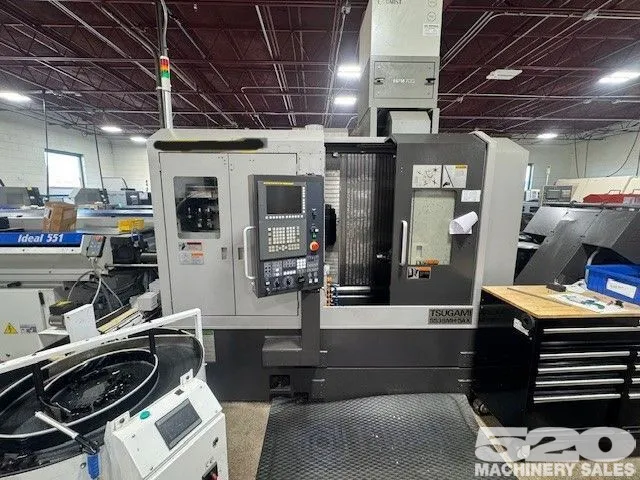
TSUGAMI - SS38MH
VIEW MACHINE -
NEW ARRIVAL
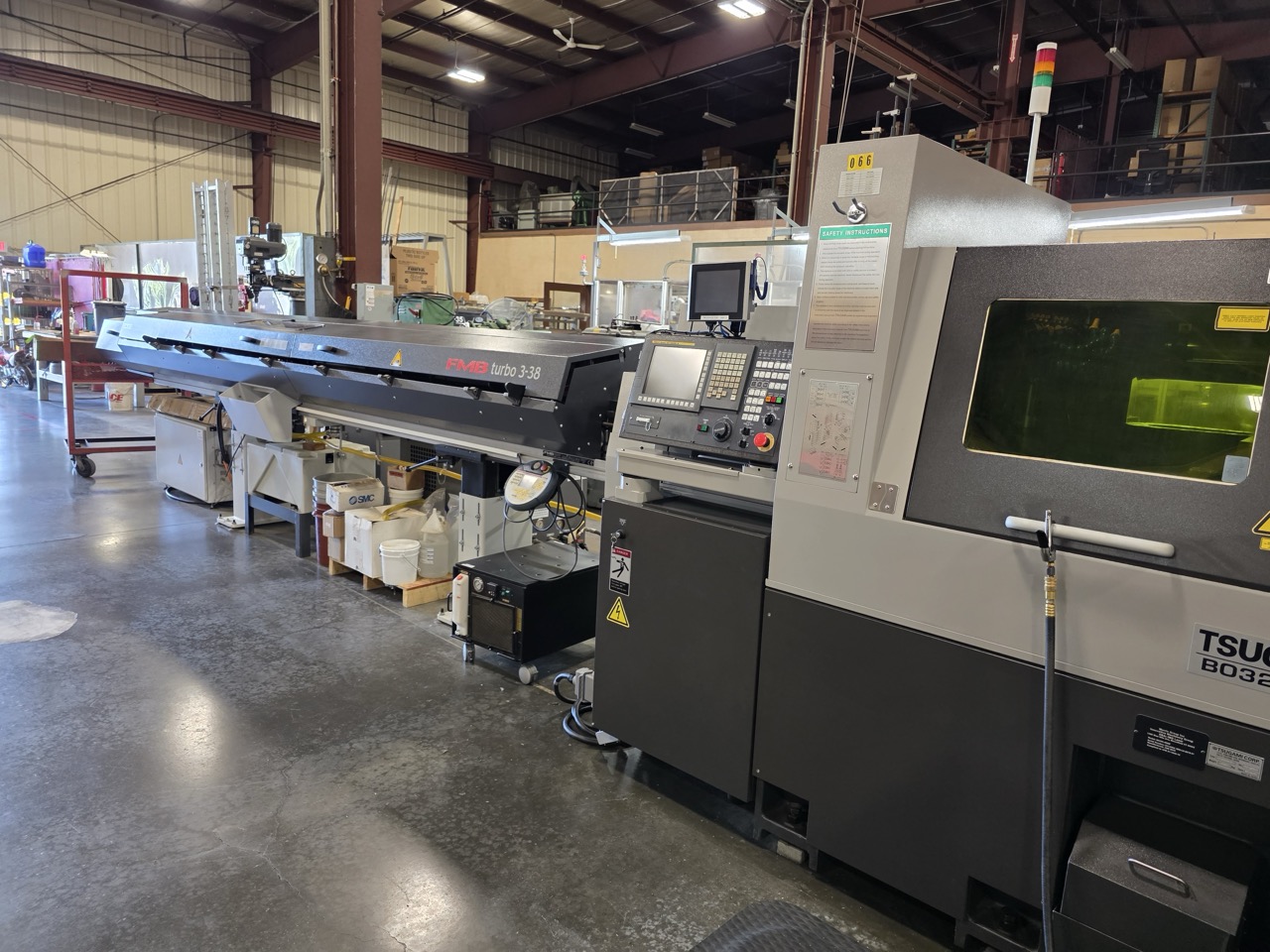
TSUGAMI - B0325B-II
VIEW MACHINE -
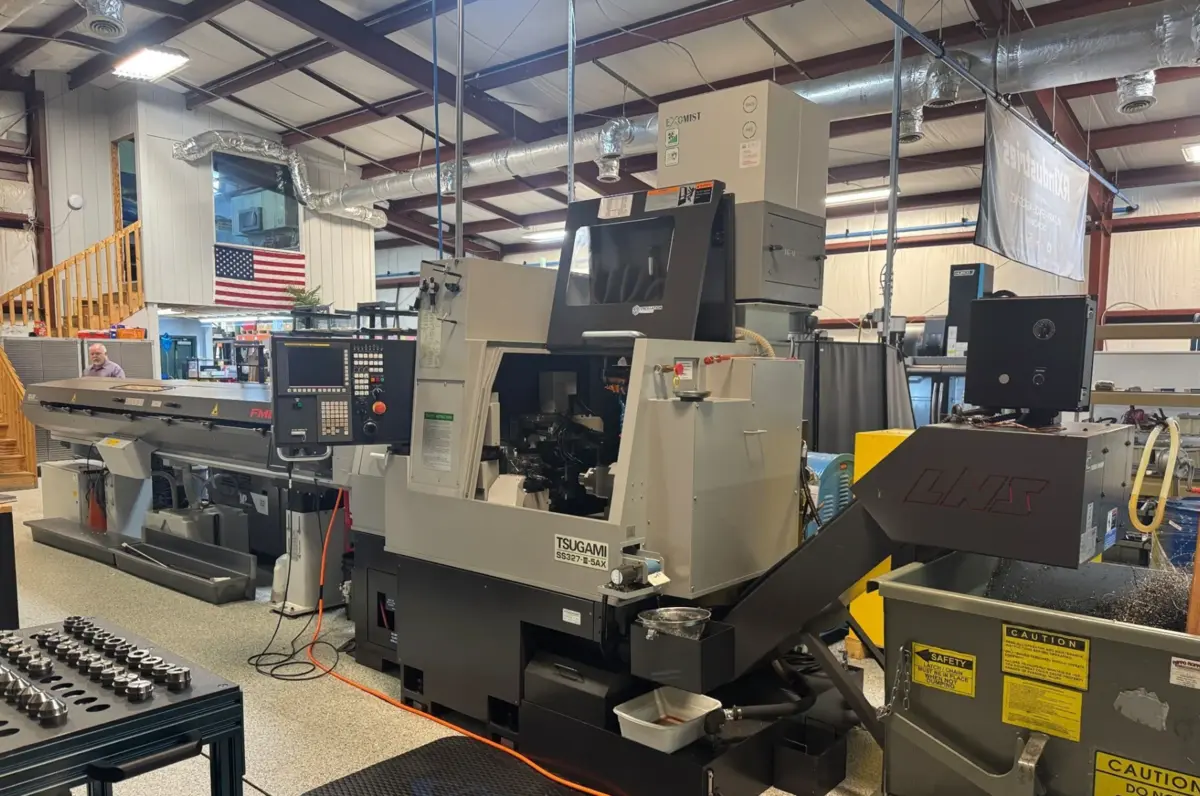
TSUGAMI - SS327-III-5AX
VIEW MACHINE -
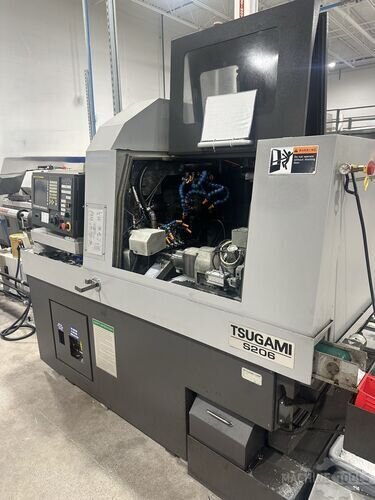
TSUGAMI - S206
VIEW MACHINE