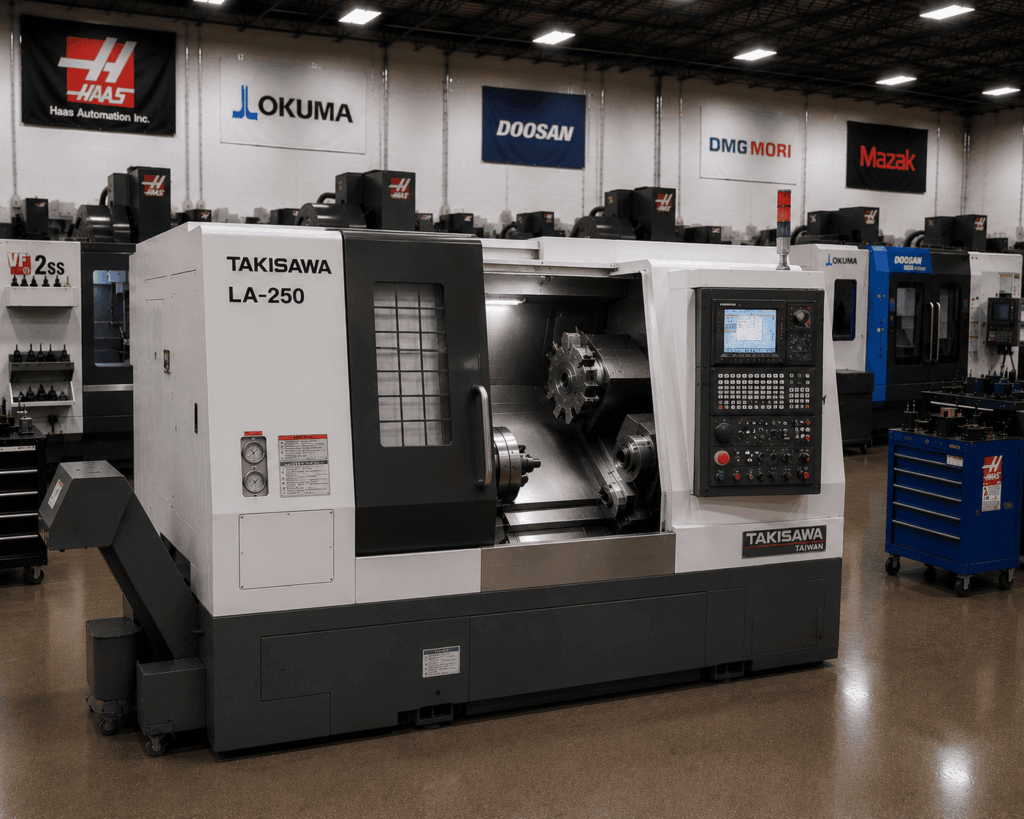
USED TAKISAWA LA-250 – 2002
The 2002 Takisawa LA-250 is a reliable 2-axis CNC slant-bed turning center designed for high-precision turning applications in both job shop and production environments. Manufactured by Takisawa Machine Tool Co., Ltd., one of Japan’s leading CNC lathe builders, the LA Series has earned an excellent reputation for its rigid construction, machining accuracy, and dependable long-term performance. The LA-250 was engineered to provide manufacturers with a versatile turning solution capable of handling a wide range of workpieces while maintaining tight tolerances and excellent surface finishes. Its combination of a rigid box-way design, high-torque spindle, and user-friendly CNC control makes it a popular choice in the used CNC machine market.
Built with a heavily ribbed cast iron slant-bed structure and precision box guideways, the Takisawa LA-250 delivers excellent vibration damping and thermal stability during heavy-duty machining. The machine offers approximately 8.7 inches (220 mm) of X-axis travel and 31.5 inches (800 mm) of Z-axis travel, allowing efficient machining of shafts, bushings, valve bodies, flanges, and other precision-turned components. It features a 10-inch hydraulic chuck, a 2.95-inch (75 mm) bar capacity, and a powerful spindle capable of speeds up to 3,500 RPM, making it suitable for machining aluminum, carbon steel, stainless steel, cast iron, brass, and engineering plastics. The rigid spindle and heavy-duty construction enable both aggressive roughing and high-quality finishing operations while maintaining consistent accuracy throughout long production runs.
The 2002 model is commonly equipped with a Fanuc 18i-T or Fanuc 21i-T CNC Control, depending on its original configuration. The control provides ISO G-code programming, constant surface speed control, threading cycles, rigid tapping (where equipped), and advanced diagnostics for efficient production machining. The machine typically includes a 10-station automatic turret, programmable hydraulic tailstock, automatic lubrication system, flood coolant, spindle orientation, and hydraulic chuck. Optional equipment such as chip conveyors, bar feeders, parts catchers, and tool setters further increase productivity and automation.
The Takisawa LA-250 is widely used throughout the automotive, hydraulic, oil and gas, agricultural equipment, aerospace, and general manufacturing industries. Typical applications include shafts, bushings, couplings, hydraulic fittings, valve components, threaded parts, bearing housings, pump components, and other precision-turned products. Its dependable construction and straightforward operation make it an excellent choice for manufacturers seeking reliable production performance.
Purchasing a used 2002 Takisawa LA-250 allows manufacturers to acquire premium Japanese CNC turning technology at a significantly lower investment than purchasing a new machine. Takisawa lathes are known for their durability, precision, and low maintenance requirements. A properly maintained LA-250 continues to deliver reliable machining performance, excellent part quality, and long service life, making it an outstanding investment for shops looking for a dependable CNC turning center.
TAKISAWA LA-250 SPECIFICATIONS
Axis
| Specification | Value |
|---|---|
| Machine Type | CNC Turning Center |
| Controlled Axes | 2 Axes (X, Z) |
| X-Axis Travel | 8.7 in (220 mm) |
| Z-Axis Travel | 31.5 in (800 mm) |
Travels / Work Envelope
| Specification | Value |
|---|---|
| Maximum Turning Diameter | 17.7 in (450 mm) |
| Maximum Turning Length | 30.2 in (767 mm) |
| Swing Over Bed | 22.8 in (580 mm) |
| Maximum Bar Capacity | 2.95 in (75 mm) |
Spindle
| Specification | Value |
|---|---|
| Chuck Size | 10 in Hydraulic Chuck |
| Spindle Speed | 3,500 RPM |
| Spindle Bore | 3.15 in (80 mm) |
| Spindle Motor | 20 HP (15 kW) |
| Drive Type | Belt or Gear Head (Configuration Dependent) |
Tool Changer
| Specification | Value |
|---|---|
| Turret Type | Automatic Turret |
| Tool Capacity | 10 Stations |
| Optional Turret | 12-Station Available |
| Maximum Boring Bar Diameter | 2.0 in (50 mm) |
CNC Control
| Specification | Value |
|---|---|
| CNC Control | Fanuc 18i-T / Fanuc 21i-T |
| Programming | ISO G-Code |
| Constant Surface Speed | Standard |
| Threading Cycles | Standard |
Coolant / Chip Management
| Specification | Value |
|---|---|
| Coolant System | Flood Coolant |
| Automatic Lubrication | Standard |
| Hydraulic Tailstock | Standard |
| Chip Conveyor | Optional |
Power Requirements
| Specification | Value |
|---|---|
| Electrical Supply | 220V / 440V, 3-Phase |
| Connected Load | Approx. 30 kVA |
| Pneumatic Supply | 80–100 PSI (5.5–6.9 bar) |
Dimensions
| Specification | Value |
|---|---|
| Machine Footprint | Approx. 115 × 71 × 71 in (2,925 × 1,803 × 1,815 mm) |
| Machine Weight | Approx. 12,125 lbs (5,500 kg) |
General Information
| Specification | Value |
|---|---|
| Manufacturer | Takisawa Machine Tool Co., Ltd. |
| Model | LA-250 |
| Year | 2002 |
| Machine Category | CNC Turning Center |
| Materials Machined | Aluminum, Steel, Stainless Steel, Cast Iron, Brass, Engineering Plastics |
| Typical Applications | Shafts, Bushings, Valve Bodies, Hydraulic Components, Flanges, Pump Parts, Precision Turned Components |
HOW MUCH DOES A USED TAKISAWA LA-250 – 2002 COST?
A used 2002 Takisawa LA-250 typically sells for $18,000 to $45,000 USD, depending on spindle hours, machine condition, maintenance history, CNC control configuration, tooling package, and installed options such as a chip conveyor, bar feeder, hydraulic tailstock, or parts catcher. Machines with documented service records and production-ready tooling generally command higher resale values because they require minimal setup before entering production.
Before purchasing a used Takisawa LA-250, buyers should inspect the spindle bearings, box guideways, turret indexing accuracy, hydraulic systems, lubrication system, coolant system, and overall machine geometry. A properly maintained 2002 Takisawa LA-250 provides excellent long-term value by combining dependable Japanese engineering, precision turning capability, and low operating costs, making it an outstanding investment for manufacturers seeking a reliable CNC turning center.
TAKISAWA LA-250 VS TAKISAWA LA-200 – WHICH ONE TO BUY?
The Takisawa LA-250 and Takisawa LA-200 are high-performance CNC turning centers engineered for precision turning, drilling, boring, and threading operations. Both machines are part of Takisawa’s reliable LA Series and are widely used in the automotive, aerospace, hydraulic equipment, medical, oil and gas, and general manufacturing industries. Known for their rigid construction, high spindle accuracy, and dependable performance, both models are suitable for continuous production environments. The primary difference between the two machines is machining capacity. The Takisawa LA-250 offers a larger swing, greater turning diameter, higher spindle torque, and increased machining length, making it better suited for medium to large workpieces compared to the more compact LA-200.
The Takisawa LA-200 is an excellent solution for machining bushings, fittings, shafts, threaded components, valve bodies, and other precision parts where high production rates and compact machine size are important.
The Takisawa LA-250 expands machining flexibility by accommodating larger hydraulic cylinders, flanges, bearing housings, pump components, automotive parts, and longer shafts. Its additional capacity allows manufacturers to machine a wider range of workpieces while maintaining excellent dimensional accuracy and surface finish.
Both machines provide exceptional reliability, machining precision, and long service life. The LA-200 is ideal for manufacturers focused on smaller precision components, while the LA-250 is recommended for shops requiring greater machining capacity and heavier cutting capability.
For companies purchasing a used CNC lathe, the Takisawa LA-250 offers an outstanding combination of productivity, durability, and machining versatility.
TAKISAWA LA-250 SPINDLE NOT TURNING – CAUSES AND TROUBLESHOOTING
If the spindle on a Takisawa LA-250 does not rotate, the issue may be caused by spindle drive faults, CNC control alarms, electrical failures, hydraulic problems, lubrication issues, chuck clamping faults, or machine safety interlocks. Proper troubleshooting helps restore machine operation quickly and reduces unnecessary production downtime.
Begin by checking the CNC control for active alarms. Emergency stop activation, door interlock faults, spindle drive alarms, servo errors, lubrication warnings, hydraulic pressure alarms, chuck clamping faults, or thermal overload conditions can prevent spindle operation. Resolve all alarms before attempting to restart the spindle.
Inspect the spindle drive system for electrical problems such as loose wiring, damaged encoder cables, faulty spindle amplifiers, blown fuses, spindle motor overload conditions, or overheating. Verify the spindle lubrication system, hydraulic unit, coolant circulation, compressed air supply, and electrical power because these systems are essential for proper spindle operation.
Review the CNC program to ensure correct spindle commands are present. Missing M03 or M04 commands, incorrect spindle speed settings, spindle orientation commands, chuck clamping issues, or interrupted machining cycles may prevent spindle startup.
If the spindle begins rotating but immediately stops, inspect spindle bearings, chuck condition, spindle nose cleanliness, tooling setup, hydraulic clamping force, and cutting loads. Excessive vibration, abnormal spindle noise, overheating, or poor workholding may indicate spindle bearing wear or mechanical damage requiring repair.
Routine spindle inspections, lubrication maintenance, hydraulic servicing, and preventive maintenance significantly reduce unexpected spindle failures and maximize machine reliability.
TAKISAWA LA-250 MAINTENANCE AND PREVENTIVE CARE GUIDE
The Takisawa LA-250 is designed for continuous production of precision-machined components. A comprehensive preventive maintenance program is essential for maintaining spindle accuracy, machine reliability, and long-term production efficiency.
Daily maintenance should include removing chips from the machining enclosure, spindle nose, chuck, turret, guideways, and chip conveyor. Operators should inspect coolant levels, coolant concentration, lubrication systems, hydraulic pressure, compressed air supply, spindle condition, and cutting tools before beginning production. Keeping the chuck jaws and spindle nose clean improves workholding accuracy and machining consistency.
Weekly maintenance should include inspecting coolant pumps, chip conveyors, centralized lubrication systems, hydraulic units, turret indexing mechanisms, electrical cabinet filters, coolant filtration systems, and pneumatic components. Remove chips from guideways, turret stations, and coolant passages to prevent contamination and premature wear.
Monthly inspections should focus on spindle runout, chuck accuracy, turret alignment, ball screws, linear guideways, spindle bearings, encoder cables, lubrication lines, hydraulic hoses, electrical connections, coolant filtration systems, and machine leveling. Machine geometry should also be verified periodically to maintain machining precision.
Additional preventive maintenance includes monitoring spindle vibration, checking axis backlash, replacing worn filters, servicing lubrication systems, inspecting hydraulic components, and maintaining complete maintenance records. Early detection of wear helps reduce repair costs and prevents unexpected production interruptions.
Consistent preventive maintenance extends spindle life, improves machining accuracy, increases productivity, and ensures the Takisawa LA-250 continues delivering dependable CNC turning performance for years.
FAQ
What is the Takisawa LA-250?
The Takisawa LA-250 is a CNC turning center designed for precision turning, drilling, boring, threading, and general machining of medium-sized components. It features a rigid machine structure, high-performance spindle, precision turret, advanced CNC control, and efficient chip management, allowing manufacturers to achieve excellent machining accuracy and repeatability.
The machine is widely used in automotive, aerospace, hydraulic equipment, oil and gas, medical, and general engineering industries. It is capable of machining shafts, bushings, valve bodies, hydraulic cylinders, flanges, threaded components, bearing housings, pump parts, and numerous other precision-machined products manufactured from steel, stainless steel, aluminum, brass, and engineering alloys.
Its rigid construction, dependable spindle, and consistent machining performance make the Takisawa LA-250 a popular choice for both job shops and high-volume production facilities.
What are the most common problems with the Takisawa LA-250?
The most common problems with the Takisawa LA-250 include spindle alarms, turret indexing faults, hydraulic system issues, lubrication warnings, servo drive errors, encoder failures, coolant contamination, chuck clamping problems, spindle orientation faults, electrical communication errors, and axis positioning issues.
Machines operating continuously may also experience spindle bearing wear, turret alignment problems, hydraulic pressure fluctuations, ball screw backlash, thermal expansion, coolant pump failures, and normal mechanical fatigue over time. Poor lubrication, contaminated coolant, worn tooling, excessive cutting loads, and delayed preventive maintenance can accelerate machine wear and reduce machining accuracy.
Routine spindle inspections, lubrication servicing, hydraulic maintenance, coolant management, turret alignment verification, machine calibration, electrical inspections, and scheduled preventive maintenance help minimize downtime and ensure the Takisawa LA-250 continues delivering reliable, accurate, and highly productive machining performance.
Related Products
-
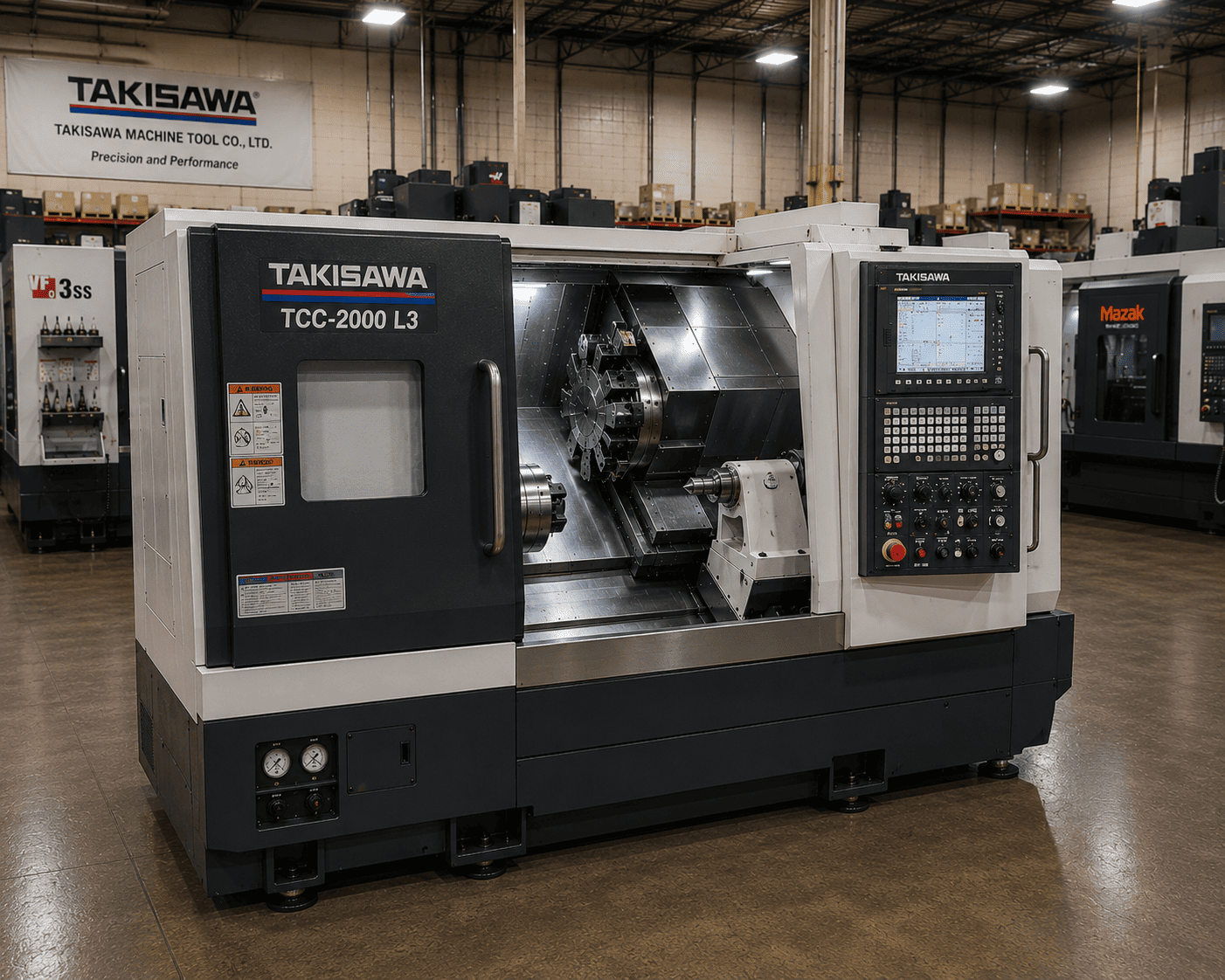
TAKISAWA - TCC-2000 L3
VIEW MACHINE -
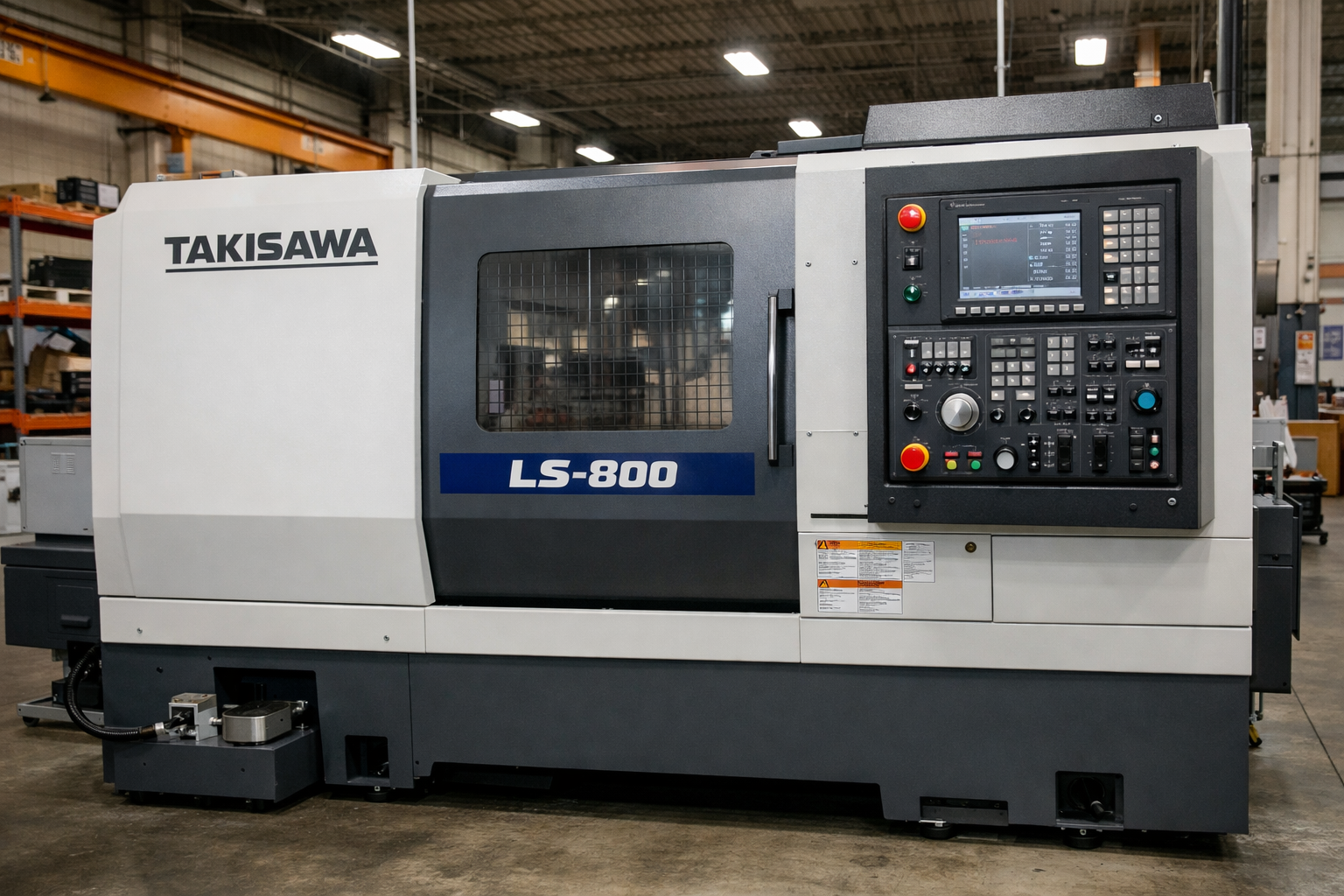
TAKISAWA - LS-800
VIEW MACHINE -
TAKISAWA - NEX-105
VIEW MACHINE -
TAKISAWA - EX-122
VIEW MACHINE