USED OKUMA MB-4000H
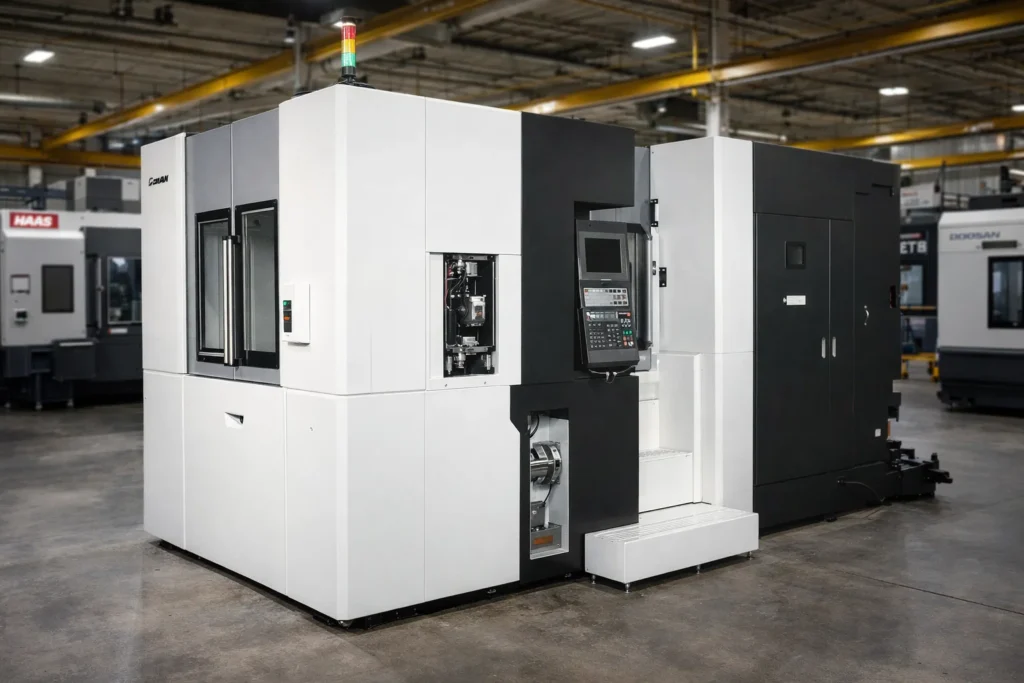
The Okuma MB-4000H is a compact horizontal machining center (HMC) designed to deliver high-speed machining, precision, and cost efficiency within a relatively small footprint. As part of Okuma’s MB-H “Affordable Excellence” series, this machine is built to provide a balance between performance and affordability, making it ideal for small to mid-sized components in industries such as automotive, general engineering, agriculture, and construction equipment.
The MB-4000H features a 400 mm pallet size and axis travels of approximately 560 mm (X), 560 mm (Y), and 625 mm (Z), allowing it to handle a wide range of medium-sized parts with efficiency and accuracy. It is equipped with a high-speed spindle capable of 15,000 rpm, with optional configurations up to 20,000 rpm, enabling both rapid material removal and fine finishing operations.
A key advantage of the MB-4000H is its focus on reducing non-cutting time. The machine offers rapid traverse speeds of around 60 m/min, fast acceleration, and short tool change times, all of which contribute to increased spindle utilization and overall productivity.
Thermal stability is maintained through Okuma’s Thermo-Friendly Concept, which helps minimize thermal deformation and ensures consistent dimensional accuracy during long cutting cycles. Additionally, the machine supports a wide range of tool magazine capacities—from 48 tools up to over 200 tools—making it suitable for complex machining tasks without frequent interruptions.
The MB-4000H is also automation-ready, with compatibility for pallet changers and flexible manufacturing systems. This makes it ideal for environments focused on maximizing cutting time and minimizing downtime. Overall, the MB-4000H provides a strong combination of speed, precision, and value, making it a practical solution for high-efficiency machining operations.
OKUMA MB-4000H SPECIFICATIONS
| OKUMA MB-4000H – AXIS |
|---|
| X-Axis |
| Y-Axis |
| Z-Axis |
| B-Axis (Rotary Table) |
| OKUMA MB-4000H – AXIS TRAVELS |
|---|
| X-Axis Travel: 560 mm (22.05 in) |
| Y-Axis Travel: 560 mm (22.05 in) |
| Z-Axis Travel: 625 mm (24.61 in) |
| B-Axis Rotation: 1° Indexing (360°) |
| OKUMA MB-4000H – CAPACITY |
|---|
| Maximum Machining Volume: 560 x 560 x 625 mm |
| Maximum Workpiece Size: Compact / Medium Parts |
| Designed for High-Speed Production Applications |
| OKUMA MB-4000H – SPINDLE |
|---|
| Spindle Speed: 15,000 RPM (Standard) |
| Optional Speed: 20,000 RPM |
| Spindle Motor Power: 26/18.5 kW (Optional 30/22 kW) |
| High-Speed, High-Acceleration Spindle |
| OKUMA MB-4000H – TABLE |
|---|
| Pallet Size: 400 mm x 400 mm |
| Table Type: Rotary Pallet |
| Table Indexing: 1° Increment |
| Pallet System: Compatible with APC Systems |
| OKUMA MB-4000H – TOOL TURRET |
|---|
| Tool Magazine Capacity: 48 Tools (Standard) |
| Expandable Capacity: Up to 218 Tools |
| Tool Type: BT40 / CAT40 |
| Tool Change System: High-Speed Automatic Tool Changer |
| Tool Selection: Random Access |
| OKUMA MB-4000H – FEEDRATES |
|---|
| Rapid Traverse (X/Y/Z): 60 m/min |
| High Acceleration Axes for Faster Cycle Times |
| Cutting Feedrate: Programmable |
| OKUMA MB-4000H – COOLANT & CHIP MANAGEMENT |
|---|
| Coolant System: Flood Coolant |
| Through-Spindle Coolant: Optional |
| Chip Conveyor: Available |
| Efficient Chip Evacuation Design for Continuous Operation |
| OKUMA MB-4000H – CONTROL SYSTEM |
|---|
| CNC Control: OSP-P300 / OSP-P500 |
| Interface: User-Friendly Control Panel |
| Programming: Conversational & G-Code |
| Features: Thermo-Friendly Concept for Stability |
| OKUMA MB-4000H – POWER & AIR REQUIREMENTS |
|---|
| Power Supply: 3-Phase AC |
| Power Consumption: Approx. 40–50 kVA |
| Air Requirement: Clean, Dry Compressed Air |
| OKUMA MB-4000H – DIMENSIONS |
|---|
| Machine Footprint: Compact Design |
| Machine Weight: Approx. 7,000–9,000 kg |
| Designed for Small Footprint Manufacturing |
| OKUMA MB-4000H – GENERAL INFORMATION |
|---|
| Machine Type: Horizontal Machining Center (HMC) |
| Series: MB-H (Affordable Excellence Line) |
| Application: High-Speed Precision Machining |
| Structure: Rigid Construction with Linear Guides |
| Automation: APC, FMS & Robotic Integration Ready |
| INDUSTRIES THAT USE OKUMA MB-4000H |
|---|
| Automotive |
| Agriculture Equipment |
| Construction Equipment |
| Rail & Transportation |
| General Engineering |
| TYPICAL PARTS OKUMA MB-4000H CAN PRODUCE |
|---|
| Small to Medium Precision Components |
| Automotive Parts |
| Pump & Valve Bodies |
| Gear Components |
| Structural Aluminum & Steel Parts |
| WHY CHOOSE OKUMA MB-4000H |
|---|
| High-Speed Machining with Compact Footprint |
| Excellent Thermal Stability (Thermo-Friendly Concept) |
| Flexible Tool Capacity for Complex Jobs |
| Automation-Ready for Increased Productivity |
| Ideal for High-Volume Production |
| Cost-Effective “Affordable Excellence” Solution |
WHY BUY USED OKUMA MB-4000H
Buying a used Okuma MB-4000H is an excellent option for manufacturers seeking reliable machining performance at a lower cost. Machines in the MB-H series are known for their durability, consistent accuracy, and ability to maintain performance over long periods, which makes them well-suited for the used equipment market. Even older units can remain productive if they have been properly maintained and serviced.
One of the primary benefits of purchasing used is cost efficiency. New horizontal machining centers can represent a significant capital investment, especially when equipped with automation systems and large tool magazines. A used MB-4000H provides similar capabilities—such as high spindle speeds, fast axis movement, and automation readiness—at a fraction of the cost, allowing businesses to expand production capacity without overextending budgets.
Cutting time is one of the most important considerations when evaluating a used MB-4000H. Machines with lower spindle hours generally experience less wear on critical components such as the spindle, guideways, and ball screws. For example, a machine from the mid-2000s with moderate cutting time may offer better long-term reliability than a newer unit that has been heavily used in continuous production. This makes reviewing maintenance records and usage history essential.
Another advantage is upgrade potential. Many used MB-4000H machines can be retrofitted with updated controls, tooling systems, or automation solutions, extending their operational life. Okuma’s strong support network and parts availability further reduce the risks associated with purchasing older equipment.
From a financial standpoint, buying used allows for faster return on investment. With lower upfront costs and the ability to maintain high cutting time utilization, a used MB-4000H can quickly generate value in both job shop and production environments.
HOW MUCH DOES A USED OKUMA MB-4000H COST?
The cost of a used Okuma MB-4000H varies based on factors such as manufacturing year, machine condition, configuration, and most importantly, cutting time (spindle hours). As a more cost-focused machine compared to the MA-H series, it generally falls into a lower price range while still offering strong performance.
Machines built before 2000 (or early-generation equivalents leading into the MB-H platform) typically range from $12,000 to $35,000. These machines are the most affordable but often come with older control systems and higher wear. Cutting time is a major factor here—machines with high spindle hours may require refurbishment, while low-hour units can still be viable for lighter production work.
Models produced between 2000 and 2010 generally range from $35,000 to $75,000. This segment often provides the best value for money, offering improved control systems, better thermal stability, and higher machining efficiency compared to earlier machines. Units with low to moderate cutting time are particularly attractive, as they can deliver reliable performance with manageable maintenance costs.
Machines from 2010 to 2025 typically range from $75,000 to $160,000 or more, depending on options such as spindle speed (15K vs 20K), tool capacity, pallet systems, and automation integration. These newer machines benefit from advanced control systems, higher efficiency, and improved reliability for continuous production environments.
Cutting time remains the most critical pricing factor. A newer machine with excessive spindle hours may be less valuable than an older machine with minimal use. Buyers should always evaluate spindle hours, maintenance history, and overall condition to determine true market value and ensure long-term operational reliability.
Related Products
-
OKUMA - MCR-S
VIEW MACHINE -
OKUMA - LU4000 EX
VIEW MACHINE -
OKUMA - MULTUS B750
VIEW MACHINE -
OKUMA - 2SP-2500H
VIEW MACHINE