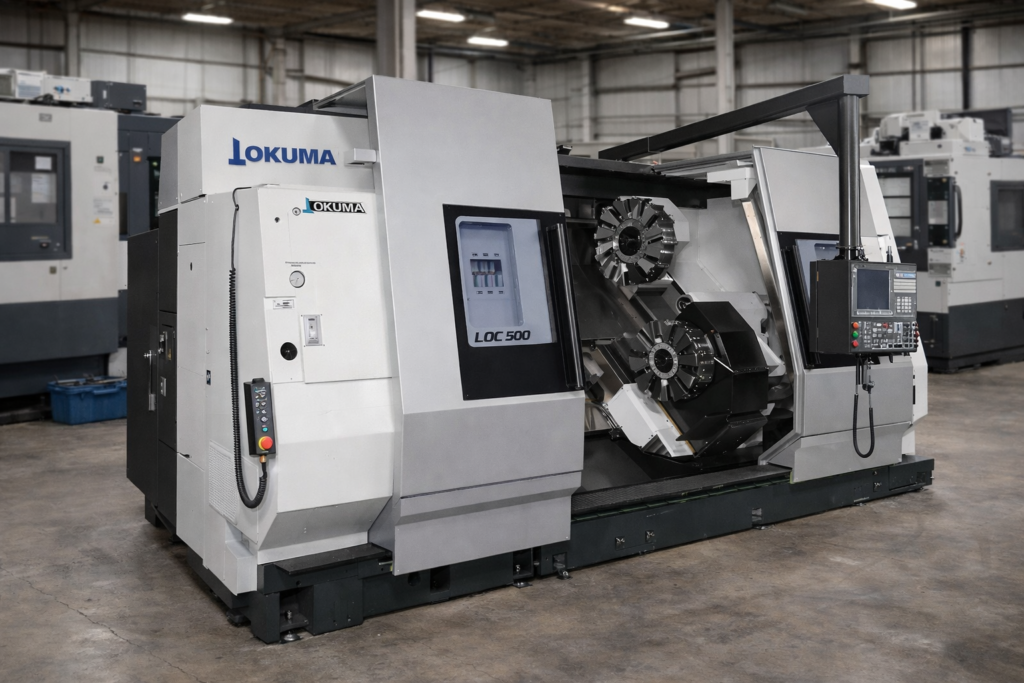
USED OKUMA LOC500
The OKUMA LOC500 is a heavy-duty horizontal CNC lathe specifically engineered for oil country applications, particularly for machining and threading large-diameter pipes used in the oil & gas industry. The name “LOC” stands for “Lathe Oil Country,” reflecting its specialized design for handling long tubular components that require high precision and consistent threading performance. Unlike general-purpose lathes, the LOC500 is optimized for pipe threading, making it a preferred solution for manufacturers involved in energy and pipeline production.
A key feature of the LOC500 is its 4-axis configuration, which allows it to perform highly accurate threading operations on large pipes with minimal deviation. The machine incorporates Okuma’s Oil Field “Threading Suite,” a proprietary system that combines variable speed threading with harmonic spindle control. This ensures precise synchronization between cutting increments and feed rates, resulting in high-quality threads and improved repeatability.
The machine offers a maximum turning diameter of approximately 660 mm and is available with multiple spindle bore configurations to accommodate different pipe sizes. This flexibility allows manufacturers to process a wide range of tubular components without requiring multiple machines. The spindle system delivers high torque and power (up to around 55 kW depending on configuration), enabling efficient machining of heavy materials and large workpieces.
Additionally, the LOC500 is built with a rigid structure and heavy-duty components to withstand continuous production demands. It typically features a turret system with multiple tool positions and optional live tooling, further enhancing its versatility.
Overall, the LOC500 is designed for precision, durability, and efficiency in demanding environments, making it a specialized yet highly capable machine for large-scale pipe threading and turning operations.
OKUMA LOC500 SPECIFICATIONS
| OKUMA LOC500 – AXIS |
|---|
| 4-Axis CNC Oil Country Lathe |
| X-Axis (Cross Slide Movement) |
| Z-Axis (Longitudinal Movement) |
| Upper Turret Axis |
| Lower Turret Axis (Optional Dual Turret Configuration) |
| Designed for Simultaneous Cutting & Threading Operations |
| OKUMA LOC500 – AXIS TRAVELS |
|---|
| X-Axis Travel: Approx. 300 – 400 mm (varies by configuration) |
| Z-Axis Travel: Approx. 1,750 – 2,000 mm |
| Long Bed Configuration for Pipe Handling |
| Designed for Extended Workpieces |
| OKUMA LOC500 – CAPACITY |
|---|
| Maximum Turning Diameter: Approx. 660 mm |
| Maximum Turning Length: Approx. 1,750 – 2,000 mm |
| Swing Over Bed: Approx. 840 mm |
| Designed for Large Diameter Pipes |
| Multiple Spindle Bore Options for Oilfield Applications |
| OKUMA LOC500 – SPINDLE |
|---|
| Spindle Speed Range: Approx. 10 – 2,000 rpm (varies by bore size) |
| Spindle Power: Approx. 37 – 55 kW depending on configuration |
| Spindle Bore Options: Up to approx. 275 mm |
| Spindle Nose: JIS A2-11 / A2-15 / A2-20 |
| High-Torque Spindle for Threading |
| OKUMA LOC500 – TABLE |
|---|
| Chuck Size Range: Approx. 15” – 24” (depending on configuration) |
| Heavy-Duty Chuck for Pipe Clamping |
| Designed for Oilfield Pipe Machining |
| High Stability for Large Workpieces |
| OKUMA LOC500 – TOOL TURRET |
|---|
| Turret Type: Heavy-Duty Turning Turret |
| Tool Capacity: Approx. 8 – 12 Stations |
| Optional Dual Turret Configuration |
| Live Tooling: Optional |
| Designed for Simultaneous Machining |
| OKUMA LOC500 – FEEDRATES |
|---|
| Rapid Traverse (X): Approx. 15 m/min |
| Rapid Traverse (Z): Approx. 20 m/min |
| Feed System: High-Thrust Servo Drives |
| Optimized for Threading Accuracy |
| OKUMA LOC500 – COOLANT & CHIP MANAGEMENT |
|---|
| High-Pressure Coolant System (Optional) |
| Efficient Chip Evacuation System |
| Large Chip Conveyor for Pipe Machining |
| Designed for Heavy Chip Loads |
| OKUMA LOC500 – CONTROL SYSTEM |
|---|
| CNC Control: Okuma OSP Suite |
| Control Type: OSP-P300 / OSP-P500 |
| Oil Field Threading Suite: Standard |
| Variable Speed Threading Control |
| Harmonic Spindle Control for Precision |
| OKUMA LOC500 – POWER & AIR REQUIREMENTS |
|---|
| Power Requirement: Approx. 50 – 70 kVA |
| Voltage: 3-Phase Industrial Supply |
| Air Pressure Requirement: Approx. 5–6 bar |
| Designed for Heavy Industrial Use |
| OKUMA LOC500 – DIMENSIONS |
|---|
| Machine Footprint: Large Industrial Layout |
| Machine Weight: Approx. 15,000 – 25,000 kg (varies by setup) |
| Long Bed Design for Pipe Handling |
| Requires Heavy Foundation Setup |
| OKUMA LOC500 – GENERAL INFORMATION |
|---|
| Machine Type: Oil Country CNC Lathe |
| Manufacturer: Okuma Corporation |
| Series: LOC (Lathe Oil Country) |
| Application: Pipe Threading & Oilfield Components |
| Designed For: High Precision Threading of Large Pipes |
| Built for Continuous Heavy-Duty Operations |
| INDUSTRIES THAT USE OKUMA LOC500 |
|---|
| Oil & Gas |
| Energy Sector |
| Pipe Manufacturing |
| Heavy Equipment |
| Industrial Manufacturing |
| TYPICAL PARTS OKUMA LOC500 CAN PRODUCE |
|---|
| Oilfield Pipes |
| Drill Pipes |
| Casing & Tubing |
| Threaded Pipe Connections |
| Couplings |
| Heavy Cylindrical Components |
| WHY CHOOSE OKUMA LOC500 |
|---|
| Specifically Designed for Oilfield Threading Applications |
| Large Spindle Bore for Big Pipe Machining |
| High Torque for Heavy-Duty Cutting |
| Advanced Threading Suite for Precision |
| Dual Turret Capability for Productivity |
| Reliable for Continuous Industrial Use |
WHY BUY USED OKUMA LOC500
Buying a used OKUMA LOC500 can be a highly practical investment for companies involved in oil & gas, pipeline manufacturing, or heavy-duty machining operations. Since the LOC500 is a specialized machine built for pipe threading and large workpieces, it retains its value and functionality even after years of operation, provided it has been properly maintained.
One of the main advantages of purchasing a used LOC500 is cost savings. New oil country lathes require a substantial capital investment due to their size, power, and specialized threading capabilities. A used machine offers similar functionality at a significantly reduced price, allowing companies to expand capacity without heavy financial strain.
Another key benefit is its application-specific performance. The LOC500 is purpose-built for threading large pipes, and its Threading Suite ensures precise synchronization between spindle speed and feed rates. This reduces errors, improves thread quality, and minimizes rework, which is critical in industries where tolerances are strict and failure is not an option.
Cutting time is a crucial factor when evaluating used machines. Since the LOC500 is often used in heavy production environments, total cutting hours can vary widely. Machines with lower cutting hours generally offer better accuracy and reduced wear on spindle bearings, guideways, and turret systems. However, even high-hour machines can remain productive due to Okuma’s robust construction and engineering.
Durability is another strong point. Okuma machines are known for their long service life, and the LOC500 is no exception. Its heavy-duty build allows it to operate reliably for decades with proper maintenance. This makes it a dependable option in the secondary market.
Additionally, spare parts availability and global support from Okuma provide confidence to buyers. Even older machines can be maintained effectively, ensuring continued operation.
In summary, a used LOC500 provides cost efficiency, proven performance, and long-term reliability, making it an excellent choice for specialized pipe threading applications.
HOW MUCH DOES A USED OKUMA LOC500 COST?
The cost of a used OKUMA LOC500 depends on several factors, including machine age, configuration, condition, and total cutting time. Because it is a specialized oil country lathe, pricing in the secondary market is influenced heavily by its application and overall wear.
For machines manufactured before 2000, pricing typically ranges from $40,000 to $120,000. These machines often have very high cutting hours (40,000–70,000+ hours) and may require refurbishment, including spindle work, turret repairs, or control upgrades. While they are the most affordable option, buyers should factor in maintenance and restoration costs.
Machines built between 2000 and 2010 are more commonly available and generally fall in the range of $120,000 to $250,000. These units often provide a good balance between cost and performance, especially if they have moderate cutting hours (20,000–40,000 hours) and documented maintenance history. Machines in this category are widely used in oilfield operations and still offer reliable threading accuracy.
For machines manufactured between 2010 and 2025, prices typically range from $250,000 to $450,000 or more, depending on configuration and condition. Newer machines often include updated controls, improved automation compatibility, and lower cutting hours. Units with less than 15,000–20,000 hours are considered premium and command higher prices due to their longer remaining service life.
Cutting time is one of the most important pricing factors. Lower-hour machines generally have less wear on critical components such as spindle bearings and guideways, resulting in better accuracy and lower maintenance costs. High-hour machines may be cheaper upfront but can require significant investment in repairs.
In conclusion, understanding the relationship between machine age, cutting time, and condition is essential when evaluating a used LOC500. A well-maintained machine with moderate hours often provides the best return on investment, balancing cost with long-term productivity.
Related Products
-
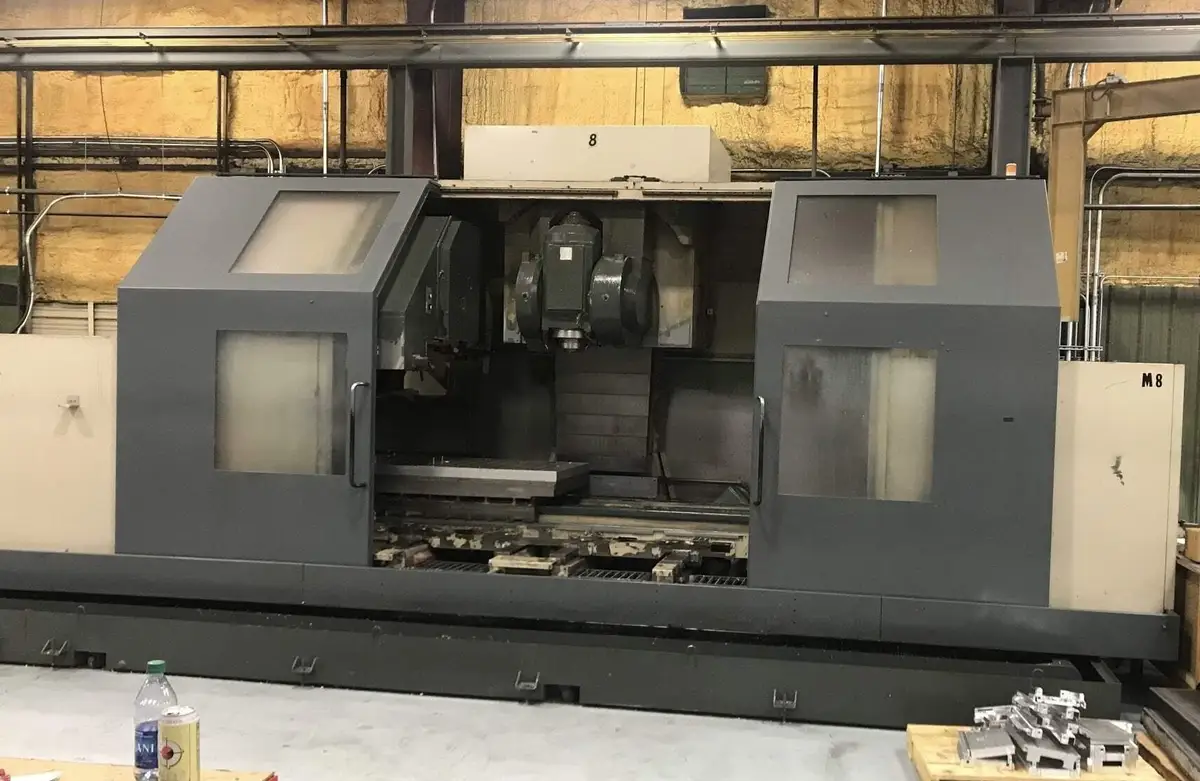
OKUMA - MILLAC 853PF-5X
VIEW MACHINE -
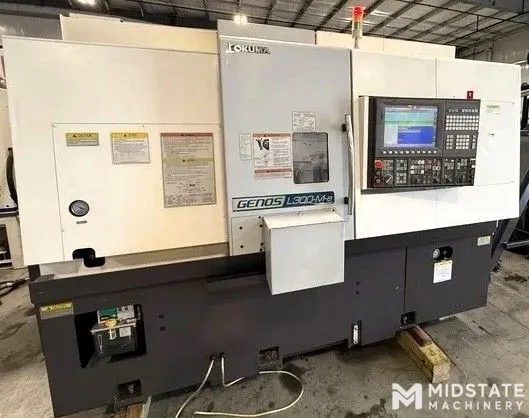
OKUMA - GENOS L300MYW-E
VIEW MACHINE -
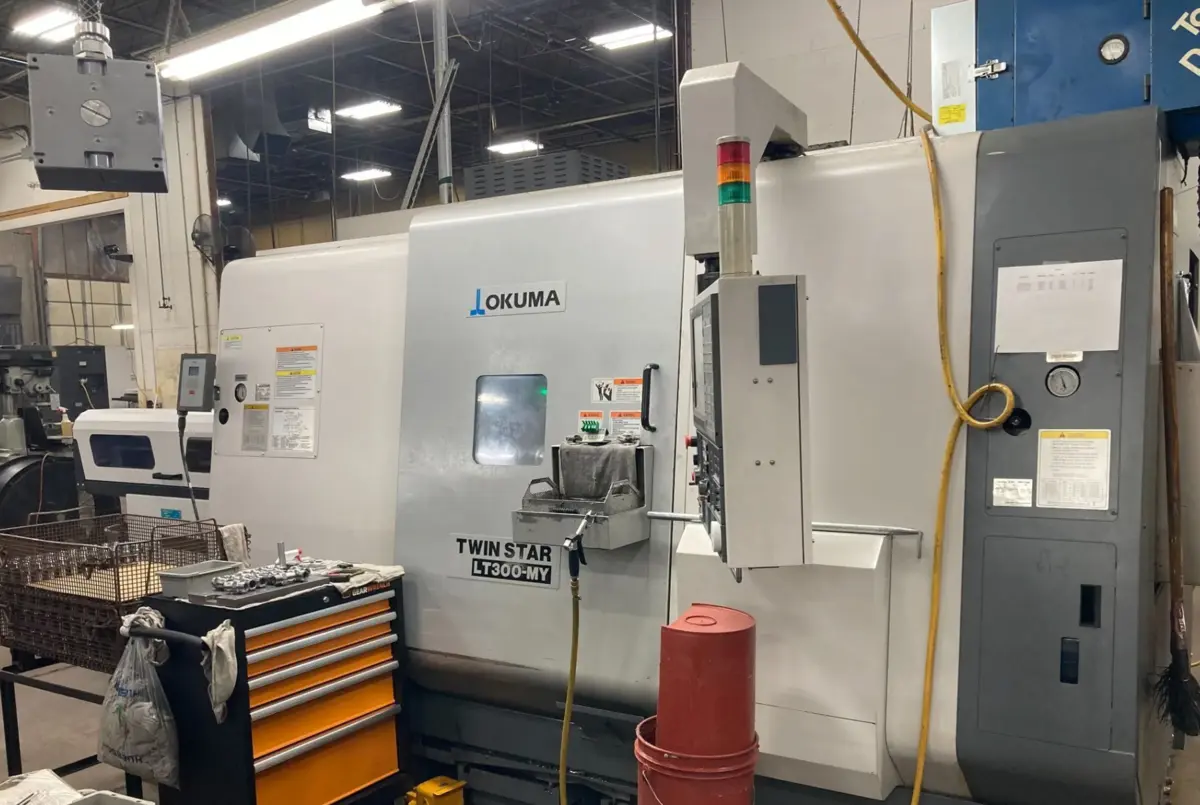
OKUMA - TWIN STAR LT300-MY
VIEW MACHINE -
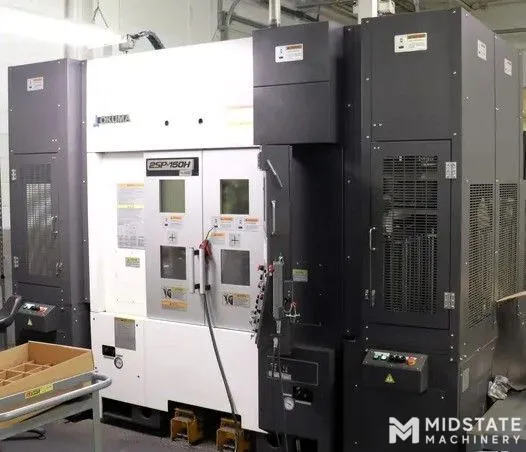
OKUMA - 2SP-150HM
VIEW MACHINE