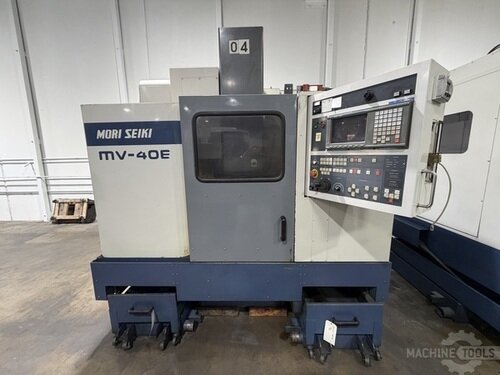
MORI SEIKI MV-40E – 1996
USED MORI SEIKI MV-40E – 1996
The 1996 MORI SEIKI MV-40E is a CNC vertical machining center designed for manufacturers that need reliable three-axis milling capability, a rigid machine structure, and a practical work envelope for production, tooling, maintenance, and general-purpose machining. Built by Mori Seiki, a manufacturer known for developing precision CNC machine tools, the MV-40E represents a generation of vertical machining centers that became widely used in machine shops for dependable day-to-day production.
The MORI SEIKI MV-40E is particularly suited to shops machining steel, aluminum, cast iron, stainless steel, and other commonly used engineering materials. Its vertical spindle arrangement provides straightforward access to the workpiece, while the fixed table allows manufacturers to use conventional vises, fixtures, clamps, and other workholding systems. This makes the machine useful for both repeat production and job-shop work where different components may be processed from one setup to another.
As a 1996 machine, the MV-40E should be evaluated based on its individual configuration rather than its model designation alone. Machines from this period can have different control versions, spindle specifications, tool magazine configurations, coolant systems, and optional equipment. Buyers should therefore confirm the serial number, control type, spindle speed, tool capacity, and installed options before purchasing a specific used example.
The MV-40E belongs to the mid-size vertical machining center category, providing enough table area and axis travel for a broad selection of industrial components without requiring the floor space associated with much larger machining centers. This makes it suitable for smaller production runs, replacement parts, tooling, fixtures, and general machining applications.
One of the important characteristics of older Mori Seiki vertical machining centers is their emphasis on rigid mechanical construction. A rigid machine structure helps maintain cutting stability when machining steel and other difficult materials. When evaluating a used MV-40E, the condition of the machine’s casting, ways or linear-motion system, ballscrews, spindle, tool changer, and worktable should therefore receive particular attention.
The CNC control is another important consideration. A 1996 MV-40E may be equipped with an older-generation Mori Seiki control configuration depending on the original machine specification and any subsequent upgrades. The condition of the control display, keyboard, operator panel, drives, memory, batteries, servo system, and available programming functions should be verified before purchase.
The machine can be used for a wide range of milling operations, including face milling, pocketing, profiling, drilling, tapping, boring, reaming, slotting, and contour machining. With appropriate tooling and workholding, the same machine can be configured for different production requirements without extensive changes to the basic machine platform.
A used MORI SEIKI MV-40E can also be attractive to manufacturers that need additional machining capacity without investing in a new vertical machining center. The purchase price of an older CNC machine can be substantially lower than newer equipment, although the buyer should budget for transportation, installation, tooling, electrical service, maintenance, and potential control or spindle repairs.
For job shops, maintenance departments, educational facilities, prototype manufacturers, and general industrial machine shops, the MV-40E can provide a practical platform for a variety of machining tasks. Its ultimate value depends heavily on the condition of the individual machine, its maintenance history, available documentation, and the options included with the machine.
MORI SEIKI MV-40E – AXIS
| Specification | Details |
|---|---|
| Machine Configuration | CNC Vertical Machining Center |
| Standard Axis Configuration | 3-Axis |
| X-Axis Travel | Approx. 22–24 in / 560–610 mm* |
| Y-Axis Travel | Approx. 16–18 in / 400–450 mm* |
| Z-Axis Travel | Approx. 18–20 in / 450–500 mm* |
| Axis Drive | CNC Servo Driven |
| Axis Feedback | Configuration Dependent |
| Rapid Traverse | Configuration Dependent |
| Positioning | CNC Controlled |
*Exact travel specifications can vary by MV-40E production configuration and should be confirmed from the machine’s original documentation.
The MV-40E provides the three linear axes required for conventional CNC milling. X-axis movement controls longitudinal table travel, Y-axis movement controls cross travel, and Z-axis movement controls vertical spindle movement.
MORI SEIKI MV-40E – AXIS TRAVELS / WORK ENVELOPE
| Specification | Details |
|---|---|
| X-Axis Travel | Approx. 22–24 in / 560–610 mm* |
| Y-Axis Travel | Approx. 16–18 in / 400–450 mm* |
| Z-Axis Travel | Approx. 18–20 in / 450–500 mm* |
| Table Length | Approx. 35–40 in* |
| Table Width | Approx. 16–18 in* |
| Spindle Nose to Table | Configuration Dependent |
| Maximum Workpiece Size | Configuration Dependent |
| Maximum Table Load | Configuration Dependent |
| T-Slots | Multiple T-Slot Workholding |
The work envelope of the MV-40E makes it appropriate for medium-sized components, fixtures, plates, brackets, housings, tooling, and general industrial parts. The exact usable machining area depends on spindle configuration, tool length, workholding arrangement, and machine condition.
MORI SEIKI MV-40E – CAPACITY / TABLE
| Specification | Details |
|---|---|
| Table Type | Fixed CNC Machining Table |
| Table Size | Approx. 35–40 x 16–18 in* |
| Workholding | Vises, Fixtures, Clamps |
| T-Slots | Yes |
| Rotary Table Compatibility | Possible |
| Multiple-Vise Machining | Application Dependent |
| Maximum Workpiece Weight | Configuration Dependent |
| Fixture Mounting | T-Slot Workholding |
The MV-40E’s table can accommodate conventional CNC vises and fixtures for a broad range of machining applications. Depending on the individual machine and available clearance, manufacturers may also use rotary tables or other workholding equipment to increase production flexibility.
When purchasing a used machine, the table should be inspected for damage, excessive wear, corrosion, drilled or tapped holes, damaged T-slots, and evidence of previous crashes. Table flatness and overall condition can have a direct effect on workholding and machining accuracy.
MORI SEIKI MV-40E – SPINDLE
| Specification | Details |
|---|---|
| Spindle Type | Vertical CNC Milling Spindle |
| Spindle Taper | No. 40 Class* |
| Maximum Spindle Speed | Configuration Dependent |
| Spindle Motor | Configuration Dependent |
| Tool Interface | CAT 40 / BT 40 Configuration Dependent |
| Spindle Cooling | Configuration Dependent |
| Through-Spindle Coolant | Optional / Configuration Dependent |
| Suitable Materials | Aluminum, Steel, Cast Iron, Stainless Steel |
*Exact spindle taper and tooling interface should be confirmed on the individual machine.
The spindle is one of the most important components to inspect on a 1996 MV-40E. Buyers should check spindle runout, bearing noise, vibration, temperature, drawbar operation, tool-clamping force, and taper condition.
A machine that has been properly maintained can continue to perform general milling operations effectively, while a machine with excessive spindle wear may require a rebuild or replacement spindle before it can be used for demanding production work.
The spindle speed should also be verified from the machine’s specifications rather than assumed solely from the model name. Different production configurations and regional specifications can result in differences between individual machines.
MORI SEIKI MV-40E – TOOL CHANGER
| Specification | Details |
|---|---|
| Tool Changer | Automatic Tool Changer |
| Tool Capacity | Configuration Dependent |
| Tool Taper | No. 40 Class* |
| Tool Selection | CNC Controlled |
| Tool Change | Automatic |
| Tool Management | CNC Controlled |
| Magazine Type | Configuration Dependent |
| Tool Monitoring | Configuration Dependent |
The automatic tool changer allows the MV-40E to perform multiple machining operations without requiring the operator to manually change every tool. This is useful for production jobs involving face milling, roughing, finishing, drilling, tapping, boring, and chamfering.
On a used 1996 machine, the tool changer should be thoroughly tested. The magazine should index correctly, the tool-change arm should move smoothly, and the machine should correctly unclamp and clamp tools.
The condition of the tool pockets is also important. Damaged pockets, broken tool-change mechanisms, missing covers, and synchronization problems can result in costly repairs.
MORI SEIKI MV-40E – CONTROL SYSTEM
| Specification | Details |
|---|---|
| CNC Control | Mori Seiki Control Configuration |
| Control Generation | 1990s-Era CNC |
| Programming | EIA/ISO G-Code |
| Tool Offset Management | Yes |
| Work Offset Management | Yes |
| CNC Diagnostics | Configuration Dependent |
| Memory Capacity | Configuration Dependent |
| RS-232 / Data Transfer | Configuration Dependent |
| Conversational Programming | Configuration Dependent |
| Additional Software | Configuration Dependent |
Because the MV-40E is a 1996 machine, control configuration should be confirmed individually. Older machines can have different Mori Seiki control generations or subsequent control modifications.
The operator should verify that the CRT or display is clear and functional, the keyboard and control buttons operate correctly, programs can be loaded and saved, offsets can be entered, and all axes respond correctly.
For shops purchasing older CNC equipment, data-transfer capability is also worth checking. If the original control has limited memory or older communications hardware, a drip-feed or DNC solution may be useful for longer programs.
The control’s battery condition should also be verified because older CNC systems may depend on batteries to preserve parameters, programs, and machine data. A machine with missing documentation or improperly maintained control parameters can require additional commissioning work.
MORI SEIKI MV-40E – COOLANT / DUST / CHIP MANAGEMENT
| Specification | Details |
|---|---|
| Coolant System | Flood Coolant / Configuration Dependent |
| Coolant Tank | Integrated / Separate Configuration |
| Coolant Pump | Configuration Dependent |
| Chip Management | Enclosed Machining Area |
| Chip Conveyor | Optional / Configuration Dependent |
| Through-Spindle Coolant | Optional |
| Mist Collection | Optional |
| Coolant Filtration | Configuration Dependent |
| Manual Chip Removal | Possible |
The coolant system helps control cutting temperature, lubricate the cutting zone, and carry chips away from the workpiece. On a used MV-40E, the coolant pump, tank, hoses, nozzles, filtration, and electrical controls should all be checked.
If the machine is equipped with a chip conveyor, it should be operated during inspection to ensure the conveyor motor, chain, flights, and controls function properly.
Older coolant systems may require cleaning because accumulated chips, sludge, tramp oil, and corrosion can affect pump performance and coolant flow.
MORI SEIKI MV-40E – POWER REQUIREMENTS
| Specification | Details |
|---|---|
| Electrical System | Industrial CNC Power |
| Main Spindle Motor | Configuration Dependent |
| Electrical Supply | Machine / Region Dependent |
| Phase | Three-Phase Industrial Power |
| Voltage | Configuration Dependent |
| Transformer | Configuration Dependent |
| Pneumatic Supply | Configuration Dependent |
| Hydraulic System | Configuration Dependent |
| Installation | Industrial CNC Environment |
Electrical requirements should be confirmed from the machine’s electrical nameplate before transportation or installation.
Because this is a 1996 CNC machine, buyers should inspect electrical cabinets, cooling fans, contactors, relays, servo amplifiers, spindle drives, wiring, connectors, and control batteries. Aging electrical components can become an important consideration when purchasing older CNC equipment.
MORI SEIKI MV-40E – DIMENSIONS
| Specification | Details |
|---|---|
| Machine Footprint | Configuration Dependent |
| Overall Width | Configuration Dependent |
| Overall Depth | Configuration Dependent |
| Overall Height | Configuration Dependent |
| Machine Weight | Configuration Dependent |
| Chip Conveyor Footprint | Additional Space Required |
| Coolant Equipment | Additional Space Required |
| Shipping Requirements | Rigging / Heavy Equipment |
The exact dimensions and weight of a 1996 MV-40E should be confirmed from the individual machine’s documentation before arranging transportation.
For used CNC equipment, the shipping configuration can also affect the final dimensions. Tool changers, chip conveyors, coolant tanks, rotary tables, transformers, guarding, and other accessories may increase the required space.
A professional rigging company should be used when moving the machine because the machine’s center of gravity and lifting points need to be considered during transportation and installation.
MORI SEIKI MV-40E – GENERAL INFORMATION
| Specification | Details |
|---|---|
| Manufacturer | Mori Seiki |
| Model | MV-40E |
| Year | 1996 |
| Machine Category | CNC Vertical Machining Center |
| Standard Configuration | 3-Axis |
| Control | Mori Seiki CNC Configuration |
| Spindle Orientation | Vertical |
| Spindle Taper | No. 40 Class* |
| Workholding | Fixed Table |
| Tool Changer | Automatic |
| Coolant | Configuration Dependent |
| Chip Conveyor | Optional |
| Rotary Table | Optional / Compatible |
| Production Type | Production / Job Shop / General Machining |
*Confirm exact specification on the individual machine.
The MORI SEIKI MV-40E is an older-generation vertical machining center, so condition is especially important when comparing different used examples. Two machines of the same year can have very different values depending on maintenance, operating hours, spindle condition, control condition, and mechanical accuracy.
INDUSTRIES THAT USE MORI SEIKI MV-40E
The MORI SEIKI MV-40E can be used across a wide range of industries requiring conventional CNC milling capability.
Automotive Manufacturing
Automotive machine shops can use the MV-40E for brackets, housings, fixtures, mounting components, plates, and tooling. Its vertical configuration is well suited to many general automotive machining operations.
Aerospace Support and Component Manufacturing
The machine can be used for aerospace support components, fixtures, brackets, tooling, and maintenance parts when the machine’s condition and accuracy are appropriate for the application.
General Job Shops
Job shops are among the most natural applications for the MV-40E. A shop can use the machine for a wide variety of customer jobs without dedicating it to a single production component.
Tool and Die Manufacturing
The MV-40E can machine mold components, fixture plates, inserts, dies, punches, and other tooling components using appropriate cutters and workholding.
Industrial Equipment
Manufacturers of pumps, machinery, material-handling equipment, and industrial systems can use the machine to produce mounting plates, brackets, housings, adapters, and other mechanical components.
Maintenance Departments
Large manufacturing facilities can use older CNC machining centers for replacement parts, repair components, maintenance tooling, and machine-shop support work.
Agricultural Equipment
Agricultural equipment manufacturers and repair facilities can use the MV-40E for brackets, mounting components, fixtures, shafts supports, housings, and replacement parts.
Prototype and Low-Volume Manufacturing
The machine can also be useful for prototypes and short production runs where flexible CNC milling capability is more important than the automation features found on newer high-production machining centers.
TYPICAL PARTS MORI SEIKI MV-40E CAN PRODUCE
| Part Type | Typical Examples |
|---|---|
| Brackets | Mounting Brackets, Support Brackets |
| Plates | Base Plates, Adapter Plates, Mounting Plates |
| Housings | Motor Housings, Equipment Housings |
| Fixtures | Assembly Fixtures, Welding Fixtures |
| Tooling | Dies, Inserts, Jigs |
| Industrial Components | Mounts, Supports, Adapters |
| Automotive Components | Brackets, Housings, Mounting Components |
| Hydraulic Parts | Manifolds, Valve Blocks |
| Prototype Parts | One-Off and Low-Volume Components |
| Maintenance Parts | Replacement Machine Components |
WHY CHOOSE MORI SEIKI MV-40E
The MORI SEIKI MV-40E provides a practical combination of CNC milling capability and relatively straightforward machine operation. Its vertical machining configuration makes it suitable for many conventional machining processes.
One of its primary advantages is versatility. The machine can perform face milling, pocketing, profiling, drilling, tapping, boring, and other milling operations depending on its installed spindle, tooling, and control configuration.
The fixed worktable provides a familiar workholding arrangement for machine operators. Conventional CNC vises and fixtures can be used for many applications, making setup relatively straightforward.
The machine’s No. 40-class tooling configuration is also suitable for general industrial machining. A wide range of cutters, drills, boring tools, taps, and other tooling is available for this tool interface.
The automatic tool changer allows multiple operations to be performed within the same program. This can reduce manual intervention and improve consistency when machining repeat components.
Another consideration is the availability of used tooling and accessories for older vertical machining centers. Buyers can often source vises, holders, cutters, probes, rotary tables, and other equipment separately to configure the machine for their specific application.
The MV-40E can also be useful as a secondary or backup CNC machine. A manufacturer with newer production equipment may use an older vertical machining center for maintenance parts, prototype work, fixtures, tooling, and less time-sensitive jobs.
Its relatively mature mechanical design can also make it straightforward for experienced machine technicians to inspect and maintain. However, the age of the machine means buyers should place significant emphasis on actual condition rather than relying solely on the Mori Seiki name or model designation.
WHY BUY USED MORI SEIKI MV-40E
Buying a used 1996 MORI SEIKI MV-40E can provide manufacturers with an economical way to add CNC milling capacity. Older machining centers are often available at substantially lower acquisition prices than newer equipment.
The machine can be particularly useful when a company needs an additional VMC for general-purpose machining but does not need the newest control features or advanced automation found on current-generation machines.
A used MV-40E can also serve as a dedicated machine for specific operations. For example, a shop might assign it to drilling and tapping, fixture manufacturing, rough machining, maintenance components, or short-run production.
The automatic tool changer provides more flexibility than a basic manual milling machine. Multiple tools can remain loaded, allowing the machine to perform several operations automatically.
Another advantage is the availability of aftermarket tooling. Buyers can equip the machine with standard workholding, CAT/BT tooling where applicable, vises, drills, end mills, boring tools, and other accessories without needing specialized modern equipment.
However, the age of a 1996 machine means inspection is particularly important. The spindle should be tested throughout its operating range, and buyers should listen for bearing noise, vibration, or abnormal temperature increases.
The ballscrews, linear guides or box ways, axis motors, servo drives, and feedback systems should also be inspected. Excessive backlash or positioning errors can affect finished-part accuracy.
The tool changer should be cycled repeatedly, and the machine should be checked for tool-change alarms or synchronization problems.
The CNC control deserves special attention. Buyers should verify display operation, memory, parameter retention, program transfer, axis control, spindle control, and alarm functions.
Electrical cabinets should also be inspected for aging components, damaged wiring, cooling-fan problems, corrosion, and obsolete components that may be difficult to replace.
A used MV-40E can therefore be an economical machining solution when the machine has been maintained properly and its mechanical and electrical condition is appropriate for the intended application.
HOW MUCH DOES A USED MORI SEIKI MV-40E COST?
The price of a used 1996 MORI SEIKI MV-40E depends heavily on its condition, control configuration, spindle condition, tool changer, operating hours, accuracy, included tooling, coolant equipment, chip conveyor, and geographic location.
A reasonable used-market estimate for a 1996 MORI SEIKI MV-40E is approximately $10,000 to $25,000 USD, although exceptionally clean machines with desirable options, recent maintenance, and strong mechanical condition can be offered outside this range.
Machines toward the lower end of the market may require work before being placed into production. This can include spindle service, ballscrew replacement, electrical repairs, control batteries, display repairs, coolant-system maintenance, lubrication work, or tool-changer repairs.
A clean machine with a functioning CNC control, accurate axes, good spindle condition, operational tool changer, and usable coolant system will generally command a higher asking price than a machine sold primarily for repair or rebuilding.
Machine hours should be considered when evaluating a used MV-40E, but hours alone do not determine value. A well-maintained machine with higher hours can be more useful than a low-hour machine that has been poorly maintained or stored improperly.
Spindle condition is especially important. Buyers should test spindle runout, tool-clamping force, bearing condition, temperature, vibration, and performance at different RPM levels.
Axis accuracy is another major factor. A ballbar test, laser calibration, or complete machine geometry inspection can help identify positioning and repeatability problems before purchase.
The control system should also be evaluated because replacement or repair of older CNC electronics can represent a significant portion of the machine’s total value. Buyers should confirm that the control boots correctly, retains parameters, accepts programs, and operates all machine functions.
Transportation and installation should be included in the acquisition budget. Depending on the machine’s location, buyers may need to budget separately for rigging, trucking, unloading, leveling, electrical installation, coolant preparation, and commissioning.
For buyers who need an affordable vertical machining center for general milling, tooling, maintenance, prototypes, or low-volume production, the used MORI SEIKI MV-40E can represent a practical option when the individual machine has been inspected and confirmed to be mechanically and electrically suitable for the intended work.
Related Products
-
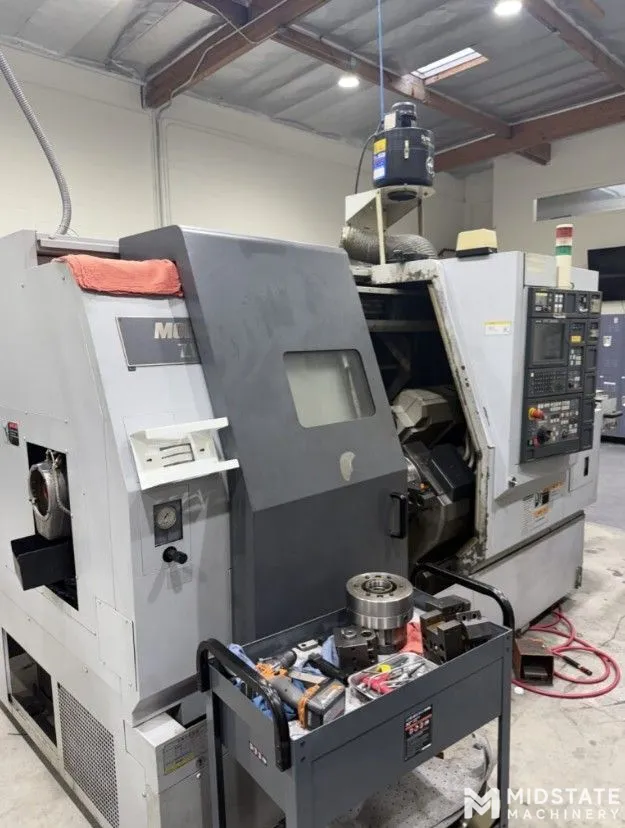
MORI SEIKI - ZL-203SMC
VIEW MACHINE -
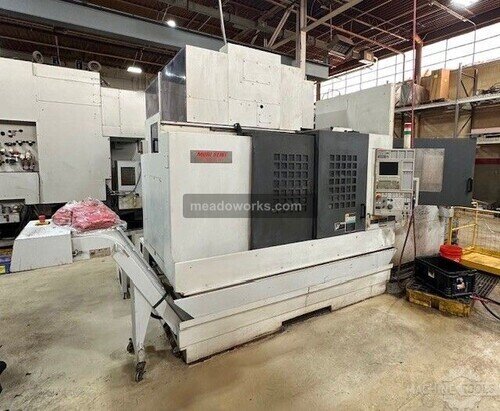
MORI SEIKI - NV5000 A1B/50
VIEW MACHINE -
MORI SEIKI - ZT-2500Y
VIEW MACHINE -
MORI SEIKI - NZX-1500/800SY2
VIEW MACHINE