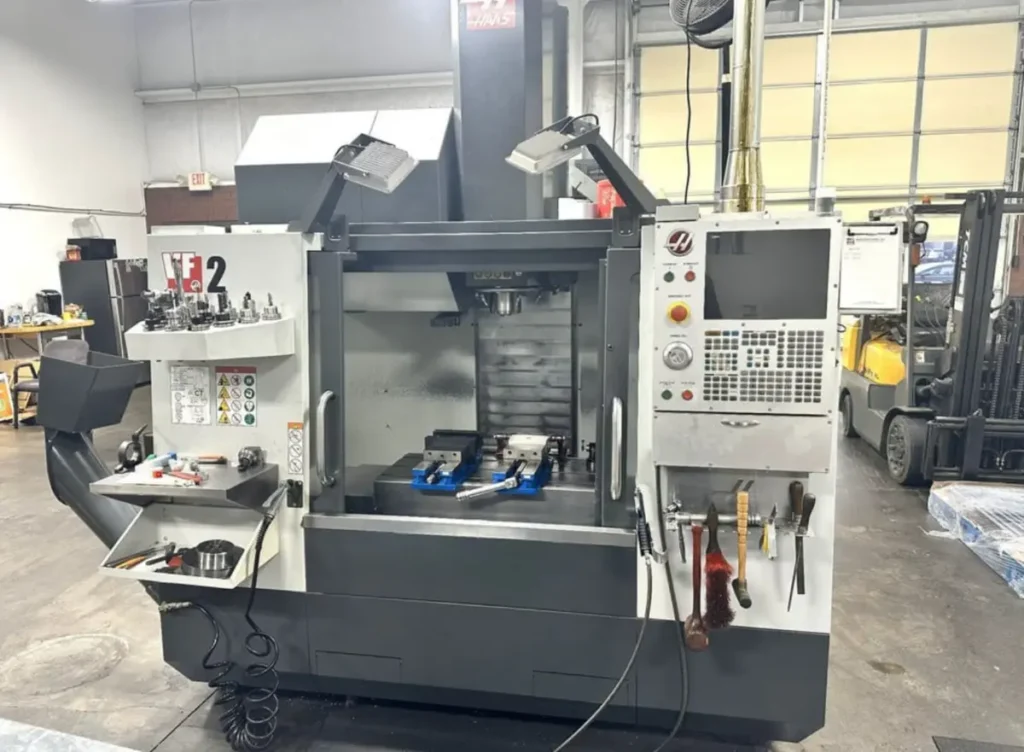
USED HAAS VF2 2018
The HAAS VF2 2018 is a CNC vertical machining center designed for precision milling, drilling, tapping, contouring, pocketing, and general production machining. The VF2 is one of Haas Automation’s most widely used vertical machining centers and is designed to provide a combination of machining capacity, spindle performance, speed, and compact floor-space requirements. A documented 2018 VF2 configuration features 30 inches of X-axis travel, 16 inches of Y-axis travel, and 20 inches of Z-axis travel, with an 8,100 RPM, 30 HP spindle and #40 CAT tooling.
The machine is suitable for job shops, aerospace manufacturers, automotive suppliers, tooling operations, mold and die shops, maintenance departments, prototype manufacturers, and production facilities. The VF2 platform provides a 36 × 14 inch table and supports up to approximately 3,000 lbs of evenly distributed workpiece weight. The standard configuration includes a 20-pocket automatic tool changer, while options such as a fourth-axis drive, probing, chip auger, and through-spindle coolant can expand its capabilities.
The HAAS VF2 2018 is particularly attractive in the used market because it offers relatively modern Haas CNC technology while generally costing considerably less than a new machine. Buyers should verify the individual machine’s spindle hours, power-on hours, control configuration, options, maintenance history, axis accuracy, spindle condition, and included tooling before purchasing.
HAAS VF2 2018 – AXIS
| Specification | Value |
|---|---|
| X Axis | 762 mm (30″) |
| Y Axis | 406 mm (16″) |
| Z Axis | 508 mm (20″) |
| Controlled Axes | 3 |
| 4th Axis | Optional |
HAAS VF2 2018 – AXIS TRAVELS / WORK ENVELOPE
| Specification | Value |
|---|---|
| X Travel | 30″ |
| Y Travel | 16″ |
| Z Travel | 20″ |
| Spindle Nose to Table Minimum | 4″ |
| Spindle Nose to Table Maximum | 24″ |
| Table Length | 36″ |
| Table Width | 14″ |
The 30 × 16 × 20 inch work envelope provides useful capacity for a broad range of small and medium-sized components.
HAAS VF2 2018 – CAPACITY
| Specification | Value |
|---|---|
| Table Size | 36″ × 14″ |
| Maximum Table Load | 3,000 lbs |
| T-Slots | 3 |
| T-Slot Width | 0.626″–0.630″ |
| T-Slot Center Distance | 4.92″ |
| Spindle Taper | #40 CAT |
| Workholding | Vises, Fixtures, Rotary Equipment |
The worktable provides enough space for standard production vises, fixture plates, clamps, and rotary equipment.
HAAS VF2 2018 – SPINDLE
| Specification | Value |
|---|---|
| Spindle Type | Inline Direct Drive |
| Maximum Spindle Speed | 8,100 RPM |
| Spindle Power | 30 HP |
| Maximum Torque | 90 ft-lb @ 2,000 RPM |
| Spindle Taper | #40 CAT |
| Drive System | Inline Direct Drive |
| Spindle Cooling | Liquid Cooled |
| Through Spindle Coolant | Optional |
A documented 2018 VF2 is equipped with an 8,100 RPM, 30 HP spindle and #40 CAT taper.
HAAS VF2 2018 – TOOL CHANGER
| Specification | Value |
|---|---|
| Tool Changer Type | Automatic Carousel |
| Tool Capacity | 20 |
| Maximum Tool Diameter | 3.5″ |
| Maximum Tool Weight | 12 lbs |
| Average Tool-to-Tool Time | 4.2 seconds |
| Average Chip-to-Chip Time | 4.5 seconds |
| Tool Taper | #40 CAT |
The 20-position automatic tool changer allows multiple machining operations to be completed in a single setup.
HAAS VF2 2018 – FEEDRATES
| Specification | Value |
|---|---|
| X Rapid Traverse | 1,000 IPM |
| Y Rapid Traverse | 1,000 IPM |
| Z Rapid Traverse | 1,000 IPM |
| Maximum Cutting Feed | 650 IPM |
| X Maximum Thrust | 2,550 lbf |
| Y Maximum Thrust | 2,550 lbf |
| Z Maximum Thrust | 4,200 lbf |
These feed and rapid-traverse specifications provide efficient positioning and reduced non-cutting time during production cycles.
HAAS VF2 2018 – CONTROL SYSTEM
| Specification | Value |
|---|---|
| CNC Control | Haas CNC Control |
| Control Generation | Haas Next Generation Control |
| Programming | G-Code |
| Program Memory | Approximately 1 GB |
| Ethernet | Included |
| Rigid Tapping | Included |
| Spindle Orientation | Included |
| HaasConnect | Configuration Dependent |
| Wireless Connectivity | Configuration Dependent |
| 4th Axis Control | Option Dependent |
| Probing | Option Dependent |
| User-Definable Macros | Configuration Dependent |
The 2018 VF2 generation was available with Haas’s modern control features, including 1 GB program memory, Ethernet, rigid tapping, and other productivity functions.
HAAS VF2 2018 – COOLANT / CHIP MANAGEMENT
| Specification | Value |
|---|---|
| Coolant Capacity | 55 gal |
| Coolant Capacity | 208 L |
| Coolant Pump | Multi-Stage |
| Flood Coolant | Standard |
| Window Air Blast | Standard |
| Chip Washdown | Standard |
| Chip Auger | Option Dependent |
| Chip Conveyor | Option Dependent |
| Through Spindle Coolant | Option Dependent |
| Oil Skimmer | Option Dependent |
The standard VF2 platform includes a 55-gallon coolant system, multi-stage pump, window air blast, and chip-washdown functionality.
HAAS VF2 2018 – POWER REQUIREMENTS
| Specification | Value |
|---|---|
| Standard Input Voltage | 220 VAC |
| Phase | Three Phase |
| Full Load Amps | Approximately 70 A |
| Compressed Air | 4 SCFM @ 100 PSI |
| Minimum Air Pressure | 80 PSI |
| High-Voltage Configuration | Option Dependent |
Exact electrical requirements should be confirmed from the individual machine’s electrical documentation before installation.
HAAS VF2 2018 – DIMENSIONS
| Specification | Approximate Value |
|---|---|
| Overall Length | Configuration Dependent |
| Overall Width | Configuration Dependent |
| Overall Height | Configuration Dependent |
| Shipping Weight | Approximately 7,800 lbs |
| Shipping Weight | Approximately 3,539 kg |
Actual dimensions and weight can vary according to chip conveyors, rotary equipment, coolant systems, probing, and other installed options.
HAAS VF2 2018 – GENERAL INFORMATION
| Item | Details |
|---|---|
| Manufacturer | Haas Automation |
| Model | VF2 |
| Year | 2018 |
| Machine Type | CNC Vertical Machining Center |
| Control | Haas CNC Control |
| Spindle Power | 30 HP |
| Spindle Speed | 8,100 RPM |
| Spindle Taper | #40 CAT |
| Tool Capacity | 20 |
| X Travel | 30″ |
| Y Travel | 16″ |
| Z Travel | 20″ |
| Table Size | 36″ × 14″ |
| Maximum Table Load | 3,000 lbs |
| Controlled Axes | 3 |
| 4th Axis | Optional |
| Coolant Capacity | 55 gal |
The documented 2018 VF2 specifications align closely with Haas’s published VF2 platform specifications.
INDUSTRIES THAT USE HAAS VF2 2018
The HAAS VF2 2018 is suitable for aerospace, automotive, defense, medical manufacturing, electronics, robotics, tooling, mold and die, industrial equipment, and general contract machining.
Its combination of a 30 × 16 × 20 inch work envelope and 30 HP spindle makes it capable of handling both light and moderately demanding machining operations.
TYPICAL PARTS HAAS VF2 2018 CAN PRODUCE
A HAAS VF2 2018 can produce aerospace brackets, automotive components, fixture plates, tooling, manifolds, housings, machine components, molds, robotics parts, medical components, and general precision-machined parts.
Typical operations include milling, drilling, tapping, boring, pocketing, contouring, chamfering, engraving, and finishing.
With optional fourth-axis equipment, the VF2 can also perform indexed or multi-sided machining without requiring the operator to repeatedly reposition the workpiece.
WHY CHOOSE HAAS VF2 2018
The HAAS VF2 2018 combines a useful 30 × 16 × 20 inch machining envelope, 30 HP direct-drive spindle, 8,100 RPM maximum speed, 20-tool automatic changer, and modern Haas control technology.
Its compact footprint makes it practical for shops with limited floor space, while its table size and spindle capacity provide enough versatility for many production and job-shop applications.
The machine can also be configured with useful options such as fourth-axis equipment, probing, chip augers, through-spindle coolant, and other productivity features.
WHY BUY USED HAAS VF2 2018
Buying a used HAAS VF2 2018 can provide manufacturers with a relatively modern CNC vertical machining center at a lower investment than purchasing new equipment.
A 2018 machine is also considerably newer than many older used VF2 models, potentially providing advantages in control technology, connectivity, machine electronics, and available options.
A documented 2018 VF2 configuration can include a fourth-axis rotary option, while other used machines may have probing, chip management, through-spindle coolant, or additional tooling.
Before purchasing, buyers should inspect spindle condition, spindle hours, power-on hours, axis backlash, positioning accuracy, ballscrews, linear guides, tool changer operation, coolant delivery, lubrication, electrical cabinet, control functionality, and maintenance records.
HOW MUCH DOES A USED HAAS VF2 2018 COST?
The price of a used HAAS VF2 2018 depends on spindle hours, power-on hours, machine condition, installed options, tooling, fourth-axis equipment, probing, coolant systems, and geographic location.
Current used-market evidence shows significant variation based on configuration. For example, a 2018 VF2SS with fourth-axis equipment and through-spindle coolant was discussed at an asking price of $60,000, while another owner reported paying $45,000 for a low-hour 2018 VF2SS several years earlier. These are VF2SS examples rather than standard VF2 transactions, so they should not be treated as direct VF2 pricing.
For used-equipment listing purposes, a reasonable estimated market range for a HAAS VF2 2018 is approximately $30,000 to $45,000 USD, depending on condition, hours, options, tooling, and accessories. Machines with low hours, probing, fourth-axis equipment, chip conveyors, through-spindle coolant, and extensive tooling may command more, while higher-hour machines or machines requiring repairs may sell for less.
For a HAAS VF2 2018, buyers should evaluate the actual machine under power and verify spindle condition, axis accuracy, tool changer performance, control operation, coolant system, maintenance history, and included options before establishing the final purchase price.
HAAS VF-2 VS HAAS VF-2SS – STANDARD VS SUPER-SPEED CNC MILL
The HAAS VF-2 and HAAS VF-2SS are closely related CNC vertical machining centers, but they are designed for different production priorities. The standard VF-2 is a versatile general-purpose VMC suited to a wide range of milling applications, while the VF-2SS, or Super Speed version, is designed to reduce cycle times through faster spindle speeds, quicker axis motion, and higher-speed machining capabilities. Choosing between the two depends on the type of parts being produced and whether productivity gains justify the additional investment.
The standard HAAS VF-2 is well suited for general machining of brackets, housings, plates, fixtures, tooling, and many other metal components. For shops performing mixed production, prototype work, repair machining, and conventional milling operations, the standard machine can provide the capacity and flexibility needed without requiring maximum-speed performance.
The VF-2SS is aimed more directly at high-production environments and applications where every second of cycle time matters. Faster rapid movements and increased machining speed can help reduce non-cutting time, while a higher-speed spindle configuration may benefit operations involving smaller cutting tools, aluminum machining, complex contours, and high-speed finishing.
However, the VF-2SS is not automatically the better choice for every shop. If production primarily involves heavier cutting, larger tools, lower spindle speeds, or short production runs, the standard VF-2 may provide more than enough capability. A machine’s actual value should be measured against the work it performs rather than simply choosing the model with higher speed specifications.
Used-machine buyers should also compare condition and configuration carefully. A well-maintained standard VF-2 may be a better purchase than a poorly maintained VF-2SS. Spindle condition, tool changer operation, axis accuracy, maintenance history, control generation, installed options, and previous usage should all be reviewed.
For shops focused on reducing cycle times and increasing output, the VF-2SS can offer significant advantages. For general-purpose machining where maximum speed is not essential, the standard VF-2 remains a practical and versatile CNC milling solution.
HAAS VF-2 AUTOMATIC TOOL CHANGER NOT WORKING – TROUBLESHOOTING GUIDE
An automatic tool changer problem on a HAAS VF-2 can bring machining operations to a complete stop. The tool changer is responsible for moving tools between the spindle and tool storage system, so even a minor sensor, alignment, mechanical, or control issue can interrupt the machining cycle. Proper troubleshooting should begin by identifying exactly where the tool-change sequence fails.
First, check the machine control for alarms or messages. The exact alarm information can provide important clues about whether the problem involves tool position, a sensor, an air-related function, spindle orientation, mechanical movement, or another part of the sequence. Record the alarm before resetting the machine because repeatedly clearing the message may make diagnosis more difficult.
Next, observe the point at which the cycle stops. Does the spindle fail to orient? Does the carousel fail to rotate? Does the tool arm fail to move? Does the tool release mechanism not operate? Identifying the failed stage can significantly narrow the possible causes.
Contamination is another common factor. Chips, coolant residue, damaged toolholders, or foreign material can interfere with moving components. Inspect accessible areas for buildup or obstructions. Toolholders should also be checked for damage or improper seating, as a damaged or incorrectly positioned tool can affect the tool-change cycle.
Sensors and switches should be inspected when the mechanical system appears to move correctly but the control does not recognize the proper position. A faulty or contaminated sensor may prevent the next stage of the tool-change sequence from beginning.
Mechanical wear or misalignment can also cause problems, particularly on older VF-2 machines with extensive production history. Worn moving components, incorrect adjustment, or damaged mechanisms may prevent proper tool positioning.
Air supply and related pneumatic functions should be checked where applicable. Insufficient pressure or a malfunctioning pneumatic component can affect tool release or movement.
Do not repeatedly force a failed tool-change cycle. Doing so can increase the risk of damaging the tool changer, spindle, or tooling. A systematic approach involving alarm review, sequence observation, mechanical inspection, and qualified service procedures is the safest way to identify and correct the problem.
HAAS VF-2 REPLACEMENT PARTS AND SERVICE COMPONENTS GUIDE
Maintaining a HAAS VF-2 may eventually require replacement parts or service components due to normal wear, production use, accidental damage, or age-related deterioration. The specific parts required depend on the machine’s production year, configuration, control generation, spindle package, tool changer design, and installed options. For this reason, buyers and maintenance personnel should always verify compatibility before ordering components.
Common service areas include the spindle system, axis components, lubrication system, coolant system, electrical components, sensors, switches, and tool changer mechanisms. Depending on machine condition, parts such as belts, seals, hoses, filters, pumps, sensors, relays, switches, and other wear items may require periodic replacement.
Spindle-related service components require particular care because incorrect parts or improper installation can create serious operational problems. If spindle bearings, drive components, cooling-related parts, or associated electrical components need attention, the machine should be diagnosed thoroughly before ordering expensive replacements.
Axis systems may require service parts when backlash, positioning errors, unusual movement, or servo-related issues develop. Ballscrews, bearings, couplings, encoders, seals, and related components should be identified using the exact machine information and appropriate parts documentation.
Tool changer parts are another important category. Components associated with tool positioning, movement, sensing, retention, and release can wear over time. Before replacing a part, determine whether the actual issue is mechanical wear, contamination, electrical failure, sensor malfunction, or improper adjustment.
When sourcing replacement components, always confirm the VF-2 serial information, production details, and exact machine configuration. Similar-looking parts may not be interchangeable across different production years.
Service quality is just as important as the replacement part itself. Improper installation, incorrect adjustment, or failure to investigate the original cause of failure can result in repeat problems. Keeping maintenance records and documenting replaced components can help technicians track recurring issues.
For used VF-2 owners, having access to accurate machine documentation and identifying parts by the exact machine configuration can reduce downtime and help prevent costly ordering mistakes.
IS THE HAAS VF-2 A VERTICAL MACHINING CENTER?
Yes, the HAAS VF-2 is a vertical machining center, commonly called a VMC. It is designed primarily for CNC milling operations and uses a vertically oriented spindle to rotate cutting tools. The workpiece is typically secured to the machine table while the spindle and machine axes position the cutting tool to remove material.
The vertical spindle arrangement makes the VF-2 suitable for a broad range of machining operations. These can include face milling, pocketing, contouring, drilling, tapping, boring, slotting, and other precision metal-cutting processes. The machine can be used to manufacture brackets, plates, fixtures, housings, tooling components, molds, machine parts, and many other types of industrial components.
As a CNC vertical machining center, the VF-2 uses computer numerical control to coordinate movement along its primary machining axes. The X-axis generally controls side-to-side table movement, the Y-axis controls front-to-back movement, and the Z-axis controls vertical movement of the spindle. Together, these movements allow the machine to position a rotating cutting tool accurately around the workpiece.
The VF-2 can also be configured with optional equipment that expands its capabilities. Depending on the individual machine, options may include probing systems, different spindle configurations, rotary tables, coolant systems, chip-management equipment, and other accessories. A rotary axis, for example, can allow more sides of a part to be machined with fewer manual setups.
The VF-2 differs from a CNC turning center or lathe because the primary cutting method is based on a rotating cutting tool rather than primarily rotating the workpiece. This makes it particularly useful for prismatic and complex-shaped parts requiring multiple milling and drilling operations.
Its combination of vertical machining design, practical work envelope, and broad application range has made the HAAS VF-2 a popular machine in job shops and manufacturing facilities. Specifications can vary by production year and configuration, so individual machine details should always be verified when evaluating a particular VF-2.
WHY IS MY HAAS VF-2 SPINDLE NOT STARTING?
A HAAS VF-2 spindle that does not start can be caused by several different issues, ranging from a simple operating condition or alarm to a problem involving the spindle drive, motor, electrical system, control, or mechanical components. The best troubleshooting approach is to identify what happens when a spindle command is issued rather than immediately assuming that the spindle motor has failed.
Start by checking the machine control for active alarms. An alarm may indicate a condition preventing spindle operation, such as an orientation issue, drive fault, safety condition, communication problem, or another machine interlock. Record the exact alarm number and message before resetting the control.
Next, verify that the correct spindle command has been entered. Confirm the programmed spindle speed and direction and make sure the machine is in the appropriate operating mode. If the spindle fails to start during a program but operates correctly through manual commands, the problem may be related to the program or operating conditions rather than the spindle hardware.
If the spindle does not respond at all, the electrical and drive systems may require inspection. Possible issues can include a spindle drive fault, damaged wiring, failed electrical components, loose connections, or problems affecting communication between the control and drive system. These components should be diagnosed using proper machine documentation and electrical safety procedures.
The spindle orientation system can also affect operation. If the machine cannot correctly complete a required orientation sequence, the control may prevent normal spindle operation. Problems involving feedback devices, sensors, drive components, or related systems may need further investigation.
Mechanical conditions should not be overlooked. A damaged toolholder, mechanical obstruction, severe bearing problem, or another physical issue may prevent normal spindle movement. Unusual noises, overheating, or vibration before the failure can provide useful clues.
For older or heavily used machines, intermittent electrical faults may also be responsible. The problem may appear only after the machine has been running for a certain period or under specific operating conditions.
Never bypass safety systems or attempt electrical repairs without proper qualifications. A structured diagnosis involving alarm information, spindle commands, control diagnostics, electrical components, and mechanical inspection is the most effective way to determine why a HAAS VF-2 spindle is not starting.
Related Products
-
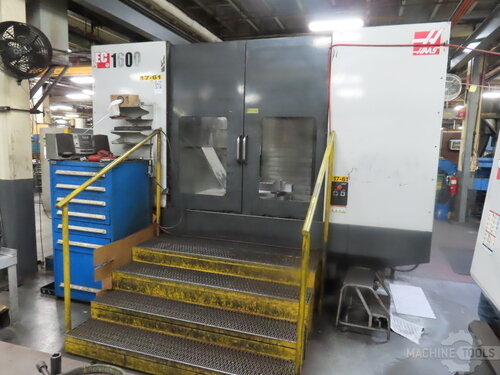
HAAS - EC1600
VIEW MACHINE -
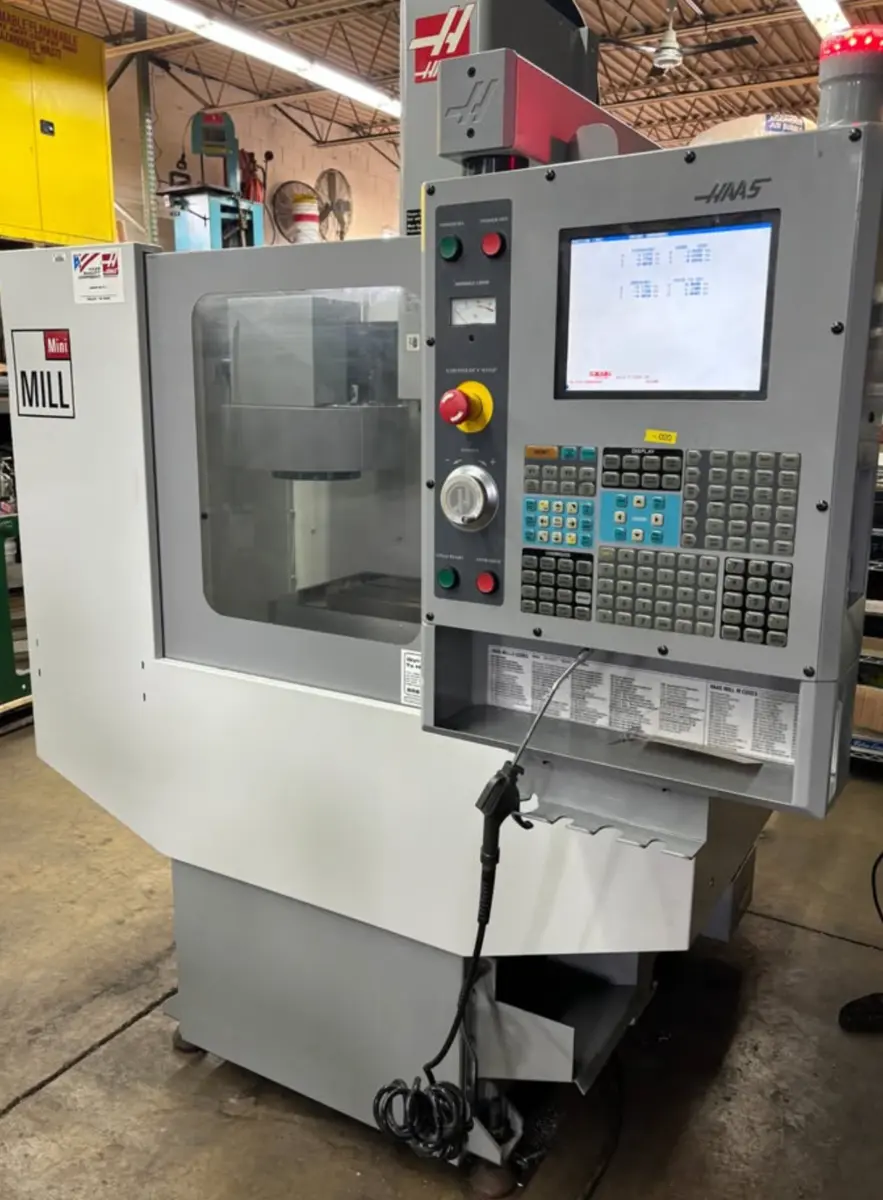
HAAS - MINI MILL
VIEW MACHINE -
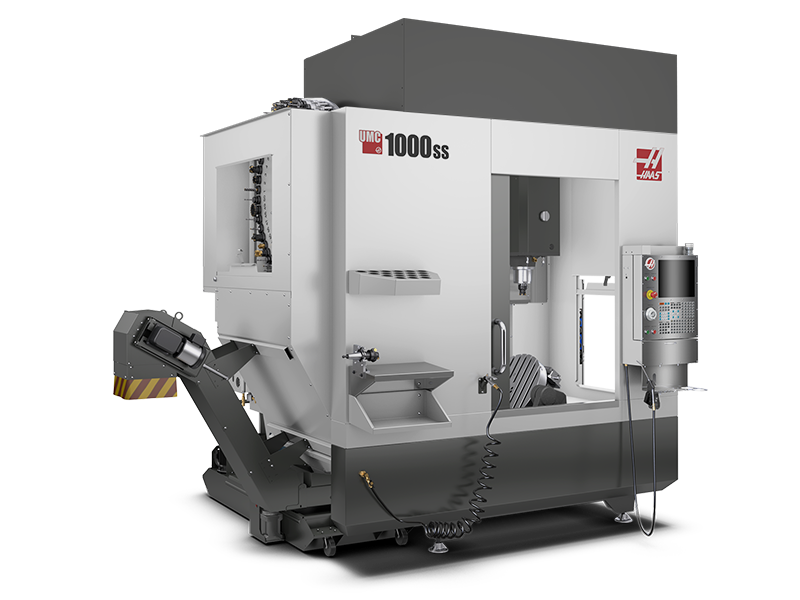
HAAS - UMC1000
VIEW MACHINE -
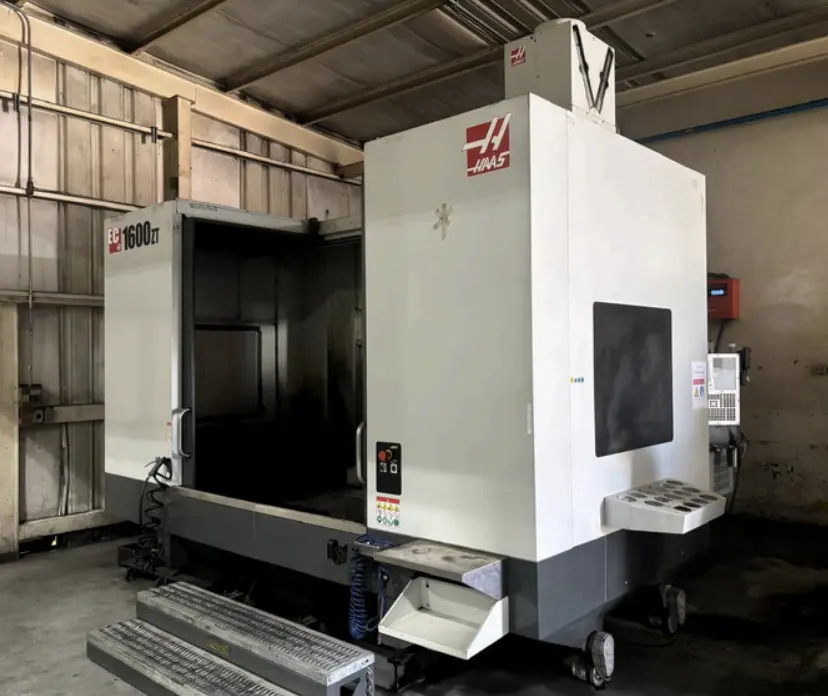
HAAS - EC1600ZT
VIEW MACHINE