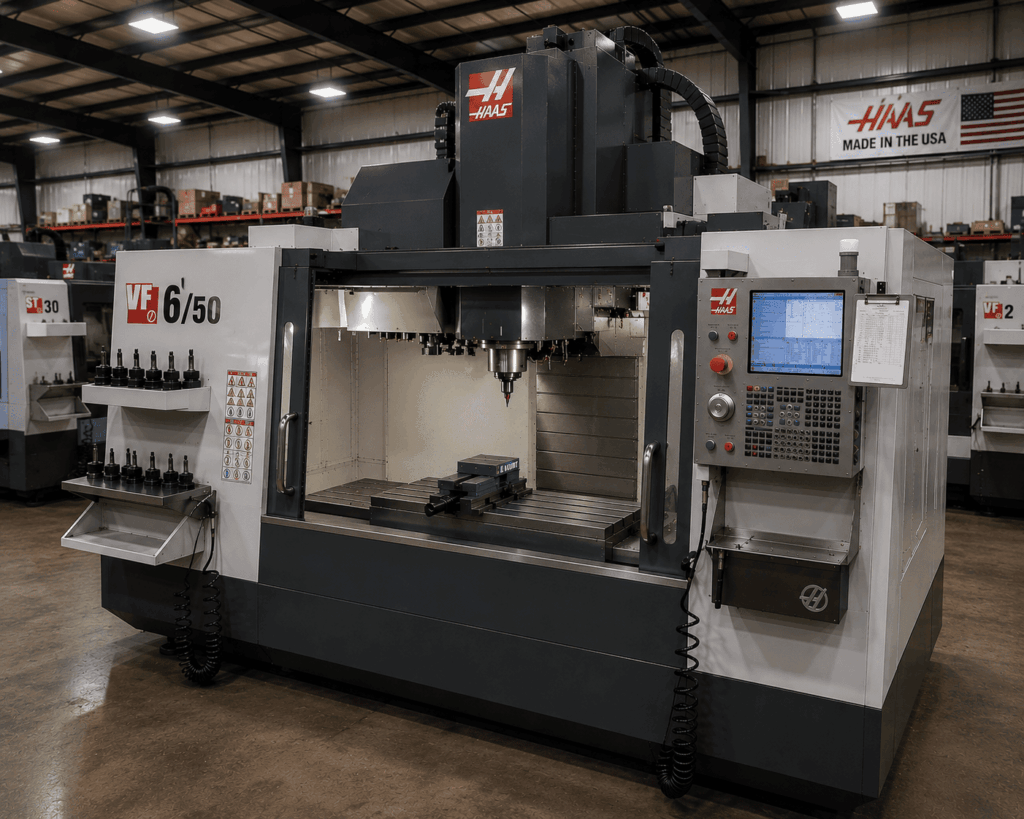
USED HAAS VF-6/50 – 2000
The 2000 Haas VF-6/50 is a heavy-duty 3-axis CNC vertical machining center (VMC) built for manufacturers that require exceptional rigidity, a large machining envelope, and the power to machine large workpieces using aggressive cutting tools. Manufactured by Haas Automation, the VF-6/50 combines the expansive travels of the VF-6 platform with a CAT 50 geared-head spindle, making it an ideal solution for heavy roughing, large-part machining, and demanding production environments. The machine is widely used in aerospace, energy, mining, heavy equipment, mold and die, oil and gas, and general industrial manufacturing where high torque and long-term reliability are essential.
Built on a heavily ribbed cast-iron structure, the Haas VF-6/50 provides outstanding rigidity, vibration damping, and thermal stability during extended machining cycles. The machine offers an impressive 64 inches of X-axis travel, 32 inches of Y-axis travel, and 30 inches of Z-axis travel, allowing manufacturers to machine large plates, structural components, machine bases, and oversized fixtures in a single setup. The machine features a 30 HP (22.4 kW) CAT 50 spindle driven through a 2-speed gearbox, producing up to 340 ft-lb (460 Nm) of torque and a maximum spindle speed of 7,500 RPM. This high-torque spindle is specifically designed for heavy milling, deep drilling, large-diameter face milling, and machining difficult materials such as stainless steel, alloy steel, cast iron, titanium, and Inconel.
The 2000 model is commonly equipped with the Classic Haas CNC Control, providing intuitive G-code programming, rigid tapping, programmable coolant, and dependable production performance. A 30+1 side-mount automatic tool changer accommodates larger CAT 50 tooling while minimizing tool change times and maximizing spindle utilization. Standard features typically include a chip auger, flood coolant system, programmable coolant nozzle, and a large coolant tank, while optional equipment such as fourth-axis rotary tables, probing systems, chip conveyors, and through-spindle coolant further expand the machine’s production capabilities.
The Haas VF-6/50 is widely utilized in industries requiring the machining of large, heavy, and precision components. Typical applications include aerospace structural parts, hydraulic manifolds, machine bases, mold plates, die components, energy equipment, transmission housings, fabrication tooling, heavy fixtures, and large production parts. Its combination of long-axis travels, high spindle torque, and rugged construction makes it one of the most capable large-frame vertical machining centers in the Haas lineup.
Purchasing a used 2000 Haas VF-6/50 provides manufacturers with industrial-grade machining capability at a significantly lower investment than buying new equipment. Haas machines are recognized for their dependable reliability, readily available replacement parts, user-friendly controls, and economical maintenance. A well-maintained VF-6/50 continues to deliver excellent machining accuracy, heavy-duty cutting performance, and long service life, making it a highly desirable machine in the used CNC equipment market.
HAAS VF-6/50 – 2000 SPECIFICATIONS
Axis
| Specification | Value |
|---|---|
| Machine Type | Vertical Machining Center (VMC) |
| Controlled Axes | 3 Axes |
| X-Axis Travel | 64.0 in (1,626 mm) |
| Y-Axis Travel | 32.0 in (813 mm) |
| Z-Axis Travel | 30.0 in (762 mm) |
Travels / Work Envelope
| Specification | Value |
|---|---|
| X Travel | 64.0 in (1,626 mm) |
| Y Travel | 32.0 in (813 mm) |
| Z Travel | 30.0 in (762 mm) |
| Spindle Nose to Table | 5.0–35.0 in (127–889 mm) |
Table
| Specification | Value |
|---|---|
| Table Size | 64 × 28 in (1,626 × 711 mm) |
| Maximum Table Load | 4,000 lbs (1,814 kg) |
| Number of T-Slots | 5 |
| T-Slot Width | 0.625 in (16 mm) |
Spindle
| Specification | Value |
|---|---|
| Spindle Taper | CAT 50 |
| Maximum Spindle Speed | 7,500 RPM |
| Spindle Motor | 30 HP (22.4 kW) Vector Drive |
| Maximum Torque | 340 ft-lb (460 Nm) @ 700 RPM |
| Drive Type | 2-Speed Gearbox |
Tool Changer
| Specification | Value |
|---|---|
| Tool Changer Type | Side-Mount Automatic Tool Changer |
| Tool Capacity | 30+1 Tools |
| Maximum Tool Diameter | 4.0 in (102 mm) |
| Maximum Tool Diameter (Adjacent Pockets Empty) | 10.0 in (254 mm) |
| Maximum Tool Length | 16.0 in (406 mm) |
| Maximum Tool Weight | 30 lbs (13.6 kg) |
| Tool-to-Tool Time | Approx. 4.2 sec |
| Chip-to-Chip Time | Approx. 6.3 sec |
CNC Control
| Specification | Value |
|---|---|
| CNC Control | Classic Haas Control |
| Programming | ISO G-Code |
| Rigid Tapping | Standard |
| Communication | RS-232 |
Coolant / Chip Management
| Specification | Value |
|---|---|
| Coolant System | Flood Coolant |
| Coolant Tank Capacity | 95 gal (360 L) |
| Chip Removal | Standard Chip Auger |
| Chip Conveyor | Optional |
| Programmable Coolant Nozzle | Standard |
Power Requirements
| Specification | Value |
|---|---|
| Electrical Supply | 220V or 440V, 3-Phase |
| Connected Load | Approx. 30 kVA |
| Pneumatic Supply | 80–100 PSI (5.5–6.9 bar) |
Dimensions
| Specification | Value |
|---|---|
| Floor Space | Approx. 195 × 102 in (4,953 × 2,591 mm) |
| Machine Height | Approx. 131.5 in (3,340 mm) |
| Machine Weight | Approx. 25,500 lbs (11,567 kg) |
General Information
| Specification | Value |
|---|---|
| Manufacturer | Haas Automation |
| Model | VF-6/50 |
| Year | 2000 |
| Machine Category | Vertical Machining Center |
| Materials Machined | Steel, Stainless Steel, Cast Iron, Titanium, Inconel, Aluminum, Brass, Engineering Plastics |
| Typical Applications | Aerospace Structures, Machine Bases, Mold Plates, Heavy Fixtures, Hydraulic Manifolds, Energy Equipment, Large Precision Components |
HOW MUCH DOES A USED HAAS VF-6/50 – 2000 COST?
A used 2000 Haas VF-6/50 typically sells for $45,000 to $85,000 USD, depending on spindle hours, overall machine condition, maintenance history, tooling package, and optional equipment such as through-spindle coolant, fourth-axis rotary table, chip conveyor, probing systems, or high-pressure coolant. Machines with documented service records, low operating hours, and factory-installed options generally command higher resale values due to their production readiness and remaining service life.
Before purchasing a used Haas VF-6/50, buyers should inspect the gearbox, spindle bearings, ballscrews, guideways, lubrication system, tool changer operation, and overall machine geometry. A properly maintained VF-6/50 offers exceptional long-term value by combining a massive work envelope with high-torque machining performance, making it an outstanding investment for manufacturers producing large, precision-machined components.
HAAS VF-6/50 VS HAAS VF-5/50 – WHICH ONE TO BUY?
The Haas VF-6/50 and Haas VF-5/50 are heavy-duty CNC vertical machining centers designed for manufacturers requiring large work envelopes, powerful cutting capability, and high rigidity for demanding machining applications. Both machines are part of the Haas VF Series and feature Haas CNC control technology, rigid cast-iron construction, CAT50 spindle tooling, automatic tool changer capability, and robust machining performance. The primary difference between these two models is size and machining capacity, with the Haas VF-6/50 providing increased axis travels and a larger work envelope compared with the VF-5/50.
The Haas VF-5/50 is designed for manufacturers requiring heavy-duty machining capability in a compact footprint. Its CAT50 spindle provides excellent rigidity and torque, making it suitable for aggressive cutting operations, large cutters, harder materials, and industrial production applications. It is widely used in aerospace, automotive, energy, mold making, and general manufacturing industries.
The Haas VF-6/50 expands on the VF-5/50 platform by offering additional machining capacity for larger components. Its extended travels allow manufacturers to machine larger plates, fixtures, molds, housings, structural components, and industrial parts while maintaining Haas accuracy and reliability.
Both machines deliver strong cutting performance and dependable operation. The VF-5/50 is ideal for shops requiring heavy-duty machining capability with moderate-size components, while the VF-6/50 is better suited for manufacturers working with larger workpieces and more complex setups.
For businesses that frequently machine oversized components or expect future growth, the Haas VF-6/50 is often the better investment because the larger work envelope provides additional flexibility and reduces setup limitations.
HAAS VF-6/50 SPINDLE NOT TURNING – CAUSES AND TROUBLESHOOTING
If the spindle on a Haas VF-6/50 does not turn, the problem may be caused by spindle drive faults, electrical issues, machine safety conditions, lubrication failures, cooling system problems, or CNC programming errors. Because the VF-6/50 uses a heavy-duty CAT50 spindle designed for demanding cutting operations, proper troubleshooting is important to prevent extended downtime.
Begin by checking the Haas CNC control for active alarms. Emergency stop activation, open enclosure doors, spindle drive alarms, lubrication warnings, servo faults, thermal overload conditions, or tool changer problems can prevent spindle operation. Clear all alarms and verify that the machine is ready before attempting spindle startup.
Inspect the spindle drive system for electrical problems. Loose wiring connections, damaged encoder cables, faulty spindle amplifiers, blown fuses, overheating conditions, or spindle motor overloads can prevent spindle rotation. Confirm spindle lubrication, cooling systems, compressed air supply, coolant flow, and machine power because these systems are critical for protecting the spindle assembly.
Review the CNC program and setup conditions. Incorrect M03 or M04 spindle commands, improper RPM settings, spindle orientation problems, interrupted tool changes, or incorrect machining parameters may prevent spindle operation. If maintenance, software updates, or parameter changes were recently performed, verify spindle-related settings.
If the spindle attempts to start but stops immediately, inspect mechanical components including spindle bearings, CAT50 tool holders, spindle taper cleanliness, drawbar operation, and excessive cutting forces. Vibration, overheating, or abnormal spindle noise may indicate spindle wear or mechanical damage.
Regular spindle inspections, proper lubrication, electrical cabinet maintenance, and preventive service reduce unexpected spindle failures. If spindle alarms remain active after basic troubleshooting, professional Haas diagnostics should be performed.
HAAS VF-6/50 MAINTENANCE AND PREVENTIVE CARE GUIDE
The Haas VF-6/50 is a large-capacity CNC vertical machining center designed for heavy-duty manufacturing applications. Due to its CAT50 spindle system, increased machining envelope, and powerful cutting capability, regular preventive maintenance is essential for maintaining accuracy, reliability, and long-term performance.
Daily maintenance should include removing chips from the enclosure, spindle taper, tool changer, table, and guideways. Operators should inspect coolant levels, coolant concentration, lubrication oil levels, compressed air supply, spindle cleanliness, and tool holder condition before starting production. Proper cleaning prevents contamination and protects critical machine components.
Weekly maintenance should include cleaning electrical cabinet filters, inspecting coolant pumps, coolant nozzles, chip removal systems, automatic lubrication systems, spindle air purge systems, and tool changer operation. Guideways, covers, and moving components should be checked for smooth operation.
Monthly inspections should focus on spindle runout, tool retention force, CAT50 tool holder condition, ball screws, linear guideways, encoder cables, electrical connections, coolant filtration systems, lubrication lines, and machine leveling. Coolant tanks should be cleaned regularly to prevent contamination that affects tool life and surface finish.
Additional preventive maintenance includes monitoring spindle vibration, checking axis backlash, inspecting spindle bearings, replacing filters, maintaining lubrication systems, and verifying machine geometry. Detailed maintenance records allow operators to identify potential problems before they become major repairs.
A consistent maintenance program improves spindle life, cutting performance, machining accuracy, and production efficiency. The Haas VF-6/50 is built for demanding industrial machining environments, and proper preventive care ensures reliable performance throughout its service life.
FAQ
What is the Haas VF-6/50?
The Haas VF-6/50 is a heavy-duty CNC vertical machining center designed for manufacturers requiring large machining capacity, powerful cutting performance, and increased rigidity. It features a CAT50 spindle system, rigid cast-iron construction, Haas CNC control, automatic tool changer, and extended axis travels for machining large components.
The VF-6/50 is widely used in aerospace, automotive, energy, defense, industrial equipment, mold making, and heavy manufacturing industries. It is suitable for producing large fixtures, molds, housings, structural components, plates, and precision industrial parts requiring strong cutting capability and accurate machining.
The CAT50 spindle provides improved tool holding strength and rigidity compared with smaller tooling systems, allowing the machine to handle aggressive cutting operations and difficult materials. Its combination of size, power, and Haas reliability makes it a valuable solution for manufacturers requiring high-performance vertical machining.
What are the most common problems with the Haas VF-6/50?
The most common problems with the Haas VF-6/50 include spindle alarms, automatic tool changer faults, lubrication system warnings, encoder errors, servo drive alarms, coolant contamination, spindle orientation issues, drawbar problems, CAT50 tool retention issues, electrical communication faults, and axis positioning errors.
Because the VF-6/50 is designed for heavy-duty machining, problems may occur due to excessive cutting loads, insufficient lubrication, coolant contamination, improper tooling, component wear, or lack of preventive maintenance.
Regular spindle inspections, lubrication checks, coolant management, electrical inspections, proper tooling practices, and scheduled maintenance help reduce downtime and maintain reliable machine performance.
Related Products
-
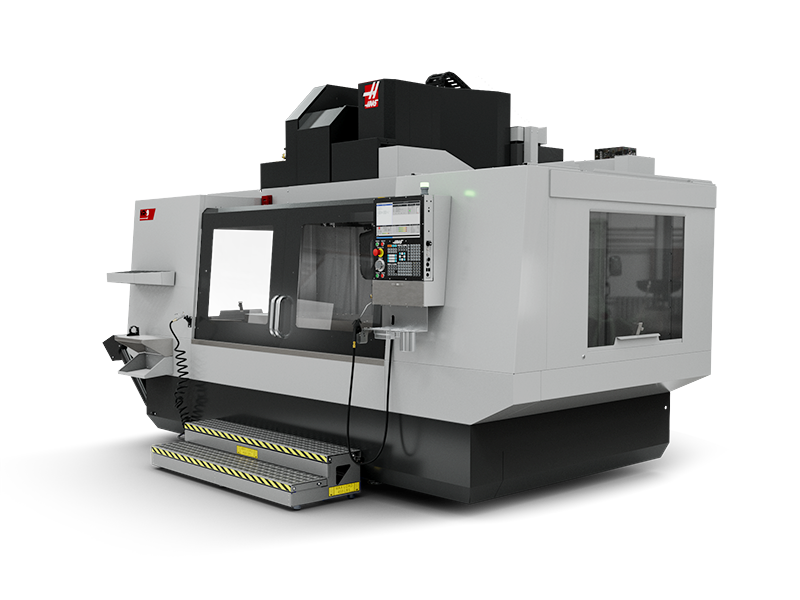
HAAS - VR9
VIEW MACHINE -
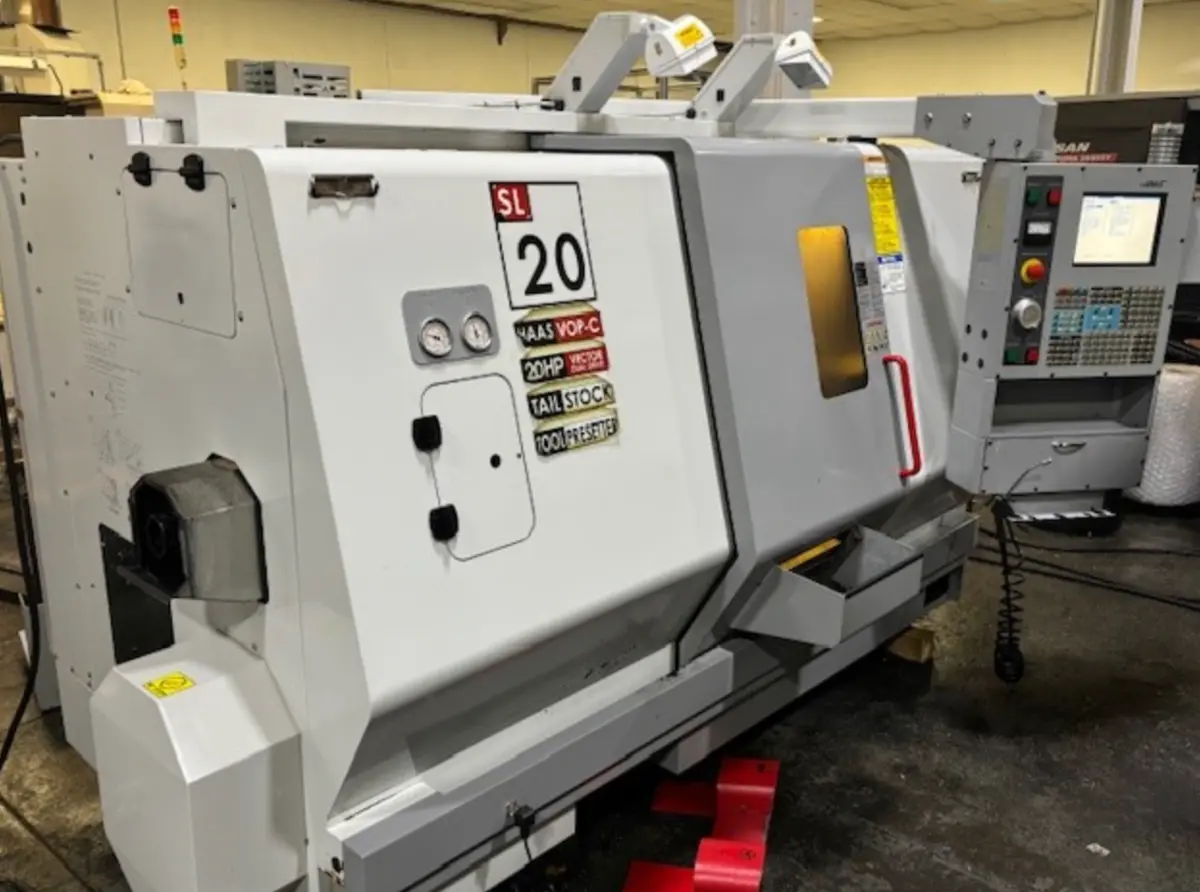
HAAS - SL20T
VIEW MACHINE -
HAAS - VF3
VIEW MACHINE -
HAAS - VF2SS
VIEW MACHINE