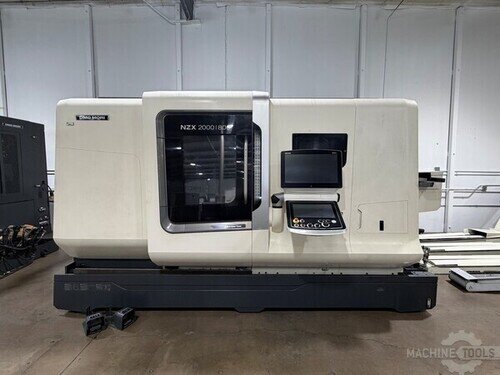
DMG MORI NZX2000/800SY – 2015
USED DMG MORI NZX2000/800SY – 2015
The 2015 DMG MORI NZX2000/800SY is a high-performance CNC horizontal turning center developed for manufacturers that require precision turning, milling, and multi-axis machining in a single production platform. Combining a main spindle, subspindle, Y-axis machining, and driven tooling, this machine is suited to complex components that would otherwise require several separate machining operations. Its dual-spindle design allows workpieces to be transferred between spindles, providing opportunities to machine multiple sides of a component while reducing manual handling and setup time.
The NZX2000/800SY belongs to DMG MORI’s NZX family of horizontal production turning machines. The model designation identifies the NZX 2000 platform with an approximately 800 mm class of turning length. The SY configuration adds a subspindle and Y-axis machining capability, expanding the range of operations that can be completed with the machine. The precise combination of axes, spindle specifications, and tooling features should be confirmed against the machine’s original build sheet.
A key advantage of the NZX2000/800SY is its ability to combine turning and milling in one setup. With suitable driven tools, operators can perform drilling, tapping, cross-hole machining, and other milling operations without transferring the workpiece to a separate machining center. This is particularly useful for components with intersecting features, flats, slots, and precision features located at different angular positions.
The dual-spindle arrangement supports machining on both ends of a part. After the main spindle completes its operations, the subspindle can receive the component and support additional machining on the opposite end. This approach can reduce secondary operations, improve consistency between features, and shorten the overall production route for suitable parts.
The Y-axis allows the machine to move cutting tools away from the spindle centerline, enabling more flexible milling and drilling operations. Combined with C-axis positioning and live tooling, this capability supports the manufacture of parts with off-center holes, milled surfaces, and other features that are difficult to produce using a conventional two-axis CNC lathe.
The machine is suited to production environments where repeatability, reduced cycle time, and reliable process control are important. Potential applications include automotive components, hydraulic and pneumatic parts, industrial machinery components, precision shafts, fittings, and complex turned parts for general manufacturing. Actual productivity depends on the workpiece material, cutting tools, program strategy, tooling package, and condition of the individual machine.
A documented 2015 NZX2000/800SY was equipped with a FANUC 31i-B CNC control, 8-inch main and subspindle chucks, 16-position turrets, high-pressure coolant, a chip conveyor, and an IEMCA KID 80 bar feeder. The listing also specified high-torque spindle options and Renishaw tool probes. These features describe that particular machine, not necessarily every NZX2000/800SY built in 2015.
For manufacturers evaluating a used CNC turning center, the NZX2000/800SY offers a combination of turning capacity, multi-axis flexibility, and production-oriented features. Buyers should inspect spindle condition, turret indexing, axis accuracy, subspindle synchronization, live-tool operation, control functionality, and included accessories before making a purchasing decision.
DMG MORI NZX2000/800SY – AXIS
The NZX2000/800SY is a multi-axis CNC turning center rather than a conventional two-axis lathe. Its main spindle, subspindle, X- and Z-axis movements, Y-axis capability, and C-axis positioning allow it to perform multiple machining operations with coordinated motion. A documented 2015 machine listing identifies eight axes, although axis count and control configuration should be checked against the specific machine.
| Specification | Details |
|---|---|
| Machine Type | CNC horizontal multi-axis turning center |
| Main Spindle | Yes |
| Subspindle | Yes |
| Main Spindle X-Axis | Approximately 210 mm / 8.2 inches |
| Second X-Axis | Approximately 210 mm / 8.2 inches |
| Y-Axis | Approximately 110 mm / 4.3 inches |
| Y-Axis Range | Approximately +65 mm / −45 mm in one documented configuration |
| Main Z-Axis | Configuration dependent |
| Second Z-Axis | Approximately 810 mm / 31.8 inches on documented machine |
| Subspindle Travel / B-Axis | Approximately 870 mm / 34.2 inches |
| C-Axis | Main and subspindle positioning; documented indexing resolution 0.001° |
| Live Tooling | Yes, on the documented SY configuration |
| Axis Count | Eight axes reported for a documented 2015 machine |
| Simultaneous Machining | Configuration and programming dependent |
DMG MORI NZX2000/800SY – AXIS TRAVELS / WORK ENVELOPE
The NZX2000/800SY is designed to machine medium-sized turned components, including parts requiring operations on both ends. Its published platform specifications include a maximum turning diameter of approximately 320 mm and a maximum turning length of approximately 810 mm. The usable cutting envelope depends on tool interference, chuck size, workholding, and the arrangement of the turrets and spindles.
| Specification | Details |
|---|---|
| Swing Over Bed | Approximately 800 mm / 31.5 inches |
| Maximum Turning Diameter | Approximately 320 mm / 12.5 inches |
| Standard Turning Diameter | Approximately 200 mm / 7.9 inches, platform reference |
| Maximum Turning Length | Approximately 810 mm / 31.8 inches |
| Maximum Workpiece Delivery Diameter | Approximately 300 mm / 11.8 inches |
| X-Axis Travel | Approximately 210 mm / 8.2 inches |
| Second X-Axis Travel | Approximately 210 mm / 8.2 inches |
| Y-Axis Travel | Approximately 110 mm / 4.3 inches |
| Main Z-Axis Travel | Verify the individual machine configuration |
| Second Z-Axis Travel | Approximately 810 mm / 31.8 inches on documented machine |
| Subspindle Travel | Approximately 870 mm / 34.2 inches |
| Bar Capacity | Approximately 65 mm / 2.5 inches |
| Work Envelope | Depends on tooling, chuck, and machining configuration |
DMG MORI NZX2000/800SY – CAPACITY / WORKHOLDING
Workholding on the NZX2000/800SY is designed for production turning, with the main spindle holding the initial workpiece and the subspindle supporting transfer and secondary-end machining. An 8-inch chuck configuration is documented for both spindles on a 2015 machine. The appropriate chuck, collet system, and gripping arrangement depend on the material, part geometry, and production requirements.
| Specification | Details |
|---|---|
| Main Spindle Chuck Size | 8 inches on documented machine |
| Subspindle Chuck Size | 8 inches on documented machine |
| Swing Over Bed | Approximately 31.5 inches |
| Maximum Turning Diameter | Approximately 12.5 inches |
| Maximum Turning Length | Approximately 31.8 inches |
| Bar Work Capacity | Approximately 2.5 inches / 65 mm |
| Main Spindle Nose | A2-8 on documented machine |
| Subspindle Nose | A2-6 on documented machine |
| Chuck Manufacturer | Kitagawa on documented machine |
| Main Chuck | Kitagawa BB208 three-jaw hydraulic chuck on documented machine |
| Subspindle Chuck | Kitagawa BB208 three-jaw hydraulic chuck on documented machine |
| Collet Chucks | Hainbuch Spanntop Nova 65 collet chucks included with one documented machine |
| Maximum Workpiece Size | Depends on chucking, tooling, and interference limits |
| Steady Rest | Verify availability and configuration |
| Tailstock | No tailstock listed for the documented machine |
| Bar Feeder Compatibility | Supported with suitable bar-feeding equipment |
DMG MORI NZX2000/800SY – SPINDLE
The main spindle and subspindle enable the machine to process components from both ends. This arrangement is particularly valuable for parts that require front-end turning, rear-end machining, and multiple milling or drilling features. Spindle performance must be evaluated in relation to the material being machined, the required surface finish, tool geometry, and the machine’s actual spindle condition.
A documented 2015 NZX2000/800SY includes high-torque spindle options rated at approximately 34 hp for both the main spindle and subspindle. The published machine information also identifies different spindle noses for the two spindles. Buyers should confirm the spindle speed ranges and motor ratings on the actual machine because spindle specifications can vary with options and regional configuration.
| Specification | Details |
|---|---|
| Main Spindle | CNC-controlled horizontal spindle |
| Subspindle | Yes |
| Main Spindle Motor | Approximately 34 hp with high-torque option on documented machine |
| Subspindle Motor | Approximately 34 hp with high-torque option on documented machine |
| Main Spindle Nose | A2-8 on documented machine |
| Subspindle Nose | A2-6 on documented machine |
| Main Chuck | 8 inches on documented machine |
| Subspindle Chuck | 8 inches on documented machine |
| Main Spindle Speed | Verify exact installed specification |
| Subspindle Speed | Verify exact installed specification |
| C-Axis Capability | Yes, configuration dependent |
| Spindle Synchronization | Verify control and installed options |
| Bar Capacity | Approximately 65 mm / 2.5 inches |
| Spindle Condition | Inspect runout, bearings, noise, vibration, and temperature |
| Spindle Options | High-torque specification reported on documented machine |
DMG MORI NZX2000/800SY – TOOL CHANGER / TURRETS
The NZX2000/800SY uses turret-based tooling rather than a conventional vertical machining center’s automatic tool magazine. Its turrets can accommodate stationary turning tools and driven tooling, allowing turning and milling operations to be performed within the same machine. A documented 2015 example has two turrets with 16 tool positions each.
Driven tooling is particularly useful for parts that require cross-drilling, radial holes, flats, slots, and other non-turning features. The exact number of driven stations, tooling interface, and available power should be verified before purchasing the machine.
| Specification | Details |
|---|---|
| Turret Configuration | Dual turret on documented machine |
| Turret Capacity | 16 positions per turret on documented machine |
| Total Listed Turret Positions | 16/16 |
| Driven Tooling | Yes |
| Maximum Driven Tool Speed | Up to 12,000 RPM on documented machine |
| Driven Tool Motor | Approximately 10 hp on documented machine |
| Turret Indexing | CNC-controlled |
| Turning Tool Compatibility | Depends on installed holders and turret specification |
| Milling Tool Compatibility | Depends on driven-tool interface |
| Toolholder System | Verify installed turret and BMT specification |
| Automatic Tool Magazine | Not a conventional machining-center tool changer |
| Tool Probes | Renishaw tool probes included with one documented machine |
| Tooling Package | Verify included holders, live tools, and accessories |
| Turret Condition | Inspect indexing repeatability, clamping, and driven-tool operation |
DMG MORI NZX2000/800SY – CONTROL SYSTEM
The CNC control manages the machine’s multi-axis movements, spindle coordination, turret operations, tool offsets, and machining programs. A FANUC 31i-B control is documented on a 2015 NZX2000/800SY. The control’s installed software, machine-builder functions, and optional cycles should be verified on the specific unit.
For multi-axis turning, control familiarity and programming capability are important purchasing considerations. Operators should be comfortable with spindle synchronization, subspindle transfer, C-axis positioning, driven-tool programming, and the coordination of multiple turrets where applicable.
| Specification | Details |
|---|---|
| CNC Control | FANUC 31i-B on documented 2015 machine |
| Control Type | CNC multi-axis turning control |
| Machine Interface | Depends on installed control and software |
| Main Spindle Control | Yes |
| Subspindle Control | Yes |
| X-Axis and Z-Axis Control | Yes |
| Y-Axis Control | Yes |
| C-Axis Control | Configuration dependent |
| Live Tool Programming | Supported when corresponding options are installed |
| Subspindle Transfer Functions | Verify installed cycles and options |
| Tool Offset Management | CNC-controlled |
| Work Coordinate Management | CNC-controlled |
| Programming | Verify available conversational cycles and software |
| Network Connectivity | Verify Ethernet, data transfer, and installed interfaces |
| Control Condition | Check alarms, battery status, backups, and parameter documentation |
DMG MORI NZX2000/800SY – COOLANT / CHIP MANAGEMENT
Coolant delivery and chip removal are important for a production turning center with dual spindles and driven tooling. Suitable coolant flow helps manage cutting temperatures, supports tool life, and removes chips from the work area. High-pressure coolant is especially useful for demanding drilling operations and materials that generate difficult chips.
A documented machine was equipped with two 300 psi high-pressure coolant systems, chuck and way-cover flushing, and a hinge-type chip conveyor. These accessories can be valuable in continuous production, but buyers should verify that they are present, operational, and suitable for the materials being machined.
| Specification | Details |
|---|---|
| Coolant System | Installed coolant system; exact configuration to verify |
| High-Pressure Coolant | Two 300 psi systems listed on documented machine |
| Coolant Delivery | Verify through-tool and external delivery options |
| Chuck Flushing | Listed on documented machine |
| Way-Cover Flushing | Listed on documented machine |
| Chip Conveyor | Hinge-type chip conveyor listed on documented machine |
| Chip Removal | Conveyor and enclosure configuration dependent |
| Coolant Tank Capacity | Verify individual machine |
| Coolant Filtration | Verify installed filtration system |
| Coolant Maintenance | Check concentration, contamination, pumps, and filtration |
| Chip Handling | Depends on workpiece material and chip morphology |
| Coolant Condition | Inspect pumps, hoses, nozzles, and high-pressure system |
| Optional Accessories | Confirm any additional filtration or coolant equipment |
DMG MORI NZX2000/800SY – POWER REQUIREMENTS
The electrical requirements of the NZX2000/800SY depend on its spindle configuration, live-tool motors, coolant systems, bar feeder, and other installed accessories. A 2015 NZX2000/800SY2 listing reports a total power requirement of approximately 95 kVA, but this should not automatically be applied to every NZX2000/800SY variant.
Before installation, the buyer should obtain the machine’s electrical nameplate and original installation documentation. The facility must have suitable electrical capacity, grounding, protection, and connections for the specific machine and its accessories.
| Specification | Details |
|---|---|
| Electrical Supply | Verify machine nameplate |
| Total Power Requirement | Approximately 95 kVA reported for a related 2015 SY2 configuration; verify exact model |
| Phase | Verify machine nameplate |
| Voltage | Verify machine nameplate and regional configuration |
| Frequency | Verify machine nameplate |
| Main Spindle Power | Approximately 34 hp with high-torque option on documented machine |
| Subspindle Power | Approximately 34 hp with high-torque option on documented machine |
| Driven Tool Motor | Approximately 10 hp on documented machine |
| Coolant System Load | Depends on installed pumps and high-pressure systems |
| Bar Feeder Power | Depends on the installed feeder |
| Chip Conveyor Power | Verify individual accessory |
| Installation Requirements | Confirm with qualified electrical personnel and manufacturer documentation |
DMG MORI NZX2000/800SY – DIMENSIONS
The NZX2000/800SY is an industrial production turning center with an enclosed work area, dual-spindle arrangement, turrets, and chip-handling equipment. Space planning should account for the machine itself as well as service access, loading and unloading, chip conveyor discharge, bar feeder length, and maintenance clearance.
The documented 2015 machine listing gives dimensions of approximately 173 × 112 × 92 inches and a weight of 18,500 pounds. These figures relate to that specific machine and may not include every accessory or optional peripheral.
| Specification | Details |
|---|---|
| Machine Length | Approximately 173 inches on documented machine |
| Machine Width | Approximately 112 inches on documented machine |
| Machine Height | Approximately 92 inches on documented machine |
| Machine Weight | Approximately 18,500 lb on documented machine |
| Bar Feeder Space | Additional space may be required |
| Chip Conveyor Space | Depends on conveyor arrangement |
| Service Clearance | Confirm manufacturer installation requirements |
| Shipping Dimensions | Verify with seller and rigging contractor |
| Foundation Requirements | Confirm machine documentation |
| Rigging Requirements | Professional industrial machinery rigging recommended |
DMG MORI NZX2000/800SY – GENERAL INFORMATION
| Specification | Details |
|---|---|
| Manufacturer | DMG MORI |
| Model | NZX2000/800SY |
| Year | 2015 |
| Machine Category | CNC horizontal multi-axis turning center |
| Primary Function | Turning, milling, drilling, and secondary-end machining |
| Machine Configuration | Dual spindle with Y-axis and driven tooling |
| Number of Axes | Eight reported for documented machine |
| CNC Control | FANUC 31i-B on documented machine |
| Main Chuck | 8 inches on documented machine |
| Subspindle Chuck | 8 inches on documented machine |
| Turrets | Two, 16 positions each on documented machine |
| Driven Tool Speed | Up to 12,000 RPM on documented machine |
| Bar Feeder | IEMCA KID 80 listed on documented machine |
| Coolant | High-pressure coolant system listed |
| Chip Conveyor | Hinge-type conveyor listed |
| Tool Probes | Renishaw probes listed |
| High-Torque Spindles | Listed on documented machine |
| Hobbing Software | Main-spindle hobbing software listed on documented machine |
| Machine Condition | Must be assessed for the individual unit |
| Availability | Depends on current seller inventory |
INDUSTRIES THAT USE THE DMG MORI NZX2000/800SY
Automotive Manufacturing
Automotive suppliers produce a wide range of turned components that benefit from repeatable CNC machining and efficient production cycles. Suitable parts may include shafts, hubs, fittings, precision sleeves, and other rotational components. Dual-spindle machining can reduce the number of separate operations required for components that need machining on both ends.
Aerospace Component Manufacturing
Aerospace suppliers often machine precision components from aluminum alloys, stainless steels, and other engineered materials. The NZX2000/800SY can be suitable for cylindrical components and parts requiring turning combined with cross-holes, milled flats, and other features. Actual suitability depends on material specifications, required tolerances, quality procedures, and the machine’s verified accuracy.
Hydraulic and Pneumatic Equipment
Hydraulic and pneumatic manufacturers produce fittings, valve bodies, adapters, sleeves, and precision connectors. These components may require internal bores, external threads, intersecting holes, and carefully finished sealing surfaces. Turning and driven-tool operations in one setup can help maintain feature relationships and reduce work-in-process handling.
Industrial Machinery
Manufacturers of pumps, gear systems, conveyors, and other industrial equipment need a steady supply of shafts, bushings, spacers, and machined housings. The machine’s production-oriented layout and dual-spindle configuration can support repeatable machining of suitable components across recurring production runs.
Oil and Gas Equipment
Selected oil and gas components, including connectors, sleeves, adapters, and machined fittings, can require turning operations combined with cross-drilling or milled features. The machine may be suitable for compatible part sizes and materials, subject to the required specifications, material certification, and production process.
General Precision Manufacturing
Job shops and contract manufacturers can use a multi-axis turning center to produce diverse components for multiple customers. The ability to combine turning and milling may reduce the need to move workpieces between a lathe and a separate milling machine. The economic benefit is greatest when part geometry and production volume justify the additional machine capability.
Electrical and Instrumentation Components
Precision electrical and instrumentation products may include connectors, housings, shafts, threaded fittings, and small mechanical interfaces. The NZX2000/800SY can machine suitable metal components where accurate concentric features, threads, and cross-holes are required.
High-Volume Component Production
Production departments manufacturing repeated batches can benefit from bar feeding, automatic tool indexing, subspindle transfer, and reduced operator intervention. The actual throughput depends on cycle time, material handling, tool life, setup quality, and the degree to which the machine can run unattended.
TYPICAL PARTS THE DMG MORI NZX2000/800SY CAN PRODUCE
| Part Type | Potential Machining Operations |
|---|---|
| Precision Shafts | Turning, facing, grooving, threading, and end machining |
| Hydraulic Fittings | Turning, threading, drilling, and cross-hole machining |
| Pneumatic Connectors | Turning, boring, drilling, and threading |
| Automotive Components | Turning, milling, chamfering, and secondary-end operations |
| Valve Components | Facing, boring, grooving, and cross-drilling |
| Industrial Bushings | Turning, boring, and finishing |
| Spacers and Sleeves | Facing, turning, boring, and chamfering |
| Precision Adapters | Turning, threading, and driven-tool operations |
| Pump Components | Turning, drilling, and selected milled features |
| Gear-Related Components | Turning and selected gear-related operations where supported by installed options |
| Threaded Components | External and internal threading, subject to tooling and programming |
| Bar-Stock Components | Automated production when paired with compatible bar-feeding equipment |
WHY CHOOSE THE DMG MORI NZX2000/800SY?
Multi-Axis Machining Capability
The NZX2000/800SY combines turning with Y-axis and C-axis machining capabilities. This allows suitable parts to be produced with fewer setups than may be required on a conventional lathe. Reduced handling can improve consistency and simplify the manufacturing process.
Dual-Spindle Productivity
The subspindle can receive a workpiece from the main spindle and support machining of the opposite end. This is valuable for components that require operations on both ends, helping reduce manual intervention and the need for a separate secondary-operation station.
Turning and Milling in One Machine
Driven tooling allows the machine to produce more than basic cylindrical shapes. With the appropriate tooling, it can perform drilling, tapping, milling, and other operations on compatible workpieces. This combination can be especially useful for complex components with multiple feature types.
Production-Oriented Turret Configuration
The documented two-turret arrangement with 16 positions per turret provides tooling capacity for a variety of operations. A suitable tooling layout can reduce tool-change interruptions and allow multiple operations to be completed within a production cycle.
Bar-Fed Manufacturing Potential
When configured with a compatible bar feeder, the NZX2000/800SY can support repeated machining of bar-stock components. Bar feeding can improve production efficiency for suitable part families and reduce the need for frequent manual loading.
Reduced Secondary Operations
Machining multiple features in one setup can help maintain the relationship between turned surfaces, drilled holes, and milled features. It can also reduce the time spent moving parts between machines and checking intermediate operations.
CNC Process Control
The FANUC 31i-B control documented on a 2015 machine supports coordinated CNC machining. The exact installed cycles and options should be confirmed, especially for shops planning to use complex subspindle transfers, multiple turrets, and driven tooling.
Established Industrial Application
The NZX platform is designed for precision production turning. For a buyer with compatible parts, experienced operators, and a suitable maintenance plan, a used NZX2000/800SY can provide substantial machining capability without the capital expenditure associated with purchasing a new production turning center.
WHY BUY A USED DMG MORI NZX2000/800SY?
Lower Initial Capital Investment
A used NZX2000/800SY can offer access to multi-axis turning, dual spindles, and live tooling without the cost of a new machine. The financial advantage depends on asking price, condition, tooling, installation expenses, and any repairs required before production.
Access to Advanced Turning Technology
The machine’s dual-spindle and Y-axis configuration supports machining strategies that are difficult to reproduce on a basic CNC lathe. For manufacturers with appropriate part requirements, this capability can expand production options.
Potential to Consolidate Operations
A shop currently using separate turning and milling operations may be able to consolidate some compatible work onto the NZX2000/800SY. Fewer setups and transfers can reduce handling time and help improve consistency, although the savings should be evaluated against actual cycle times and setup requirements.
Useful Production Accessories
Some used machines are sold with bar feeders, high-pressure coolant systems, chip conveyors, tool probes, and workholding. Included accessories can reduce the cost and time required to establish a production-ready cell. Buyers should confirm that each item is included in the sale and operates correctly.
Suitability for Repeat Production
The machine can be attractive to manufacturers producing recurring batches of shafts, fittings, connectors, and other turned components. When the part family matches the machine’s work envelope and tooling, the equipment can support repeatable production.
Inspection Before Purchase
A pre-purchase inspection should include spindle operation, axis movement, turret indexing, live tooling, subspindle transfer, coolant delivery, chip removal, and CNC alarm history. A test cut on a representative workpiece can help evaluate real machining performance.
Verify Service and Control Support
Before committing to a purchase, buyers should confirm the availability of qualified service technicians, replacement components, control backups, manuals, and machine-specific documentation. Maintenance records and a clear history of repairs can help assess risk.
Evaluate the Complete Installed Cost
The purchase price is only one part of acquiring a used production turning center. Freight, rigging, electrical work, foundation preparation, bar-feeder installation, tooling, coolant equipment, operator training, and initial maintenance may all contribute to the final investment.
HOW MUCH DOES A USED DMG MORI NZX2000/800SY COST?
The price of a used DMG MORI NZX2000/800SY depends on machine condition, spindle hours, maintenance history, control configuration, tooling, workholding, bar-feeding equipment, and the seller’s location. Machines with functioning dual spindles, operational live tooling, complete accessories, and documented service history may be more attractive than units requiring significant repairs or missing production equipment.
A published listing for a 2015 NZX2000/800SY identified the machine as sold, but the listing did not provide a verified completed sale price. Therefore, it should not be treated as evidence of a specific market value. A reliable estimate requires current comparable asking prices or a direct quotation for the machine being considered.
| Pricing Factor | Effect on Purchase Evaluation |
|---|---|
| Machine Condition | Wear, damage, alarms, and required repairs can significantly affect value |
| Spindle Condition | Bearing noise, vibration, runout, and temperature should be checked |
| Axis Accuracy | Backlash, positioning, repeatability, and geometry influence suitability |
| Subspindle Operation | Transfer accuracy and synchronization are important for complete-part machining |
| Live Tooling | Working driven tools and turret stations can add production value |
| CNC Control | Control condition, software, options, and serviceability affect usability |
| Bar Feeder | Included compatible equipment may reduce additional setup costs |
| Coolant Equipment | High-pressure systems and filtration should be checked for operation |
| Tooling and Chucks | Included holders, chucks, and collet systems can reduce startup costs |
| Maintenance History | Records and documented repairs help establish machine condition |
| Installation | Freight, rigging, electrical work, and commissioning add to total investment |
| Asking Price | Obtain a current written quotation from the seller |
| Final Valuation | Compare the machine’s condition and included equipment with comparable offers |
Before purchasing, request a complete specification sheet, machine serial number, control details, spindle-hour and power-on-hour records, maintenance history, accessory list, and a demonstration of the main spindle, subspindle, turrets, and driven tooling. Where possible, arrange an independent inspection and a test cut.
For a production shop, the best-value machine is not necessarily the one with the lowest asking price. A unit that includes working bar-feeding equipment, suitable chucks, tooling, probes, and high-pressure coolant may offer a better overall investment than a cheaper machine requiring extensive repairs or additional equipment. Obtain a current quote and assess the complete installed cost before making a purchasing decision.
Related Products
-
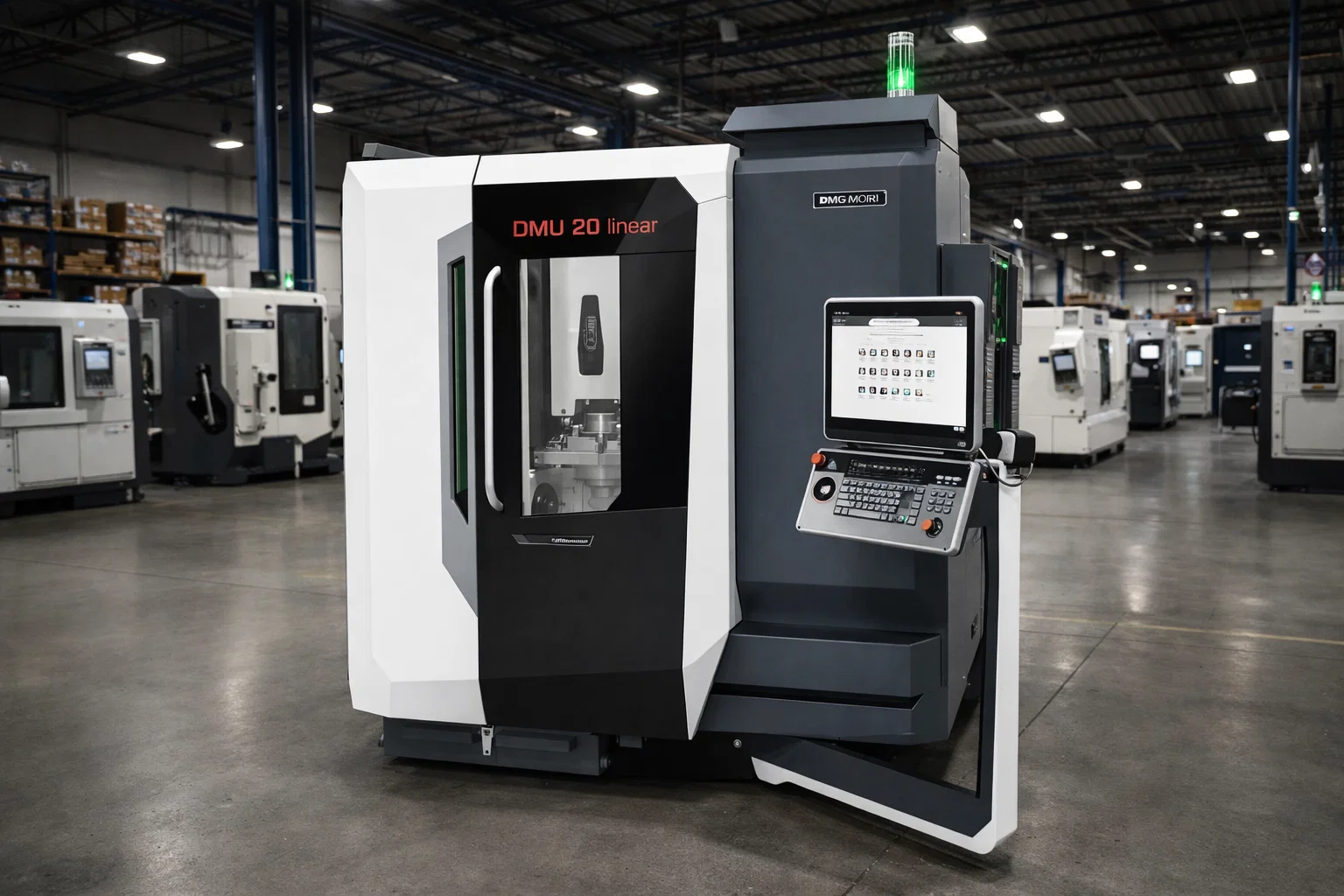
DMG MORI - DMU 20 linear
VIEW MACHINE -
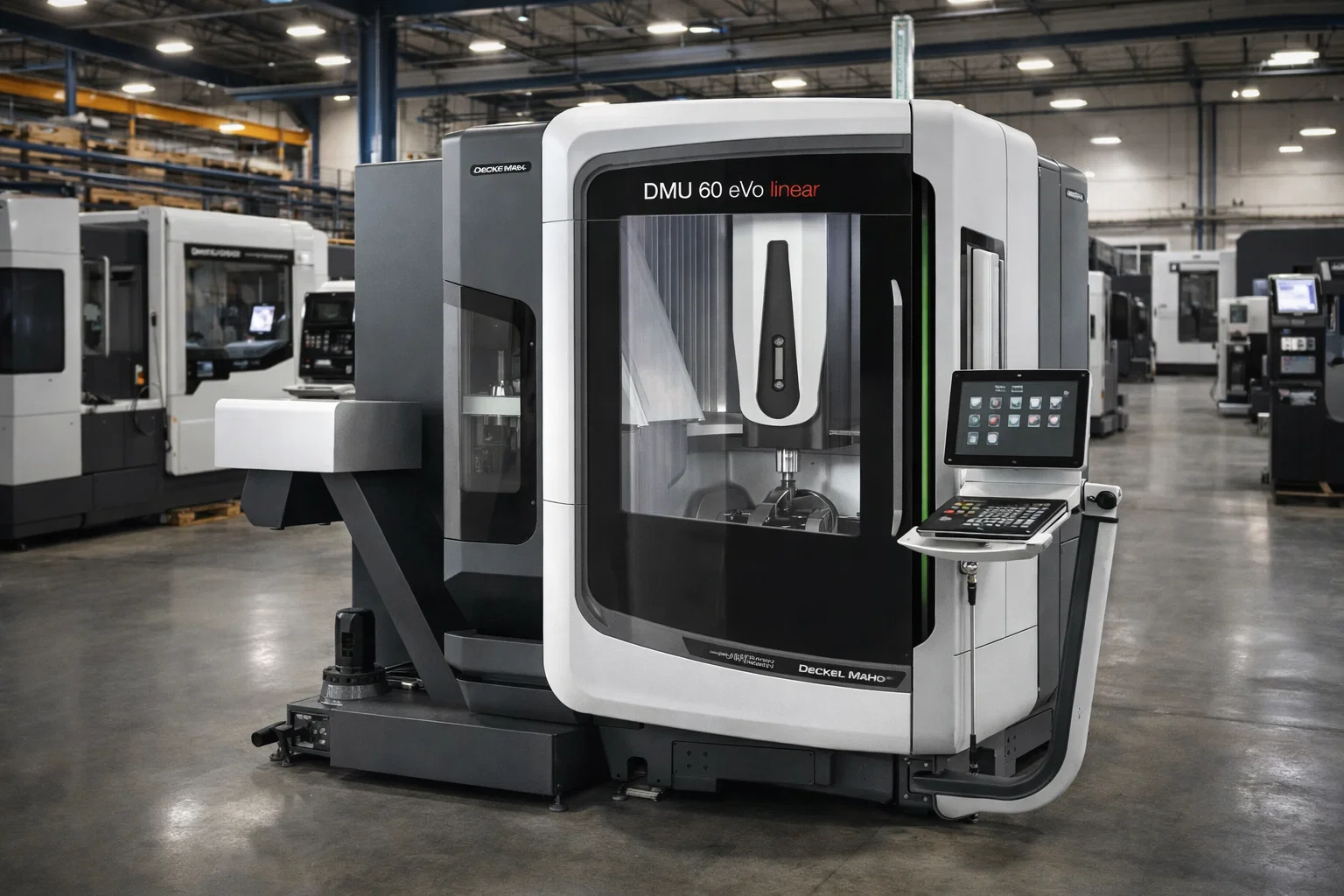
DMG MORI - DMU 60 (FD) eVo
VIEW MACHINE -
DMG MORI - WASINO A 150Y | 18
VIEW MACHINE -
DMG MORI - Vertical Mate 35
VIEW MACHINE