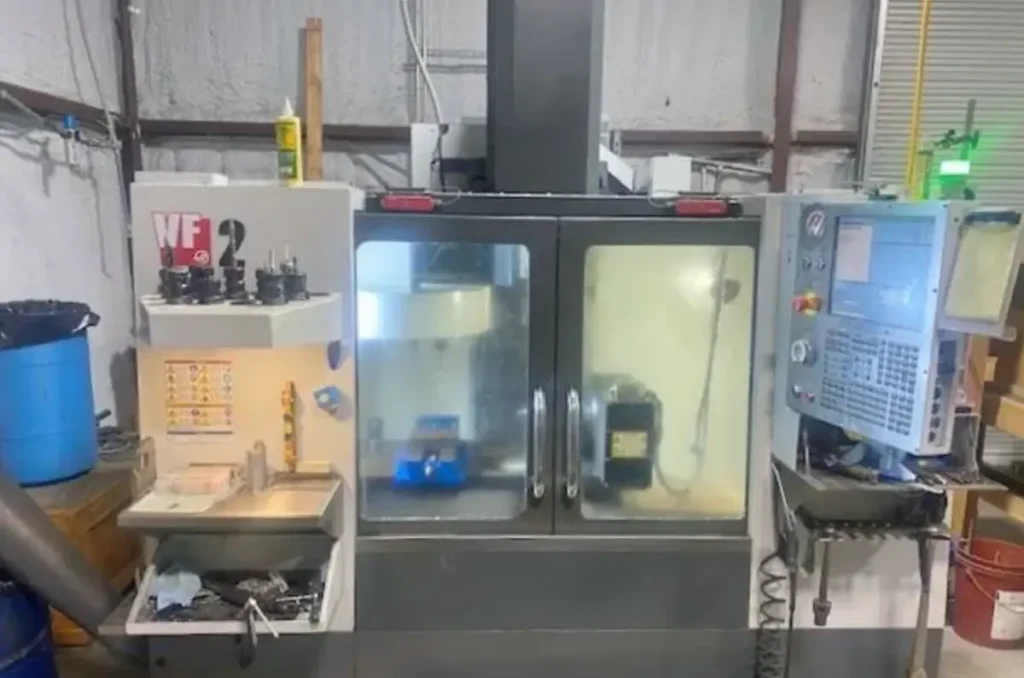
USED HAAS VF2 2013
The 2013 HAAS VF2 is a proven 3-axis Vertical Machining Center (VMC) designed for high-precision milling, drilling, tapping, and production machining. As one of the most widely used models in the Haas VF Series, the VF2 combines a rigid cast-iron frame, precision linear guideways, an inline direct-drive spindle, and the dependable Haas CNC Control to deliver exceptional machining accuracy and long-term reliability. The 2013 HAAS VF2 remains a popular choice for job shops, OEM manufacturers, mold makers, and contract machining facilities because of its versatility, ease of operation, and affordable ownership costs.
The machine features 30 inches of X-axis travel, 16 inches of Y-axis travel, and 20 inches of Z-axis travel, making it ideal for machining tooling plates, fixtures, aerospace components, mold inserts, automotive parts, and precision production components. Its heavy-duty cast-iron construction minimizes vibration during heavy cutting operations, while precision linear guideways and oversized ballscrews provide excellent positioning accuracy and repeatability. Whether machining aluminum, stainless steel, cast iron, titanium, or engineering plastics, the 2013 HAAS VF2 consistently delivers outstanding surface finishes and tight machining tolerances.
Powering the machine is an 8,100 RPM CAT40 inline direct-drive spindle rated at 30 HP and capable of producing approximately 90 ft-lb of torque. The standard 20-pocket automatic carousel tool changer provides fast and dependable tool changes, while 1,000 IPM rapid traverse rates reduce cycle times and improve production efficiency. Many used machines are equipped with factory-installed options such as through-spindle coolant (TSC), programmable coolant nozzle, probing systems, rotary tables, chip augers, chip conveyors, and fourth-axis preparation to further increase machining flexibility.
The dependable Haas CNC Control offers intuitive programming, rigid tapping, USB connectivity, Ethernet capability, and straightforward day-to-day operation. Many machines have also been upgraded with additional memory and software features, allowing them to remain productive in today’s manufacturing environments.
Today, the 2013 HAAS VF2 continues to be one of the best values in the used CNC market by combining proven reliability, low operating costs, excellent parts availability, and consistent machining performance.
HAAS VF2 SPECIFICATIONS
HAAS VF2 – AXIS
| Specification | Value |
|---|---|
| Number of Axes | 3 Axis |
| X-Axis Travel | 30 in |
| Y-Axis Travel | 16 in |
| Z-Axis Travel | 20 in |
| Rapid Traverse (X/Y/Z) | 1,000 IPM |
HAAS VF2 – AXIS TRAVELS / WORK ENVELOPE
| Specification | Value |
|---|---|
| X Travel | 30 in (762 mm) |
| Y Travel | 16 in (406 mm) |
| Z Travel | 20 in (508 mm) |
| Spindle Nose to Table (Maximum) | 24 in |
| Spindle Nose to Table (Minimum) | 4 in |
HAAS VF2 – TABLE
| Specification | Value |
|---|---|
| Table Size | 36 × 14 in |
| Maximum Table Load | 3,000 lbs |
| T-Slots | 3 |
| T-Slot Width | 5/8 in |
HAAS VF2 – SPINDLE
| Specification | Value |
|---|---|
| Maximum Spindle Speed | 8,100 RPM |
| Spindle Power | 30 HP |
| Maximum Torque | 90 ft-lb @ 2,000 RPM |
| Spindle Taper | CAT40 |
| Drive Type | Inline Direct Drive |
HAAS VF2 – TOOL CHANGER
| Specification | Value |
|---|---|
| Tool Capacity | 20 Tools |
| Tool Changer Type | Automatic Carousel |
| Maximum Tool Diameter | 3.5 in |
| Maximum Tool Length | 16 in |
| Maximum Tool Weight | 12 lbs |
| Tool-to-Tool Time | Approx. 4.2 sec |
| Chip-to-Chip Time | Approx. 4.5 sec |
HAAS VF2 – CONTROL SYSTEM
| Specification | Value |
|---|---|
| CNC Control | Haas CNC Control |
| USB Interface | Standard |
| Ethernet Connectivity | Standard |
| Rigid Tapping | Standard |
| Memory | 16 MB (Expandable on many machines) |
| Fourth-Axis Ready | Optional |
HAAS VF2 – COOLANT / CHIP MANAGEMENT
| Specification | Value |
|---|---|
| Flood Coolant | Standard |
| Coolant Tank Capacity | 55 gal |
| Through-Spindle Coolant | Optional |
| Programmable Coolant Nozzle | Optional |
| Chip Washdown | Standard |
| Chip Auger | Optional |
| Chip Conveyor | Optional |
HAAS VF2 – POWER REQUIREMENTS
| Specification | Value |
|---|---|
| Electrical Supply | 220V / 440V 3-Phase |
| Air Requirement | 100 PSI |
| Main Disconnect | Included |
HAAS VF2 – DIMENSIONS
| Specification | Value |
|---|---|
| Machine Footprint | Approx. 101 × 99 in |
| Machine Height | Approx. 101 in |
| Machine Weight | Approx. 7,800 lbs |
HAAS VF2 – GENERAL INFORMATION
| Specification | Value |
|---|---|
| Manufacturer | Haas Automation |
| Model | VF2 |
| Year | 2013 |
| Machine Type | Vertical Machining Center |
| Spindle Taper | CAT40 |
| CNC Control | Haas CNC Control |
| Primary Application | Precision Milling, Drilling & Tapping |
WHY BUY USED HAAS VF2 2013
Purchasing a used 2013 HAAS VF2 gives manufacturers access to one of the industry’s most trusted machining centers at a significantly lower investment than purchasing new equipment. Its rigid machine structure, powerful 30 HP inline direct-drive spindle, dependable Haas CNC Control, and versatile machining envelope make it suitable for everything from prototype work to high-volume production.
Many used machines include valuable factory-installed options such as through-spindle coolant, probing systems, rotary tables, chip conveyors, and fourth-axis preparation that improve productivity while reducing setup times. Haas machines are recognized worldwide for affordable maintenance, readily available replacement parts, and dependable long-term reliability, making the 2013 HAAS VF2 an outstanding investment for virtually any machine shop.
HOW MUCH DOES A USED HAAS VF2 2013 COST?
The value of a used 2013 HAAS VF2 depends on spindle hours, machine condition, installed options, tooling packages, and maintenance history. Machines equipped with through-spindle coolant, probing systems, rotary tables, chip conveyors, and documented service records generally command higher resale values.
Before purchasing, buyers should inspect spindle condition, guideways, lubrication system, tool changer operation, coolant system, CNC diagnostics, and machine geometry. Well-maintained machines with lower operating hours and complete maintenance records typically provide the best long-term value.
A used 2013 HAAS VF2 typically sells between $30,000 and $48,000, depending on spindle hours, tooling, installed options, machine condition, and maintenance history.
INDUSTRIES THAT USE HAAS VF2
- Aerospace Manufacturing
- Automotive Manufacturing
- Medical Device Manufacturing
- Mold & Die Industry
- Tool & Die Shops
- Industrial Equipment Manufacturing
- Electronics Manufacturing
- Energy Equipment Manufacturing
- Contract Manufacturing
- Precision Engineering
- General Manufacturing
- Research & Development
TYPICAL PARTS HAAS VF2 CAN PRODUCE
- Aerospace Components
- Mold Inserts
- Tooling Plates
- Precision Fixtures
- Hydraulic Manifolds
- Medical Device Components
- Automotive Components
- Electronic Enclosures
- Prototype Parts
- Production Fixtures
- Precision Machine Components
- Custom Machined Parts
WHY CHOOSE HAAS VF2 2013
The 2013 HAAS VF2 combines a rigid cast-iron frame, dependable 30 HP CAT40 inline direct-drive spindle, proven Haas CNC Control, and a compact footprint into one of the industry’s most versatile vertical machining centers. Its excellent machining accuracy, simple operation, low maintenance requirements, and broad application range make it an ideal solution for both job shops and production manufacturers.
Manufacturers continue to choose the HAAS VF2 because of its outstanding durability, strong aftermarket support, excellent parts availability, and impressive resale value. Whether machining aerospace components, tooling, molds, fixtures, or precision production parts, the used 2013 HAAS VF2 delivers reliable performance, high productivity, and excellent long-term return on investment.
HAAS VF-2 VS HAAS TM-1P – WHICH CNC MILL IS BETTER FOR YOUR SHOP?
The HAAS VF-2 and HAAS TM-1P are both three-axis CNC milling machines, but they are designed around different shop requirements. The VF-2 is a production-oriented vertical machining center, while the TM-1P belongs to Haas’s Toolroom Mill family and is intended to provide CNC capability in a more open and flexible machine format. The better choice depends on the type of work, production volume, available floor space, and level of automation required.
The VF-2 provides 30 inches of X-axis travel, 16 inches of Y-axis travel, and 20 inches of Z-axis travel. Its current configuration includes a 30-hp spindle, 8,100-rpm maximum speed, liquid-cooled spindle, and a 20-tool carousel changer. These characteristics make the VF-2 particularly suitable for production machining, repeat jobs, fixtures, housings, plates, and general industrial components.
The TM-1P also offers 30 inches of X travel and 16 inches of Y travel, but its Z-axis travel is 16 inches. Haas lists it with a 7.5-hp spindle, 6,000-rpm maximum speed, air-cooled belt-drive spindle, and 10-tool carousel. Its table and overall configuration are oriented toward toolroom-style work, prototyping, repair machining, education, and lower-volume applications.
For a shop producing parts continuously, the VF-2 generally provides greater spindle power, faster machining capability, more Z-axis travel, and greater tool capacity. The TM-1P can make more sense where accessibility, simpler setups, prototyping, and toolroom work are more important than production speed.
Used-machine buyers should also evaluate condition rather than selecting solely by model. Spindle health, axis accuracy, backlash, tool changer operation, control condition, maintenance history, and included accessories can significantly affect the value of either machine.
HAAS VF-2 TOOL RELEASE PROBLEMS – TROUBLESHOOTING GUIDE
A tool release problem on a HAAS VF-2 can prevent the machine from completing an automatic tool change and may leave a tool stuck in the spindle. Because tool release depends on coordinated mechanical, pneumatic, electrical, and control functions, troubleshooting should begin by determining exactly what happens when the tool-release command is activated.
One of the first things to check is the machine’s air supply. Haas currently lists a minimum air pressure requirement of 80 psi for the VF-2. If incoming pressure is too low, unstable, or restricted, pneumatic functions associated with tool release may not operate correctly.
If adequate air pressure is available, inspect the toolholder and spindle area for chips, coolant residue, contamination, or physical damage. Material trapped around the taper or retention area can interfere with proper tool seating and release. A damaged toolholder can create similar symptoms.
The tool-release mechanism itself should also be investigated. Mechanical wear, damaged components, incorrect adjustment, or a problem with the release mechanism can prevent the tool from being released even when the machine receives the correct command.
Spindle orientation is another important consideration. Automatic tool changes require the spindle to reach the appropriate orientation before the tool can be released. If the spindle does not orient correctly, the tool-release sequence may not proceed normally.
Electrical and sensor-related problems can also create apparent tool-release failures. The control needs appropriate feedback to confirm that machine components have reached the required positions. A failed or incorrectly adjusted sensor may therefore interrupt the sequence.
When troubleshooting, pay attention to whether the tool release fails every time or only under certain conditions. Record alarms, observe spindle orientation, verify air pressure, inspect the taper and toolholder, and identify the exact point where the sequence stops.
Do not bypass interlocks or repeatedly force the tool-release mechanism. If a tool remains stuck, follow the machine-specific recovery procedure or have a qualified CNC technician perform the repair. This reduces the possibility of damaging the spindle, toolholder, drawbar, or tool changer.
HAAS VF-2 COMMON WEAR PARTS AND MAINTENANCE ITEMS
The HAAS VF-2 contains numerous mechanical, electrical, lubrication, coolant, and tooling-related components that can experience normal wear during years of machining. Regular maintenance helps identify deteriorating components before they cause unexpected downtime. This is particularly important for used VF-2 machines because operating hours and previous maintenance practices can vary considerably.
Lubrication-related items should be monitored regularly. Proper lubrication is essential for moving components, and lubrication problems can accelerate wear in the machine’s axis system. Operators should monitor lubricant levels and investigate warnings or unusual consumption rather than treating them as routine alerts.
Coolant-system components are also subject to wear. Pumps, hoses, filters, nozzles, and associated fittings can eventually require cleaning or replacement. Contaminated coolant can also affect pumps and create buildup around machine components.
Tooling-related components experience frequent use. Toolholders, retention components, and cutting tools should be inspected for damage and contamination. Damaged tooling can produce poor surface finish, vibration, dimensional errors, and additional spindle loading.
The automatic tool changer contains moving and sensing components that should be kept clean and properly maintained. Chips and coolant residue can interfere with movement, while mechanical wear or sensor problems can eventually result in failed tool changes.
Way covers, seals, belts, hoses, switches, and other exposed components can also deteriorate over time. Regular inspection makes it easier to identify cracking, leaks, looseness, or unusual movement.
Spindle condition deserves particular attention. Abnormal noise, vibration, excessive heat, inconsistent speed, or deteriorating surface finish can indicate developing spindle problems. Early investigation can sometimes prevent a larger repair.
Axis components should be monitored for backlash, unusual noise, rough movement, positioning problems, and servo alarms. These symptoms may indicate wear involving ballscrews, bearings, linear guides, encoders, or related components.
Maintenance should be documented rather than performed only when a failure occurs. Recording inspections, lubrication, replaced parts, spindle issues, axis adjustments, and tool changer repairs creates a useful service history.
For used VF-2 owners, preventive maintenance is particularly valuable because identifying wear early can help control repair costs and keep the machine productive.
WHAT ARE THE X, Y, AND Z TRAVELS OF THE HAAS VF-2?
The current standard HAAS VF-2 has 30 inches of X-axis travel, 16 inches of Y-axis travel, and 20 inches of Z-axis travel. In metric measurements, these correspond to approximately 762 mm X, 406 mm Y, and 508 mm Z. Haas identifies the VF-2 as a three-axis CNC vertical mill with this 30-by-16-by-20-inch travel configuration.
The X-axis provides 30 inches of movement across the machine’s primary horizontal direction. This gives the operator substantial room for positioning workpieces, fixtures, and cutting tools across the table. It is particularly useful when machining longer plates, brackets, housings, and multiple components within one setup.
The Y-axis provides 16 inches of front-to-back travel. This dimension is important when determining whether a workpiece and fixture combination will fit within the machine’s usable machining envelope. Haas also offers variants such as the VF-2YT with increased Y-axis travel, so buyers should verify the exact model before assuming every VF-2 has identical specifications.
The Z-axis provides 20 inches of vertical travel. This movement determines how far the spindle can travel vertically relative to the table and is especially important when working with tall fixtures, deep components, or parts requiring significant tool clearance.
The machine’s spindle nose-to-table dimensions provide additional context. Haas lists approximately 24 inches between the spindle nose and table at maximum and 4 inches at minimum for the current VF-2.
When evaluating a used VF-2, nominal travel specifications should not be the only consideration. Actual machine condition can affect usable machining capability. Excessive backlash, damaged ballscrews, inaccurate positioning, worn guides, or control problems may reduce practical performance even though the machine’s published travel remains unchanged.
Buyers should therefore inspect all three axes through their full travel where possible. Listen for abnormal sounds, check for rough movement, observe positioning behavior, and review maintenance records. The combination of published travel and actual machine condition gives a much better indication of what a particular used VF-2 can handle.
WHY IS MY HAAS VF-2 TOOL CHANGER MAKING UNUSUAL NOISES?
Unusual noise from a HAAS VF-2 tool changer should not be ignored, particularly when the sound is new, becoming louder, or occurring together with failed tool changes. A normal tool-change cycle produces mechanical movement and operating noise, but clunking, grinding, scraping, knocking, or repeated impact sounds may indicate a problem requiring inspection.
One possible cause is misalignment within the tool-change mechanism. If components are no longer correctly positioned, the tool changer may make contact where it should not. Haas’s tool-changer troubleshooting documentation specifically identifies loud clunking during tool changes as a possible indication of incorrect positioning or a change in machine parameters following events such as a crash or component replacement.
Chips and contamination are another common area to inspect. Accumulated material can interfere with carousel movement, tool pockets, moving mechanisms, or tool seating. Coolant residue can also contribute to buildup and unusual movement.
Damaged toolholders can create additional noise. A toolholder that is bent, damaged, contaminated, or incorrectly seated may not move smoothly during the tool-change sequence. Inspect tools and holders rather than assuming the noise originates inside the changer itself.
Mechanical wear is another possibility on heavily used machines. Bearings, drive components, gears, belts, mechanisms, or other moving parts can gradually develop wear and produce noises that were not present when the machine was operating normally.
The tool changer should also be observed during a complete cycle. Determine whether the noise occurs when the carousel indexes, when the tool arm moves, when the spindle releases the tool, or when the sequence completes. The timing of the sound can provide an important clue.
Spindle orientation and tool-release problems can sometimes appear to be tool-changer noise because the systems operate together during an automatic tool change.
Do not continue running repeated tool changes simply to reproduce a loud mechanical noise. If the mechanism is striking, grinding, binding, or stopping unexpectedly, continued operation could increase damage. Record any alarms, identify the exact stage where the noise occurs, inspect for visible obstructions, and use the appropriate machine-specific service procedure or qualified technician for further diagnosis.
Related Products
-
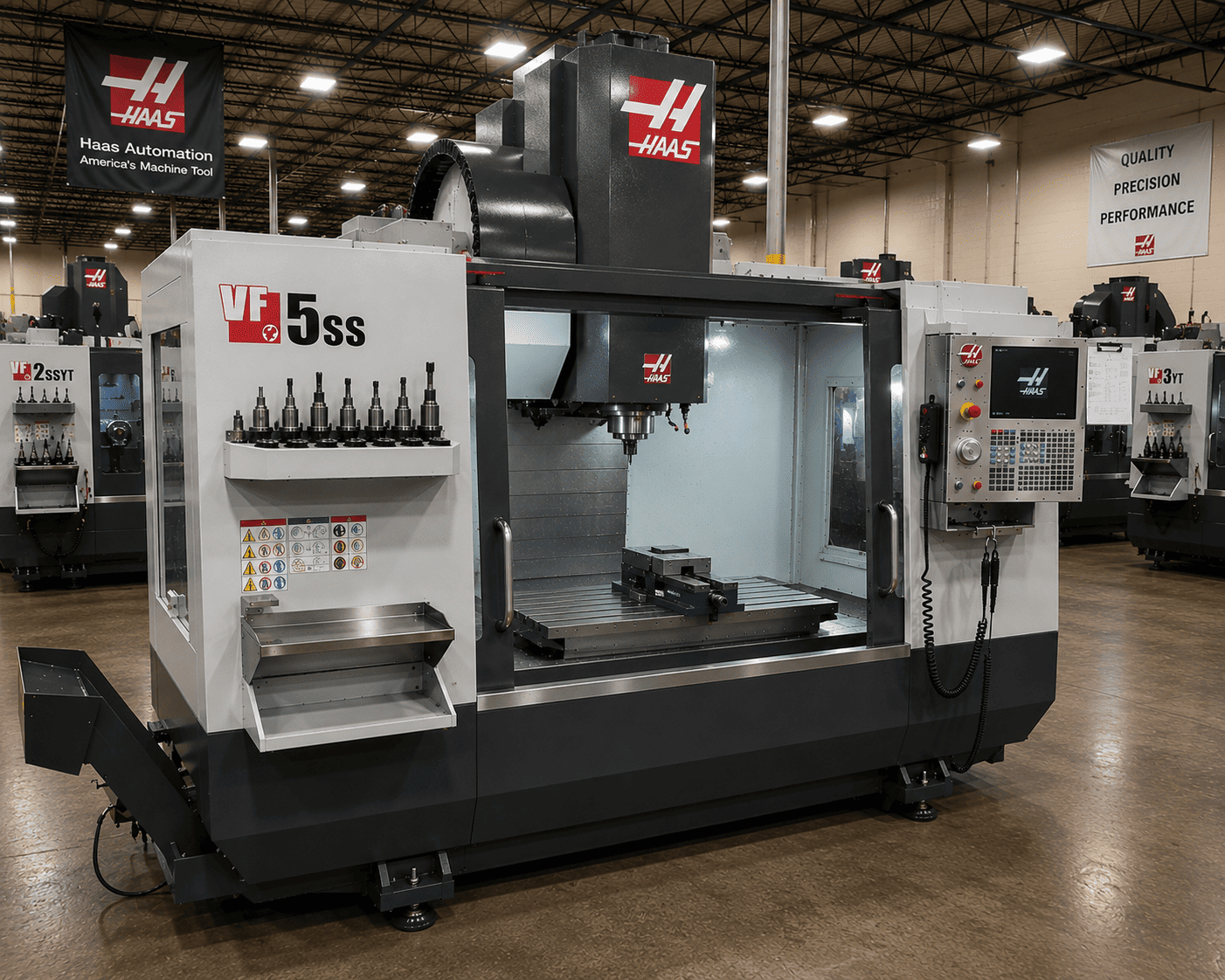
HAAS - VF5SS
VIEW MACHINE -
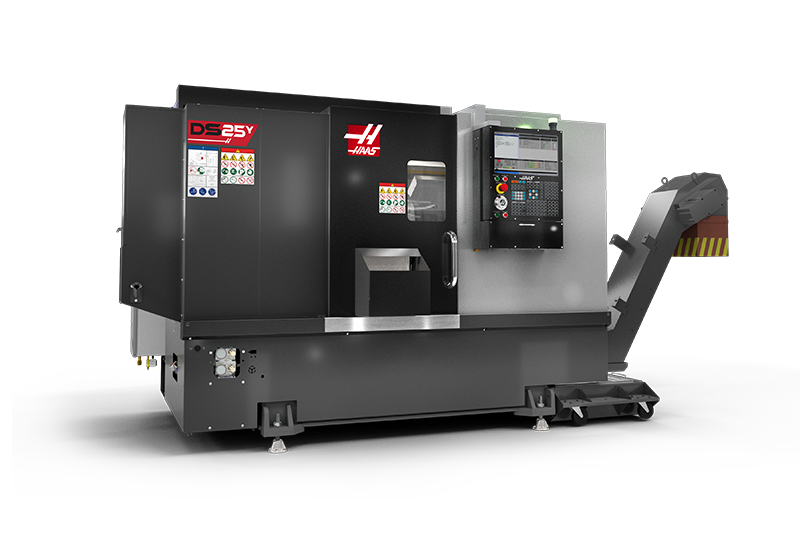
HAAS - DS25Y
VIEW MACHINE -
HAAS - ST30
VIEW MACHINE -
HAAS - VF9/40
VIEW MACHINE