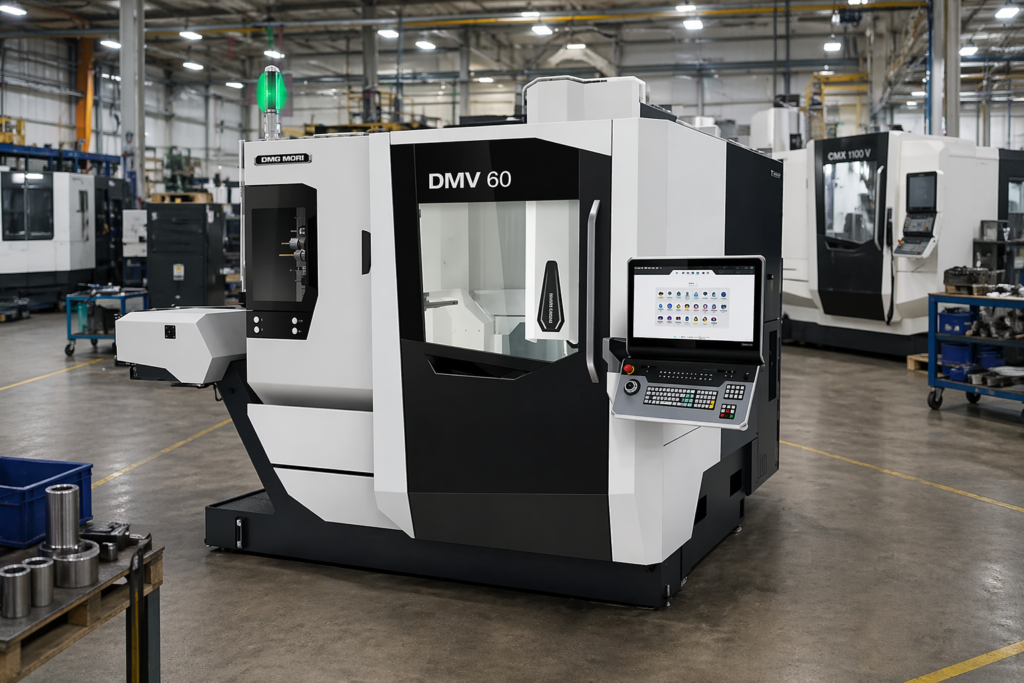
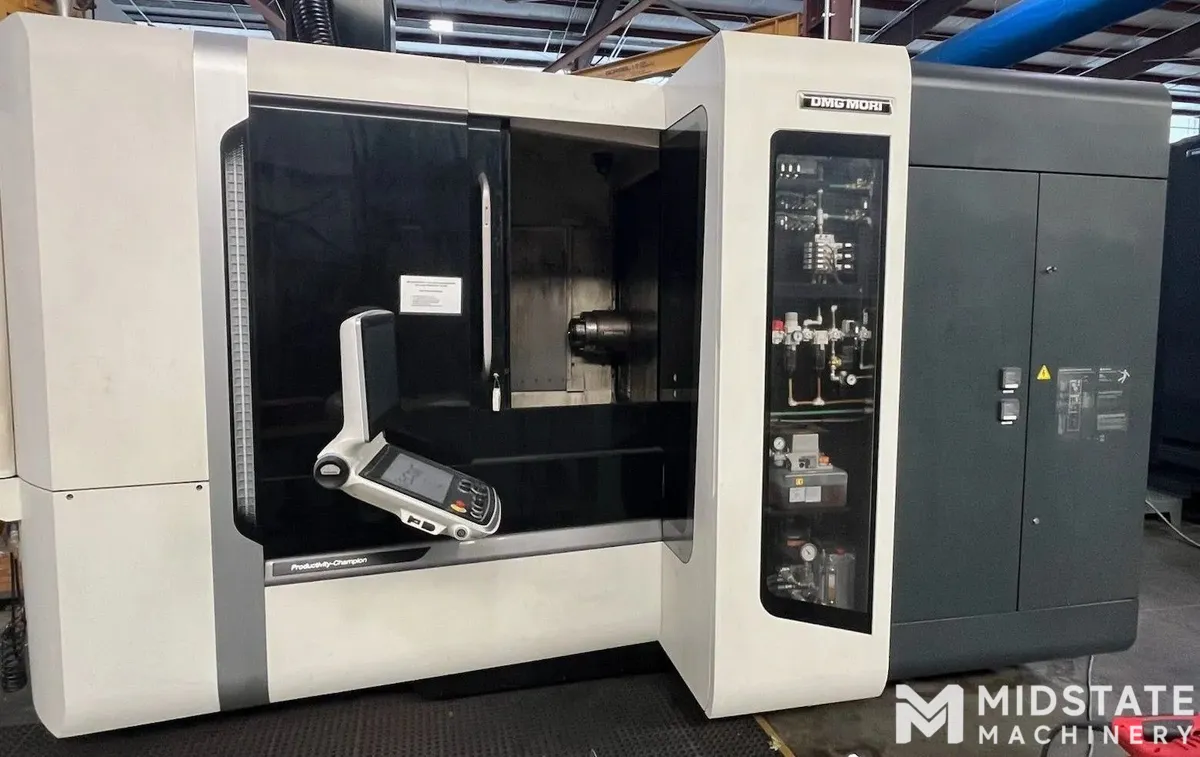
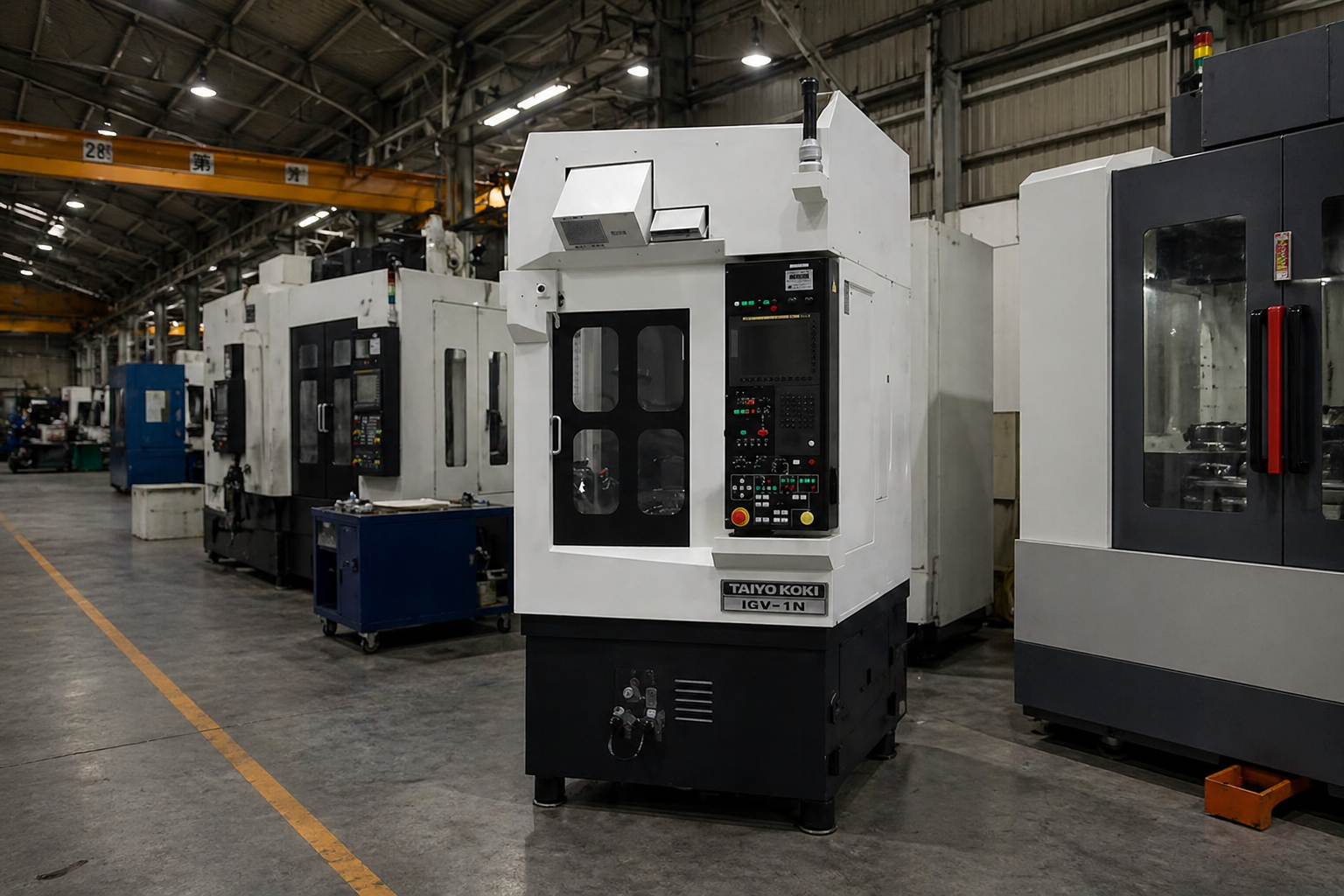
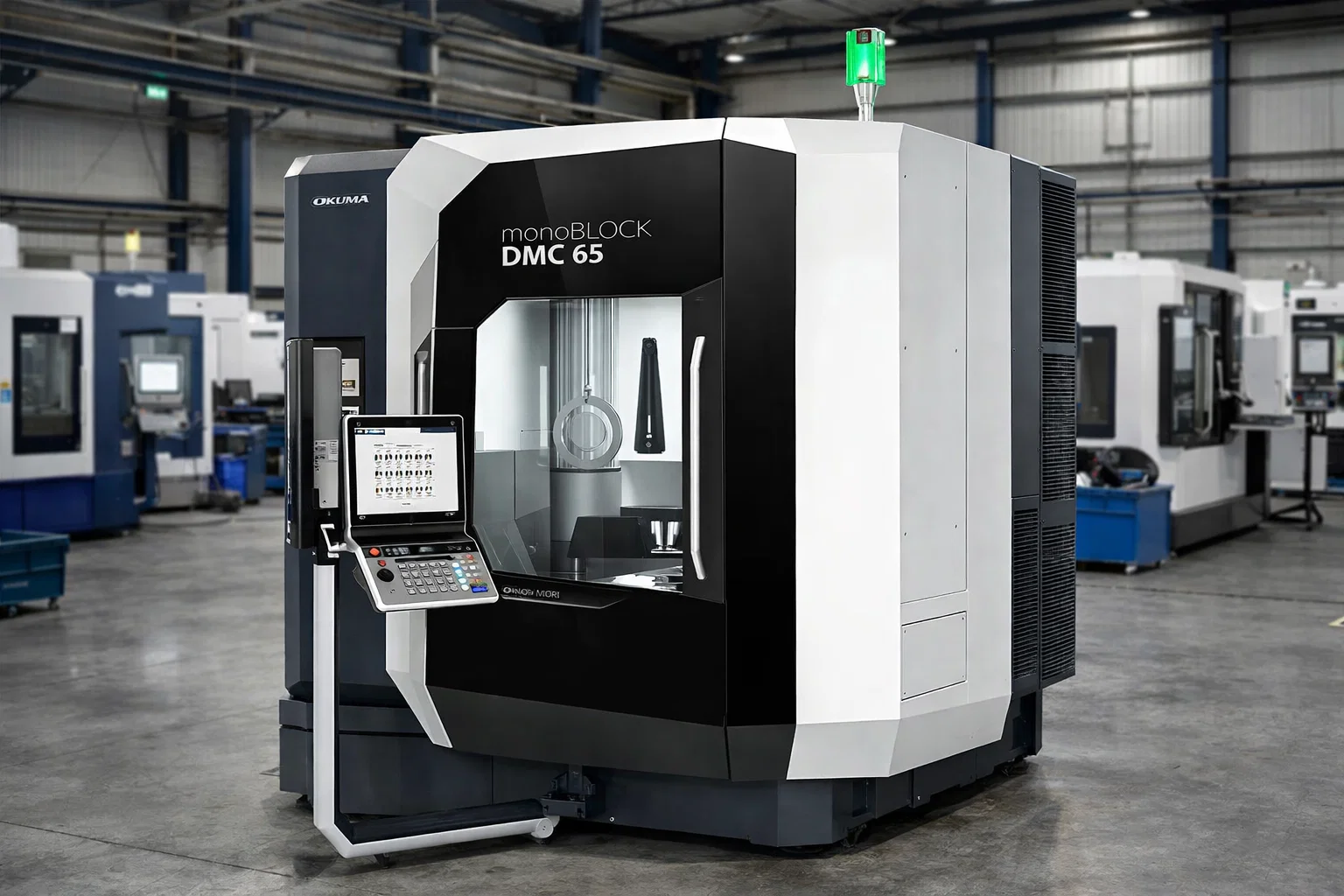
The DMG MORI DMV 60 is a high-performance vertical machining center designed for precision milling, particularly in die & mold, automotive, and general engineering applications. It represents a newer generation of DMG MORI vertical machines, combining strong structural rigidity with advanced spindle and control technologies. With axis travels of approximately 600 mm (X), 600 mm (Y), and 510 mm (Z), the DMV 60 offers a balanced working envelope suitable for medium-sized components while maintaining high stability during machining operations.
A key feature of the DMV 60 is its monolithic machine bed and massive cast construction, which increases static rigidity by around 40% compared to earlier designs. This structural strength ensures minimal vibration during heavy cutting, resulting in improved surface finishes and consistent dimensional accuracy. The fixed table design further enhances process stability, allowing the machine to handle workpieces up to 1,000 kg without compromising performance.
The spindle system is another highlight, offering multiple configurations ranging from 12,000 rpm to 20,000 rpm. This flexibility allows the DMV 60 to efficiently machine a wide variety of materials, from aluminum to hardened steels. Combined with rapid traverse speeds of up to 42 m/min, the machine is optimized to maximize cutting time while minimizing idle movements, improving overall productivity.
Precision is further enhanced through features such as direct measuring systems, linear scales, and advanced thermal compensation. These technologies ensure high positioning accuracy and repeatability, even during long machining cycles. The DMV 60 also supports modern control systems such as Siemens and Heidenhain, making it adaptable to different shop environments. Overall, the DMV 60 is a robust and versatile machining center designed for shops that require high precision, stability, and efficient cutting performance in a compact footprint.
DMG MORI DMV 60SPECIFICATIONS
DMG MORI DMV 60 – AXIS
Vertical Machining Center (VMC)
3-Axis configuration (X, Y, Z)
Monolithic machine bed design for high rigidity
Wide roller guideways on all axes
Direct drive system in X and Y axes for precision
DMG MORI DMV 60 – AXIS TRAVELS
X-axis travel: 600 mm
Y-axis travel: 600 mm
Z-axis travel: 510 mm
DMG MORI DMV 60 – CAPACITY
Maximum table load: approx. 1,000 kg
Maximum workpiece height: approx. 550 mm
Maximum workpiece length: approx. 900 mm
Maximum workpiece width: approx. 600 mm
DMG MORI DMV 60 – SPINDLE
Standard spindle: inlineSPINDLE up to 12,000 rpm
Optional speedMASTER spindle: up to 15,000 rpm
High-speed option: up to 20,000 rpm
BIG PLUS spindle interface for rigidity
High torque and stable cutting performance
DMG MORI DMV 60 – TABLE
Fixed machine table design for stability
Supports heavy workpieces up to 1,000 kg
Constant dynamic behavior regardless of load
Ideal for die & mold applications
DMG MORI DMV 60 – TOOL TURRET
Automatic Tool Changer (ATC)
Tool capacity: typically 30 tools (standard)
Optional expanded tool magazine
Fast tool change capability
Designed for high productivity machining
DMG MORI DMV 60 – FEEDRATES
Rapid traverse: up to 42 m/min (all axes)
High acceleration for improved productivity
Smooth and precise feed control
Suitable for high-speed machining
DMG MORI DMV 60 – COOLANT & CHIP MANAGEMENT
Flood coolant system
Optional through-spindle coolant
Chip conveyor (optional)
Efficient chip evacuation
Designed for continuous machining operations
DMG MORI DMV 60 – CONTROL SYSTEM
SIEMENS control option
HEIDENHAIN control option
CELOS / ERGOline interface (modern UI)
Advanced simulation and programming features
Digital-ready platform for automation
DMG MORI DMV 60 – POWER & AIR REQUIREMENTS
Power requirement: approx. 25–35 kVA
Compressed air: approx. 6 bar
Energy-efficient operation
Stable power supply for precision machining
DMG MORI DMV 60 – DIMENSIONS
Compact machine footprint
Designed for shop floor efficiency
Machine weight: approx. 6,000–7,000 kg (typical range)
Ergonomic machine design
DMG MORI DMV 60 – GENERAL INFORMATION
High-performance vertical milling center
Up to 40% higher rigidity vs previous generation
Direct measuring system for high accuracy
Thermal compensation for precision stability
Suitable for automation (Robo2Go integration)
INDUSTRIES THAT USE DMG MORI DMV 60
Tool and die manufacturing
Automotive industry
Aerospace components
Medical device manufacturing
General precision engineering
Mold and die applications
TYPICAL PARTS DMG MORI DMV 60 CAN PRODUCE
Molds and dies
Precision machined components
Automotive parts and fixtures
Aerospace structural parts
Medical components
Custom machined parts
WHY CHOOSE DMG MORI DMV 60
Extremely high rigidity and stability
High-speed and high-performance machining
Handles heavy workpieces up to 1,000 kg
Advanced spindle options up to 20,000 rpm
Excellent precision with direct measuring system
Ideal for die & mold and high-accuracy applications
WHY BUY USED DMG MORIDMV 60
Buying a used DMG MORI DMV 60 is a practical choice for manufacturers looking to access modern machining capabilities at a reduced cost. One of the primary advantages is depreciation—new machines in this category are expensive, but their value drops significantly after initial use. This allows buyers to acquire a relatively advanced machine with strong performance capabilities at a fraction of the original investment.
Another major factor is cutting time efficiency relative to cost. The DMV 60 is designed for high-speed and high-precision machining, and even used models retain excellent spindle performance and rigidity. For many job shops and medium production environments, a properly maintained used machine can deliver nearly the same cycle times as a new one. This makes it highly cost-effective in terms of output per hour, especially when production volumes do not justify a brand-new investment.
Durability is also a strong advantage. The DMV 60 is built with a rigid cast structure, roller guideways, and high-quality components that are designed to withstand long machining cycles. Machines with moderate cutting time (for example, under 20,000–25,000 spindle hours) typically still offer reliable performance with limited wear. Even higher-hour machines can remain productive if they have been well maintained, though they may require more frequent servicing.
Additionally, used machines often come with added value such as tooling, fixtures, or automation-ready configurations. Evaluating a machine based on cutting time rather than just manufacturing year is critical, as spindle hours provide a more accurate measure of wear and remaining life. For businesses focused on maximizing return on investment, a used DMV 60 offers a strong combination of modern technology, durability, and cost savings.
HOW MUCH DOES A USED DMG MORIDMV 60COST?
The price of a used DMG MORI DMV 60 depends on several factors, including manufacturing year, configuration, condition, and most importantly, cutting time (spindle hours). Machines with lower cutting hours and a strong maintenance history typically command higher prices, while heavily used machines are more affordable due to wear on key components such as the spindle, guideways, and ball screws.
For machines built before 2000, direct DMV 60 models are not available, but comparable older vertical machining centers typically range from $10,000 to $30,000. These machines generally have high cutting hours and older control systems, making them suitable for basic machining tasks rather than high-precision or high-speed production.
Machines from the 2000–2010 period, while not exact DMV 60 models, fall into a similar performance category and are typically priced between $30,000 and $70,000. Units with moderate cutting time (around 20,000–35,000 spindle hours) are considered good value, offering a balance between affordability and reliable performance.
For actual DMV 60 machines manufactured between 2010 and 2025, prices usually range from $70,000 to $150,000 depending on condition and specifications. Machines with low cutting hours (under 10,000–15,000 hours), high-speed spindle options, and advanced control systems are priced at the higher end of this range. Automation-ready machines or those with additional tooling can further increase value.
Cutting time plays a critical role in valuation. A newer machine with excessive spindle hours may be priced similarly to an older machine with lower usage. Therefore, buyers should prioritize condition, service records, and real machining performance over just the year of manufacture to ensure a smart and cost-effective investment.