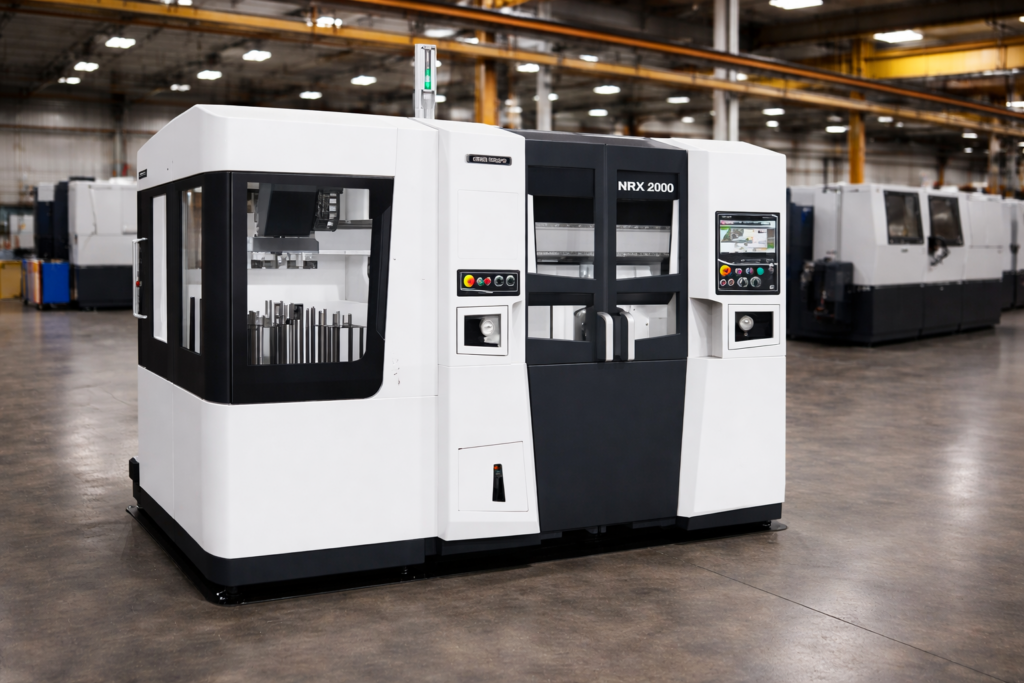
USED DMG MORI NRX 2000
The DMG MORI NRX 2000 is a high-efficiency parallel dual-spindle, dual-turret production turning center designed for mass production of flange-type and small industrial components. It is part of DMG MORI’s NRX series, which focuses on extreme productivity, compact footprint, and fully automated manufacturing for automotive and industrial parts.
The machine is specifically engineered for simultaneous two-part machining, where Spindle 1 and Spindle 2 operate in parallel with independent turrets. This configuration allows two machining processes to run at the same time, effectively doubling productivity in a single machine footprint.
The NRX 2000 supports workpieces up to approximately 180 mm in diameter and 100 mm in length, making it ideal for flange components, hubs, collars, and similar high-volume parts used in automotive and hydraulic systems. Its compact design includes a machine width of around 1,650 mm, making it one of the most space-efficient dual-spindle machines in its category.
A key strength of the NRX 2000 is its fully integrated automation concept, where a gantry loader is typically used to enable continuous unmanned production. This allows raw material loading, machining, and part unloading to occur in a seamless cycle, significantly reducing labor dependency and increasing machine utilization.
The machine structure is designed with high rigidity and FEM-optimized casting, ensuring stable cutting performance even during continuous high-speed production. The front-access turret layout improves tool change efficiency and operator accessibility. Chip evacuation is also optimized through a dedicated chute system to maintain uninterrupted operation.
Depending on configuration, the NRX 2000 can support milling capabilities, driven tools, and multiple turret options, making it suitable for flexible production lines where both turning and light milling are required.
Overall, the NRX 2000 is a high-productivity, automation-first dual-spindle turning system designed for maximum output in compact, unmanned manufacturing environments.
DMG MORI NRX 2000 SPECIFICATIONS
| DMG MORI NRX 2000 – AXIS |
|---|
| X-Axis (Radial Movement) |
| Z-Axis (Longitudinal Movement) |
| Dual Spindle Configuration |
| Dual Turret Configuration |
| Optional C-Axis & Milling Capability |
| DMG MORI NRX 2000 – AXIS TRAVELS |
|---|
| X-Axis Travel: approx. 100 mm |
| Z-Axis Travel: approx. 220 mm |
| DMG MORI NRX 2000 – CAPACITY |
|---|
| Maximum Turning Diameter: approx. 180 mm |
| Maximum Turning Length: approx. 100 mm |
| Ideal for flange-type parts |
| Designed for mass production |
| DMG MORI NRX 2000 – SPINDLE |
|---|
| Dual spindle system (Main + Sub) |
| Simultaneous machining capability |
| Optimized for high-speed production |
| High thermal stability |
| DMG MORI NRX 2000 – TABLE / WORKHOLDING |
|---|
| Chuck-based workholding |
| Integrated gantry loader system |
| Automatic part transfer between spindles |
| Designed for unmanned operation |
| DMG MORI NRX 2000 – TOOL TURRET |
|---|
| Dual turret configuration |
| Simultaneous machining on both sides |
| High rigidity turret design |
| Optional live tooling |
| DMG MORI NRX 2000 – FEEDRATES |
|---|
| High-speed synchronized machining |
| Optimized for cycle time reduction |
| DMG MORI NRX 2000 – COOLANT & CHIP MANAGEMENT |
|---|
| Integrated chip disposal system |
| Improved chip evacuation design |
| Suitable for continuous production |
| DMG MORI NRX 2000 – CONTROL SYSTEM |
|---|
| Control System: MAPPS / Fanuc |
| COMPACTline interface |
| Production-focused CNC control |
| DMG MORI NRX 2000 – POWER & AIR REQUIREMENTS |
|---|
| Industrial power supply (approx. 25–40 kVA) |
| Air Supply: approx. 5–6 bar |
| DMG MORI NRX 2000 – DIMENSIONS |
|---|
| Machine Width: approx. 1,650 mm |
| Machine Height: approx. 2,100 mm |
| Compact footprint with integrated automation |
| DMG MORI NRX 2000 – GENERAL INFORMATION |
|---|
| Machine Type: Twin-Spindle CNC Turning Center |
| Dual turret + dual spindle architecture |
| Designed for unmanned mass production |
| Extremely compact and automation-ready |
| INDUSTRIES THAT USE DMG MORI NRX 2000 |
|---|
| Automotive |
| Industrial Equipment Manufacturing |
| Mass Production Engineering |
| TYPICAL PARTS DMG MORI NRX 2000 CAN PRODUCE |
|---|
| Flange components |
| Hubs |
| Small precision parts |
| Automotive components |
| WHY CHOOSE DMG MORI NRX 2000 |
|---|
| Extremely High Productivity with Dual Spindles |
| Ideal for Flange Mass Production |
| Compact with Built-in Automation |
| Designed for Continuous Unmanned Operation |
WHY BUY USED DMG MORI NRX 2000
Buying a used DMG MORI NRX 2000 is a strategic decision for manufacturers focused on high-volume, low-cycle-time production, especially for flange and small component manufacturing. Since the machine is designed for continuous automated operation, it retains strong productivity value even in used condition if properly maintained.
The biggest advantage is extreme productivity per machine footprint. The dual-spindle, dual-turret architecture allows two parts or two operations to be processed simultaneously, effectively reducing cycle time by nearly half compared to conventional single-spindle machines. This makes even older machines highly competitive in production environments.
Cutting time is a critical factor when evaluating a used NRX 2000. These machines are typically deployed in 24/7 automated production lines, meaning usage hours can accumulate quickly. Machines with lower cutting time (under 20,000–25,000 hours) generally offer better long-term reliability. Units under 10,000–15,000 hours are especially valuable because spindle synchronization accuracy, turret wear, and loader systems tend to remain in near-original condition.
Another advantage is built-in automation integration. Since the NRX 2000 is designed around gantry loading systems, it already operates as a production cell rather than a standalone machine. This reduces additional automation investment costs for manufacturers scaling production.
Additionally, DMG MORI’s global service network ensures availability of spare parts and technical support, even for older installations. Many used NRX 2000 systems can also be retrofitted with modern controls or upgraded automation modules to extend service life.
While it is not a flexible job-shop machine, the NRX 2000 excels in dedicated mass production environments where consistency, speed, and uptime matter most.
In summary, a used NRX 2000 offers outstanding value through dual-spindle productivity, automation readiness, and high-output efficiency for dedicated production lines.
HOW MUCH DOES A USED DMG MORI NRX 2000 COST?
The cost of a used DMG MORI NRX 2000 depends heavily on manufacturing year, automation configuration, machine condition, and most importantly, total cutting time.
For older machines manufactured before 2000, comparable dual-spindle production lathes typically range from $60,000 to $120,000, depending on wear condition and retrofit status. These machines may lack modern control systems and full automation integration.
Machines produced between 2000 and 2010 generally fall within the $120,000 to $250,000 range. These units often include improved CNC controls, better spindle synchronization, and more stable automation systems. Machines with lower cutting time (under 20,000–25,000 hours) are priced higher due to better mechanical condition.
For NRX 2000 systems from 2010–2025, used prices typically range from $250,000 to $500,000+, depending on whether they include gantry loaders, chip conveyors, tool monitoring systems, and automation peripherals.
Cutting time plays a major role in valuation. Since NRX machines are built for continuous production, they often accumulate high usage hours quickly. Machines with low cutting time (under 10,000–15,000 hours) are considered premium due to higher spindle synchronization accuracy and reduced wear on turrets and loader systems.
Buyers should carefully evaluate maintenance history, spindle vibration, turret indexing accuracy, and automation system condition rather than relying only on age or appearance.
Overall, the cost of a used NRX 2000 is determined by automation level, configuration, and usage history, with cutting time being the most important indicator of long-term reliability and true production value.
Related Products
-
DMG MORI - NHX 6300
VIEW MACHINE -
DMG MORI - NZX-6000E/2000
VIEW MACHINE -
DMG MORI - NHX4000
VIEW MACHINE -
DMG MORI - NZX 2500
VIEW MACHINE