USED OKUMA GP-57N
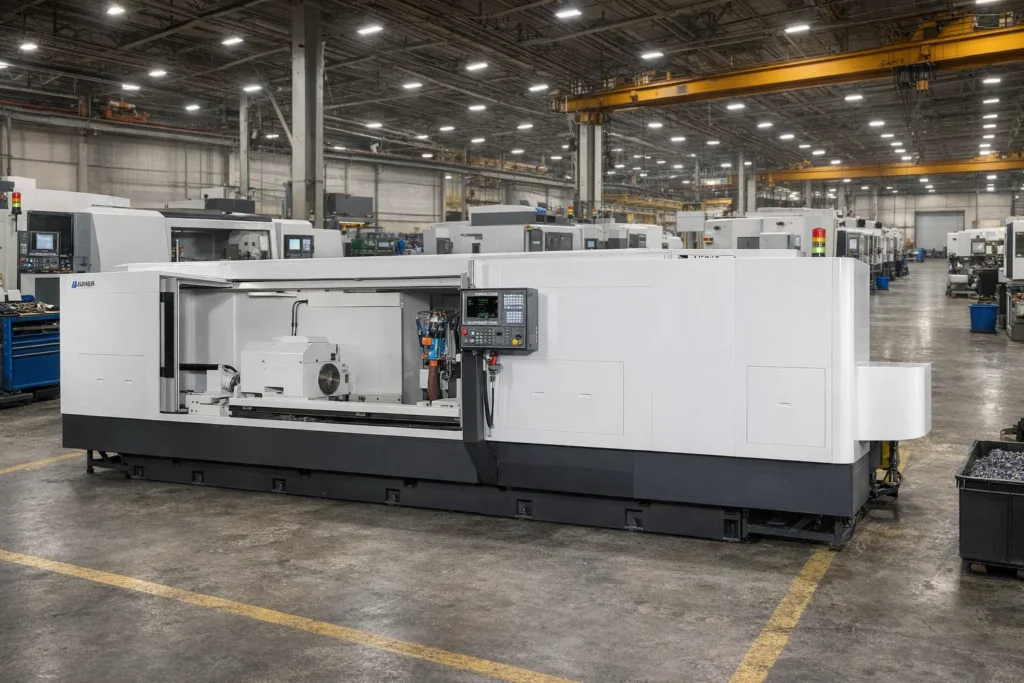
The Okuma GP-57N is a large-capacity CNC cylindrical grinding machine designed for high-precision external (OD) grinding of large and long workpieces. As part of Okuma’s GP-N series, it is engineered specifically for heavy-duty applications requiring consistent accuracy, rigidity, and productivity. The machine is widely used in industries such as energy, automotive, heavy equipment, and general engineering, where large shafts and cylindrical components must be machined to tight tolerances.
The GP-57N offers a maximum grinding diameter of approximately 550 mm and supports workpiece lengths of up to 3,150 mm, depending on configuration. This makes it ideal for long shafts, rolls, and multi-journal components that require stable and precise grinding across extended lengths. The machine can handle heavy workpieces, typically up to around 1,800 kg, ensuring suitability for demanding industrial applications.
A key feature of the GP-57N is its rigid construction, including wide V-flat guideways that enhance stability and reduce deflection during long grinding operations. The machine is equipped with a large grinding wheel (approximately 760 mm diameter) powered by a 15 kW spindle motor, with optional upgrades to 22 kW for increased material removal capability. The hydrodynamic wheel spindle ensures high rotational accuracy, minimal vibration, and improved surface finish.
The GP-57N uses Okuma’s OSP-P300GA control system, featuring IGAP+ conversational programming for easier operation and faster setup. Rapid traverse speeds and efficient cycle execution help maximize grinding (cutting) time while minimizing idle movement.
Designed for high grinding time utilization, the machine supports automation and integration into production lines. Overall, the GP-57N delivers a powerful combination of size, rigidity, and precision, making it a reliable solution for large-part cylindrical grinding applications.
OKUMA GP-57N SPECIFICATIONS
| OKUMA GP-57N – AXIS |
|---|
| X-Axis |
| Z-Axis |
| Simultaneous 2-Axis CNC Control |
| OKUMA GP-57N – AXIS TRAVELS |
|---|
| Rapid Traverse X-Axis: Approx. 12 m/min |
| Rapid Traverse Z-Axis: Approx. 10 m/min |
| OKUMA GP-57N – CAPACITY |
|---|
| Maximum Grinding Diameter: 550 mm |
| Distance Between Centers: 2,150 / 2,650 / 3,150 mm |
| Maximum Grinding Length: Up to 3,150 mm |
| Maximum Workpiece Weight: Up to 1,800 kg |
| OKUMA GP-57N – SPINDLE |
|---|
| Wheel Spindle Type: Hydrodynamic Spindle |
| Wheel Spindle Motor: 15 kW (Optional 22 kW) |
| Grinding Wheel Diameter: Ø760 mm |
| Wheel Peripheral Speed: 45 m/s |
| Designed for Heavy-Duty & High-Precision Grinding |
| OKUMA GP-57N – TABLE |
|---|
| Table Type: Reciprocating Table |
| Guideway: Wide V & Flat Guideways |
| Table Drive: Servo Controlled |
| High Rigidity for Large Workpieces |
| OKUMA GP-57N – TOOL TURRET |
|---|
| Wheel Head Type: Plain Head |
| Designed for External (OD) Grinding |
| Suitable for Large Shaft Components |
| Supports Heavy-Duty Grinding Operations |
| OKUMA GP-57N – FEEDRATES |
|---|
| Rapid Traverse X-Axis: Approx. 12 m/min |
| Rapid Traverse Z-Axis: Approx. 10 m/min |
| Fine Feed Control for Precision Grinding |
| Programmable Feedrates |
| OKUMA GP-57N – COOLANT & CHIP MANAGEMENT |
|---|
| Coolant System: High-Flow Grinding Coolant |
| Full Enclosure for Safe Operation |
| Efficient Swarf & Grinding Debris Removal |
| OKUMA GP-57N – CONTROL SYSTEM |
|---|
| CNC Control: OSP-P300GA |
| Programming: Conversational (IGAP+) & G-Code |
| User-Friendly Interface |
| Supports Automation Integration |
| OKUMA GP-57N – POWER & AIR REQUIREMENTS |
|---|
| Power Supply: 3-Phase AC |
| Power Consumption: Approx. 25–35 kVA |
| Air Requirement: Clean, Dry Compressed Air |
| OKUMA GP-57N – DIMENSIONS |
|---|
| Floor Space: Approx. 8,350 x 3,360 mm (varies by configuration) |
| Larger Footprint for Heavy-Duty Applications |
| Machine Weight: Approx. 12,000–18,000 kg (configuration dependent) |
| OKUMA GP-57N – GENERAL INFORMATION |
|---|
| Machine Type: CNC Cylindrical Grinder |
| Application: External (OD) Grinding |
| Design: Heavy-Duty Machine for Large Parts |
| Structure: High Rigidity with Thermal Stability |
| Ideal for Long & Large Diameter Workpieces |
| INDUSTRIES THAT USE OKUMA GP-57N |
|---|
| Automotive |
| Aerospace |
| Energy & Power Generation |
| Oil & Gas |
| Heavy Machinery |
| TYPICAL PARTS OKUMA GP-57N CAN PRODUCE |
|---|
| Large Shafts |
| Turbine Components |
| Rollers |
| Spindles |
| Heavy Cylindrical Parts |
| WHY CHOOSE OKUMA GP-57N |
|---|
| Larger Capacity (Up to 550 mm Diameter) |
| Handles Long Workpieces up to 3,150 mm |
| Hydrodynamic Spindle for High Stability |
| Excellent Surface Finish & Accuracy |
| Designed for Heavy-Duty Industrial Applications |
| High Reliability & Repeatability |
WHY BUY USED OKUMA GP-57N
Buying a used Okuma GP-57N is a strategic decision for manufacturers requiring large-scale grinding capability without the significant investment associated with a new machine. Machines in this category are built with heavy-duty construction and precision components, allowing them to maintain performance and accuracy over long operational lifespans when properly maintained.
One of the primary advantages of purchasing used is cost efficiency. Large cylindrical grinders like the GP-57N are expensive when new, especially when equipped with high-power spindles and automation systems. A used machine allows businesses to access the same large work envelope, high rigidity, and precision grinding capability at a substantially lower cost, improving capital efficiency.
Grinding time (spindle hours) is the most critical factor when evaluating a used GP-57N. Machines with lower grinding hours generally retain better spindle condition and guideway accuracy. For example, a machine from the early 2010s with moderate grinding time may provide more reliable performance than a newer unit that has been heavily used in continuous production. Since the GP-57N is typically used for long shaft grinding, wear on guideways, tailstock, and steady-rest components should be carefully inspected.
Another advantage is process capability. The GP-57N is designed for long-length and heavy-duty grinding operations, and even in a used condition, it can significantly improve workflow efficiency by reducing setups and handling time for large components. Additionally, Okuma’s strong global support network and long-term parts availability reduce the risks associated with purchasing older equipment.
From a financial perspective, buying used enables faster return on investment. With lower upfront costs and the ability to sustain long grinding cycles, a used GP-57N can quickly contribute to production output and profitability in heavy manufacturing environments.
HOW MUCH DOES A USED OKUMA GP-57N COST?
The cost of a used Okuma GP-57N depends on factors such as manufacturing year, machine configuration, condition, and most importantly, grinding time (spindle hours). As a large-capacity cylindrical grinder, it typically commands higher prices than smaller models due to its size, power, and capability.
Machines built before 2000 (or earlier-generation large cylindrical grinders comparable to this platform) generally range from $25,000 to $70,000. These machines are the most affordable but may include outdated control systems and higher wear levels. Grinding time is especially important in this category—machines with high spindle hours may require refurbishment, while low-hour units can still be viable for lighter production applications.
Models produced between 2000 and 2010 typically range from $70,000 to $160,000. This segment often offers the best balance between price and performance, with improved control systems, better spindle technology, and enhanced rigidity. Units with low to moderate grinding time are particularly desirable, as they can deliver reliable accuracy with manageable maintenance costs.
Machines from 2010 to 2025 generally range from $160,000 to $350,000 or more, depending on configuration, spindle power (15 kW vs 22 kW), automation integration, and control upgrades. These newer machines benefit from improved efficiency, better thermal stability, and enhanced consistency in long production runs.
Grinding time remains the most critical pricing factor. A newer machine with excessive spindle hours may be less valuable than an older unit with minimal use. Buyers should carefully evaluate spindle condition, guideway wear, and maintenance history to determine true market value and ensure long-term operational reliability.
Related Products
-
OKUMA - LU7000 EX
VIEW MACHINE -
OKUMA - LT-3000EX 2T2MY
VIEW MACHINE -
OKUMA - MB-56V
VIEW MACHINE -
OKUMA - VTR-350A
VIEW MACHINE