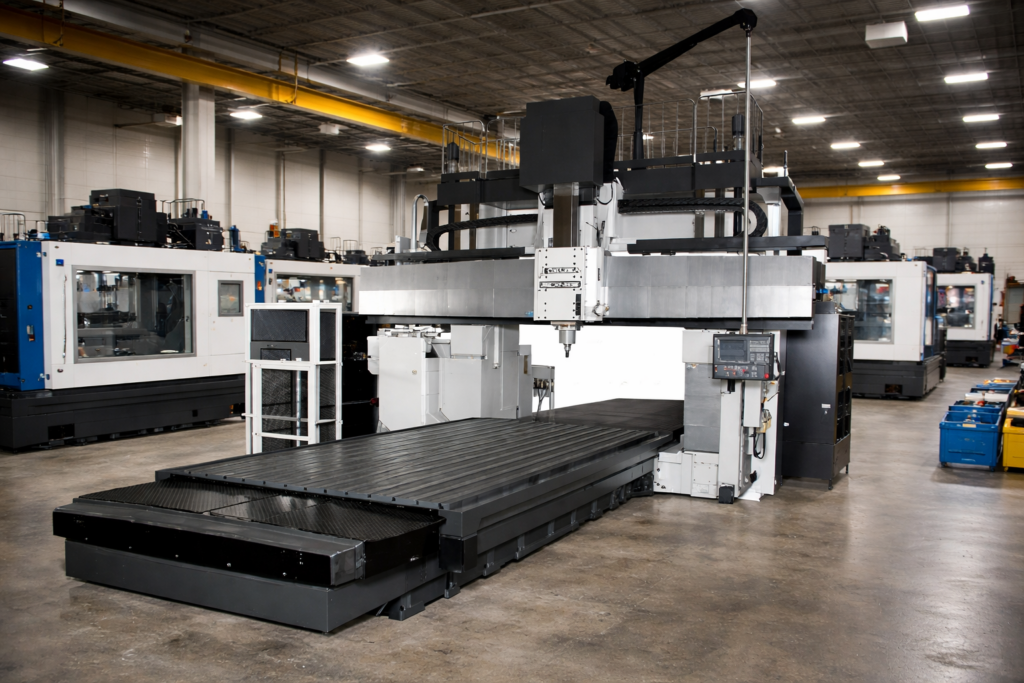
USED OKUMA MCR-BIII
The OKUMA MCR-BIII is a large double-column machining center designed for heavy-duty, high-precision 5-face machining of oversized components in a single setup. It belongs to Okuma’s MCR series, which is widely used in automotive, aerospace, railway, energy, and heavy equipment manufacturing industries where large workpieces, high rigidity, and stable accuracy are essential. The machine is built to handle both rough machining and precision finishing on complex large parts such as dies, molds, and structural components.
A key feature of the MCR-BIII is its rigid ram-type spindle head combined with a strong double-column structure. This design ensures excellent stability during heavy cutting operations and allows multiple machining orientations using interchangeable attachment heads. The system supports 5-face machining in a single setup, significantly reducing repositioning errors and improving production efficiency.
The machine is designed with a wide and scalable work envelope. Depending on configuration, it offers X-axis travel ranging from approximately 3,000 mm up to 12,000 mm, making it suitable for very large components. The distance between columns also varies by model size, typically ranging from about 2,050 mm upward, allowing flexibility for different part dimensions.
The spindle system is built for power and rigidity rather than ultra-high speed. Standard spindle speed is around 4,000 RPM, with optional configurations up to 6,000–10,000 RPM depending on setup. Spindle power is typically around 30/22 kW (or higher configurations up to 40 hp class), enabling strong cutting performance on steel and cast iron.
Tool capacity is also a strong advantage, starting from around 50 tools and expanding up to 180 or more depending on production needs. This supports complex multi-operation machining with reduced downtime for tool changes.
Overall, the MCR-BIII is designed for large-scale industrial machining where rigidity, flexibility through attachments, and long-term dimensional stability are more important than compact size or high-speed light machining.
OKUMA MCR-BIII SPECIFICATIONS
| OKUMA MCR-BIII – AXIS |
|---|
| 3-Axis Double Column Machining Center |
| X-Axis (Table Longitudinal Movement) |
| Y-Axis (Cross Rail / Column Movement) |
| Z-Axis (Ram / Spindle Head Vertical Movement) |
| Optional 5-Face Machining via Attachment Heads |
| AAC (Auto Attachment Changer) System |
| Heavy-Duty Ram-Type Spindle Head |
| OKUMA MCR-BIII – AXIS TRAVELS |
|---|
| X-Axis Travel: 3,000 – 12,000 mm |
| Y-Axis Travel: Up to 3,550 mm (config dependent) |
| Z-Axis Travel: Approx. 800 – 1,200 mm |
| Wide Column Spacing: 2,050 – 3,550 mm |
| Designed for Extra-Large Workpieces |
| OKUMA MCR-BIII – CAPACITY |
|---|
| Table Size: 2,000 x 4,000 mm to 3,000 x 12,000 mm |
| Maximum Workpiece Capacity: Multi-ton class |
| High Load Bed for Heavy Components |
| Suitable for Large Die & Structural Parts |
| OKUMA MCR-BIII – SPINDLE |
|---|
| Spindle Speed: 4,000 rpm (Optional up to 10,000 rpm) |
| Spindle Motor Power: 40 hp / 30 hp continuous |
| Ram-Type High Rigidity Spindle Head |
| Vertical & Horizontal Attachment Capability |
| High Torque for Heavy Cutting |
| OKUMA MCR-BIII – TABLE |
|---|
| Large Fixed Table Construction |
| High Rigidity Design for Heavy Loads |
| Supports Very Large Workpieces |
| Optimized for 5-Face Machining with Attachments |
| OKUMA MCR-BIII – TOOL MAGAZINE |
|---|
| Tool Capacity: 50 Tools (Standard) |
| Optional: 72 / 100 / 120 / 180 Tools |
| Side-Mounted Tool Magazine |
| Automatic Tool Changer (ATC) |
| Supports Multiple Attachment Heads via AAC |
| OKUMA MCR-BIII – FEEDRATES |
|---|
| Rapid Traverse (X/Y/Z): High-speed industrial class |
| Stable Motion for Large Axis Travel |
| Optimized for Heavy Cutting Cycles |
| High Precision Positioning |
| OKUMA MCR-BIII – COOLANT & CHIP MANAGEMENT |
|---|
| Flood Coolant System |
| High-Volume Chip Flushing |
| Chip Conveyor (Optional) |
| Designed for Continuous Heavy Machining |
| OKUMA MCR-BIII – CONTROL SYSTEM |
|---|
| CNC Control: Okuma OSP Suite |
| Thermo-Friendly Concept |
| Servo Stability Control |
| AAC Integration for Multi-Axis Attachments |
| High Accuracy Machining Control |
| OKUMA MCR-BIII – POWER & AIR REQUIREMENTS |
|---|
| Power Requirement: Approx. 60 – 80 kVA |
| Voltage: 3-Phase Industrial Supply |
| Air Requirement: Approx. 5–6 bar |
| Heavy Industrial Operation Support |
| OKUMA MCR-BIII – DIMENSIONS |
|---|
| Machine Length: Up to ~12,000 mm+ (config dependent) |
| Machine Width: ~6,000 – 7,500 mm |
| Machine Height: ~5,000 – 6,500 mm |
| Extremely Large Double Column Structure |
| Factory-Level Installation Required |
| OKUMA MCR-BIII – GENERAL INFORMATION |
|---|
| Machine Type: Double Column Machining Center |
| Manufacturer: Okuma Corporation |
| Model: MCR-BIII |
| Designed for Large Die, Mold & Structural Machining |
| 5-Face Machining via Attachment Heads |
| High Rigidity for Heavy Cutting Applications |
| INDUSTRIES THAT USE OKUMA MCR-BIII |
|---|
| Aerospace |
| Automotive |
| Energy |
| Heavy Engineering |
| Mold & Die |
| Rail & Shipbuilding |
| TYPICAL PARTS OKUMA MCR-BIII CAN PRODUCE |
|---|
| Large Die & Mold Bases |
| Aerospace Structural Frames |
| Shipbuilding Components |
| Heavy Machine Bases |
| Rail Components |
| Large Industrial Housings |
| WHY CHOOSE OKUMA MCR-BIII |
|---|
| Extremely Large Machining Envelope |
| High Rigidity Double Column Structure |
| AAC System Enables Flexible 5-Face Machining |
| Handles Heavy Cutting and Finishing in One Setup |
| High Tool Capacity for Complex Jobs |
| Proven Reliability in Heavy Industry Applications |
WHY BUY USED OKUMA MCR-BIII
Buying a used OKUMA MCR-BIII is a practical and cost-effective option for manufacturers that require large-scale machining capability without the extremely high capital investment of a new double-column system. Since this machine is built for heavy structural work, it retains strong rigidity and performance even after many years of industrial use.
One of the biggest advantages is cost reduction. A new MCR-BIII is a major investment due to its large travel capacity, rigid double-column construction, and attachment-based 5-face machining system. A used machine provides access to the same industrial-scale capability at a significantly lower price, making it attractive for heavy engineering, automotive tooling, and mold manufacturing operations.
Another key benefit is 5-face machining efficiency. The machine uses interchangeable attachment heads that allow different machining orientations without full re-fixturing. This reduces setup time, minimizes alignment errors, and improves overall production efficiency. Even in used condition, this flexibility remains highly valuable.
Cutting time (machine hours) is an important evaluation factor. Lower-hour machines generally offer better spindle health, improved guideway accuracy, and reduced wear on mechanical systems. However, due to its heavy-duty structure, the MCR-BIII can still perform reliably at higher hours if maintenance has been properly carried out.
Another advantage is versatility in large-part machining. It can handle everything from heavy roughing to precision finishing of large dies and structural components, making it suitable for both job shops and dedicated production environments.
Additionally, Okuma machines are known for long-term service support and control reliability, which reduces risk when buying used equipment in this category.
Overall, a used MCR-BIII offers excellent value for manufacturers needing large-scale, rigid, and flexible machining capability at a significantly reduced investment.
HOW MUCH DOES A USED OKUMA MCR-BIII COST?
The cost of a used OKUMA MCR-BIII depends heavily on machine size configuration, age, condition, spindle hours, and attachment system setup. As a large double-column machining center, pricing is primarily driven by structural condition and production usage history.
For older machines (typically pre-2000 or heavily used units with 40,000–80,000+ cutting hours), prices generally range from $120,000 to $300,000. These machines are often sold in as-is condition and may require spindle refurbishment, control upgrades, or guideway reconditioning before full production use.
For machines built between 2000 and 2010, used pricing typically falls between $300,000 and $600,000, depending on condition and configuration. Machines in this range often have moderate cutting hours (20,000–50,000 hours) and can still perform reliably in heavy industrial environments if properly maintained.
For newer machines manufactured between 2010 and 2025, pricing generally ranges from $600,000 to $1.2M+, especially for units with extended table travel, high tool capacity, or advanced automation and attachment systems.
Cutting time is one of the most important pricing factors. Lower-hour machines typically have better spindle condition, improved axis accuracy, and reduced wear on attachment changers and guideways. Higher-hour machines may be more affordable initially but can require additional maintenance investment.
Other key pricing factors include table size configuration, spindle power rating, attachment head system condition, tool magazine capacity, and whether the machine has been used in continuous heavy production environments.
In conclusion, the used MCR-BIII market is strongly driven by condition and cutting hours. A well-maintained mid-hour machine typically offers the best balance of cost efficiency and large-part machining capability.
Related Products
-
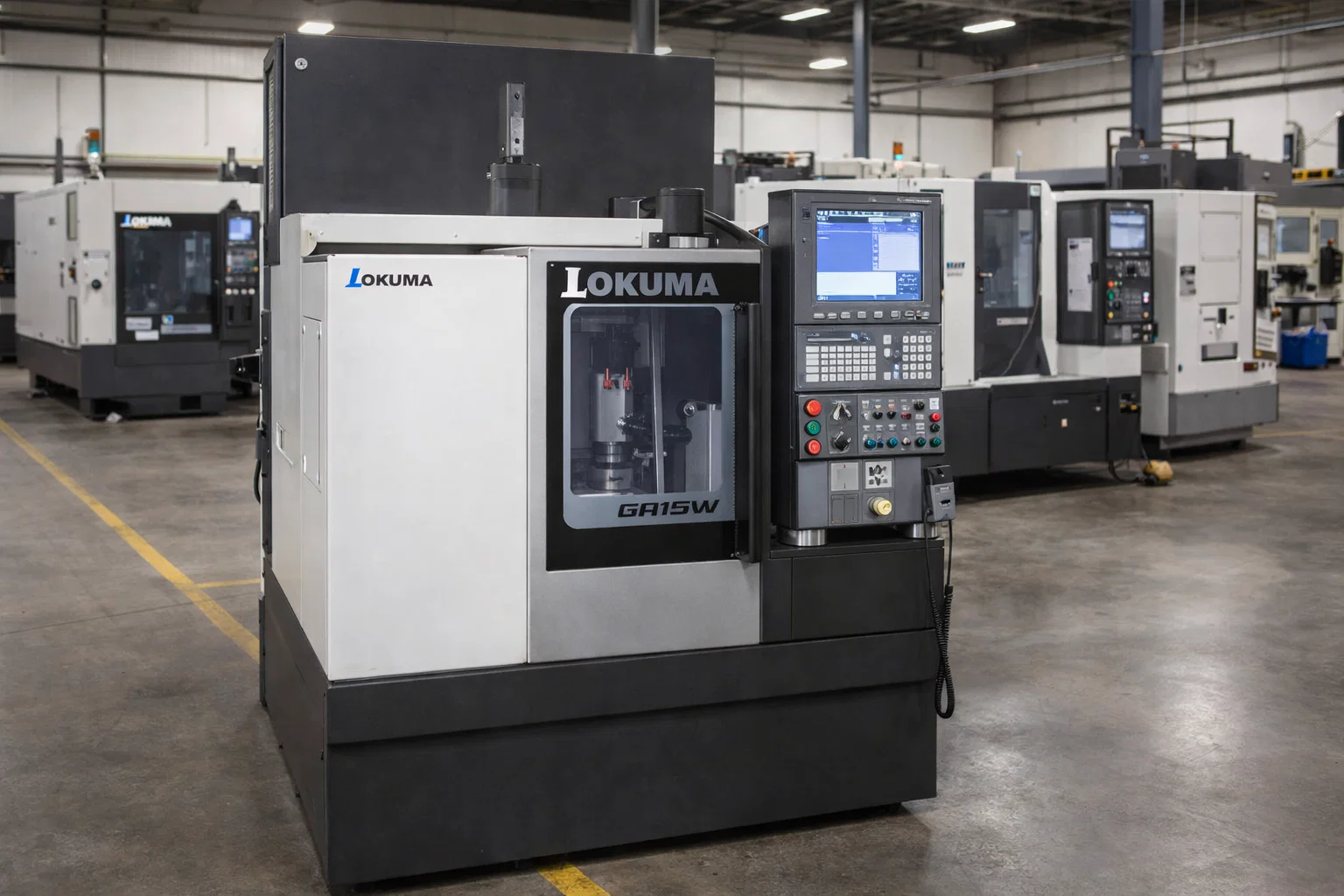
OKUMA - GP/GA15W
VIEW MACHINE -
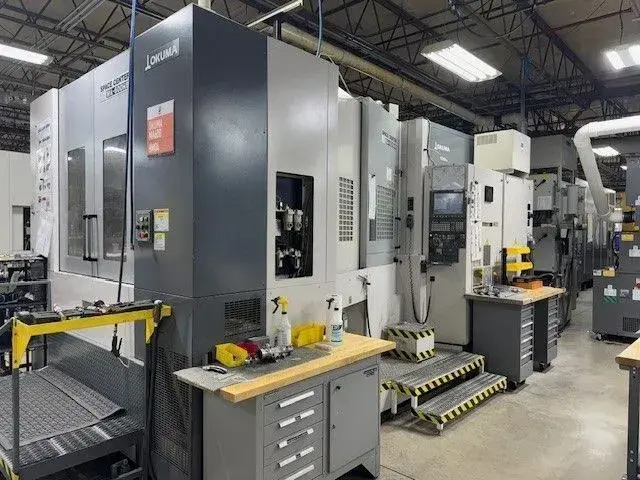
OKUMA - MA-600HB
VIEW MACHINE -
OKUMA - M560-V
VIEW MACHINE -
OKUMA - MB-46V II
VIEW MACHINE