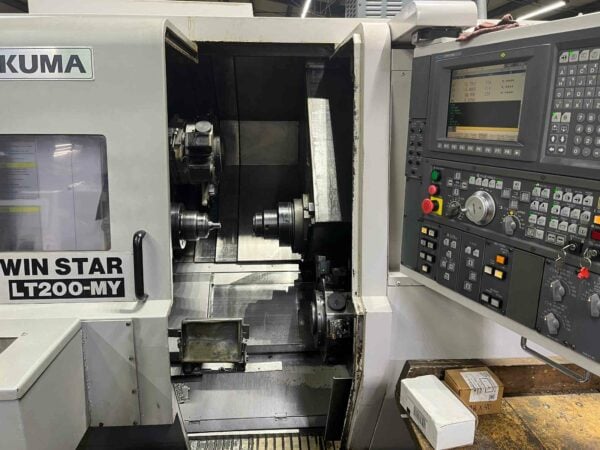
USED OKUMA LT-200 MY – 2005
The USED OKUMA LT-200 MY – 2005 is a high-productivity CNC turning and milling center designed for manufacturers that need more capability than a conventional single-spindle CNC lathe. Part of Okuma’s Twin Star family, the LT-200 MY combines turning, live tooling, C-axis machining, Y-axis capability, twin-spindle operation, and twin-turret configurations in a compact production-oriented platform. The machine is particularly useful for manufacturers producing complex turned components that require milling, drilling, tapping, cross-hole machining, or secondary operations without transferring the workpiece to another machine.
The LT-200 MY has a maximum swing of approximately 15.75 inches and a maximum cutting diameter of approximately 8.27 inches, with a maximum turning length of approximately 21.26 inches in the commonly documented configuration. Both the main spindle and sub-spindle use A2-6 spindle noses, with approximately 2.44-inch spindle bores and 2-inch bar capacity. Main and sub-spindle speeds are commonly listed up to 4,500 RPM, while the live-tooling system can reach approximately 6,000 RPM.
One of the major advantages of the LT-200 MY is its combination of two spindles and two turrets. Used LT-200 MY machines are commonly equipped with 12-station turrets, with live-tooling capability available for machining operations on the workpiece. This arrangement allows manufacturers to perform multiple operations in one setup and can significantly reduce handling and work-in-process between turning and milling operations.
The Y-axis provides additional flexibility for off-center milling and drilling. The commonly published specification shows approximately ±3.62 inches of Y-axis travel, while the sub-spindle has approximately 28.74 inches of B/W-axis travel, depending on the terminology used in the machine documentation. The LT-200 MY can therefore be configured for highly automated production of parts requiring multiple machining operations.
The 2005 model is also commonly found with an Okuma OSP-P100L CNC control, although individual machines may have different control configurations or later upgrades. Used examples can also be equipped with chip conveyors, parts catchers, touch setters, bar-feed interfaces, collet systems, tooling packages, and other production accessories.
For manufacturers looking for a used CNC turning center with live tooling, Y-axis capability, C-axis machining, twin spindles, and twin-turret production capability, the OKUMA LT-200 MY remains a versatile machine platform. Exact specifications, options, tooling, machine hours, condition, and control configuration should always be verified on the individual used machine before purchase.
OKUMA LT-200 MY 2005 – AXIS
The OKUMA LT-200 MY is designed around a multi-axis turning configuration that can combine conventional turning with milling operations. Commonly documented machines use two turrets, two spindles, C-axis functionality, and Y-axis capability on the upper turret.
| Axis / Function | Approximate Specification |
|---|---|
| X-Axis Travel – Turret 1 | 7.56″ |
| X-Axis Travel – Turret 2 | 7.56″ |
| Z-Axis Travel – Turret 1 | 27.56″ |
| Z-Axis Travel – Turret 2 | 27.56″ |
| Y-Axis Travel | Approximately ±3.62″ |
| Sub-Spindle W/B-Axis Travel | Approximately 28.74″ |
| C-Axis | 0.001° indexing, configuration dependent |
| Turret 1 | 12 stations |
| Turret 2 | 12 stations |
| Spindles | Main + Sub |
| Live Tooling | Yes |
| Y-Axis | Yes |
Published specifications for the 2005 LT-200 MY show 7.56-inch X-axis travel on both turrets and 27.56-inch Z-axis travel on both turrets. The Y-axis travel is listed at approximately ±3.62 inches, while the sub-spindle travel is approximately 28.74 inches.
The combination of X, Z, Y, C, and sub-spindle movement allows the machine to perform substantially more than basic turning. Y-axis movement is particularly useful when using live tools to machine features away from the centerline of the part.
OKUMA LT-200 MY 2005 – AXIS TRAVELS / WORK ENVELOPE
The work envelope of the OKUMA LT-200 MY is suited to small- and medium-sized precision components. Its approximately 8.27-inch maximum cutting diameter makes the machine particularly useful for parts that do not require the large swing and chuck capacity of heavy-duty turning centers.
The commonly published specifications are:
| Work Envelope | Specification |
|---|---|
| Swing | 15.75″ |
| Swing Over Cross Slide | 12.20″ |
| Maximum Cutting Diameter | 8.27″ |
| Maximum Turning Length | 21.26″ |
| Distance Between Spindle Noses | 37.80″ |
| X Travel | 7.56″ |
| Z Travel | 27.56″ |
| Y Travel | Approximately ±3.62″ |
| Sub-Spindle Travel | 28.74″ |
The 37.80-inch maximum distance between spindle noses provides the machine with substantial positioning flexibility for transferring and supporting parts between the main and sub-spindle.
Because the actual work envelope depends on tooling, chuck configuration, part geometry, and the machine’s specific options, buyers should confirm the exact usable envelope on an individual machine.
OKUMA LT-200 MY 2005 – CAPACITY / WORKHOLDING
The LT-200 MY is commonly configured with an approximately 8-inch main chuck and a smaller sub-spindle chuck, although individual machines may be supplied with different chucking and collet arrangements.
A documented 2005 LT-200 MY example lists an 8-inch chuck, 2-inch bar capacity, 15.75-inch swing, and 8.27-inch maximum turning diameter. Another documented machine is equipped with ATS collet chucks on both the main and sub-spindles.
| Capacity | Approximate Specification |
|---|---|
| Main Chuck | 8″ commonly equipped |
| Sub-Spindle Chuck | Approximately 6″ commonly equipped |
| Maximum Bar Capacity | 2″ |
| Spindle Bore | 2.44″ |
| Swing | 15.75″ |
| Maximum Turning Diameter | 8.27″ |
| Maximum Turning Length | 21.26″ |
The dual-spindle design allows parts to be transferred from the main spindle to the sub-spindle for additional machining. This is useful for components requiring front- and back-side operations.
OKUMA LT-200 MY 2005 – MAIN SPINDLE
The main spindle of the LT-200 MY is commonly specified with an A2-6 spindle nose, approximately 2.44-inch spindle bore, and approximately 2-inch bar capacity.
Published specifications list a main spindle speed range of approximately 45 to 4,500 RPM and a main spindle motor rated at approximately 15 HP for 30-minute duty and 10 HP continuous.
| Main Spindle Specification | Approximate Value |
|---|---|
| Spindle Nose | A2-6 |
| Spindle Bore | 2.44″ |
| Bar Capacity | 2″ |
| Speed Range | 45–4,500 RPM |
| Motor | 15 HP / 10 HP continuous |
| C-Axis | Yes, configuration dependent |
The spindle speed range provides flexibility for both roughing and finishing operations. C-axis capability further allows the spindle to be positioned for live-tool machining.
OKUMA LT-200 MY 2005 – SUB SPINDLE
The sub-spindle is one of the most important features of the LT-200 MY. It allows the machine to grip the part after machining on the main spindle and perform additional operations without removing the workpiece.
The commonly documented LT-200 MY specification lists the sub-spindle with the same 4,500 RPM maximum speed, approximately 2.44-inch bore, 2-inch bar capacity, and A2-6 spindle nose as the main spindle.
| Sub-Spindle Specification | Approximate Value |
|---|---|
| Spindle Nose | A2-6 |
| Spindle Bore | 2.44″ |
| Bar Capacity | 2″ |
| Maximum Speed | 4,500 RPM |
| Motor | 15 HP / 10 HP continuous |
| Sub-Spindle Travel | 28.74″ |
| C-Axis | Configuration dependent |
This arrangement is useful for machining both ends of shafts, bushings, fittings, and other components where secondary setup would otherwise be required.
OKUMA LT-200 MY 2005 – Y AXIS
The Y-axis is a key feature distinguishing the LT-200 MY from many conventional CNC turning centers.
The upper turret’s Y-axis is commonly listed with approximately ±3.62 inches of travel. Other published documentation shows the positive and negative travel separately, approximately +1.65/+1.96 inches and -1.97/-1.65 inches, depending on the specification source and configuration.
Y-axis capability allows the live tooling to move away from the centerline of the workpiece. This makes the machine suitable for:
- Off-center drilling
- Cross drilling
- Milling flats
- Slot milling
- Keyway machining
- Side-hole machining
- Radial milling
- Complex turned-and-milled components
For manufacturers producing parts that would otherwise require a separate machining center after turning, the Y-axis can reduce secondary operations and part handling.
OKUMA LT-200 MY 2005 – C-AXIS / LIVE TOOLING
The LT-200 MY combines C-axis spindle positioning with live tooling to provide milling and drilling capability on the turning center.
The rotary tooling system is commonly specified for speeds from approximately 50 to 6,000 RPM, with approximately 5.4 HP rotary tool motors.
| Live Tooling Feature | Specification |
|---|---|
| Live Tool Speed | 50–6,000 RPM |
| Rotary Tool Motor | Approx. 5.4 HP |
| C-Axis | Yes |
| Y-Axis | Yes |
| Live Tool Stations | Configuration dependent |
| Turret Stations | 12 + 12 commonly documented |
Live tooling substantially expands the type of components that can be produced. Instead of turning the OD and then moving the component to a separate mill for drilling or milling, many operations can be completed within the LT-200 MY.
OKUMA LT-200 MY 2005 – TURRET / TOOL CAPACITY
The LT-200 MY is commonly configured with two 12-station turrets, giving the machine a total of up to 24 turret positions.
Published specifications identify the turrets as 12-position units, with rotary tooling capability. Some used machines are supplied with tooling packages, static holders, radial live-tool units, collet holders, and other accessories.
| Turret Specification | Approximate Value |
|---|---|
| Turret 1 | 12 stations |
| Turret 2 | 12 stations |
| Total Positions | 24 |
| Live Tooling | Yes |
| Tooling Type | Configuration dependent |
The twin-turret configuration makes the LT-200 MY well suited to production environments where several tools must remain loaded and ready for rapid cycle execution.
OKUMA LT-200 MY 2005 – CONTROL SYSTEM
A commonly documented 2005 LT-200 MY is equipped with the Okuma OSP-P100L CNC control.
The OSP control provides the machine with the CNC platform required for coordinated turning, milling, spindle synchronization, C-axis operations, and multi-axis machining.
Some used machines may have different controls or control upgrades, so buyers should verify the actual control installed on the machine being considered.
Features documented on used LT-200 MY machines can include:
- OSP-P100L CNC control
- Tool life management
- Tool wear compensation
- Spindle orientation
- Synchronous tapping
- Thermal compensation
- Nose radius compensation
- Parts programming
- C-axis control
- Live-tool machining
- Automatic part transfer functions
A machine with a clean, operational control and documented maintenance history can be particularly valuable when purchasing a 20-year-old multi-axis CNC.
OKUMA LT-200 MY 2005 – CHIP MANAGEMENT / COOLANT
The LT-200 MY can be equipped with automatic chip-handling equipment such as a chip conveyor. Used examples are also commonly advertised with parts catchers and other production accessories.
Chip management is especially important on a twin-spindle, live-tool CNC because the machine can generate chips from both turning and milling operations.
Common equipment may include:
- Chip conveyor
- Flood coolant
- Parts catcher
- Parts ejector
- Coolant system
- Tool touch setter
- Automatic doors
- Bar-feed interface
The exact coolant pump, tank capacity, filtration system, chip conveyor style, and high-pressure coolant capability should be confirmed for each individual machine.
OKUMA LT-200 MY 2005 – AUTOMATION CAPABILITY
The LT-200 MY is well suited to production automation because of its twin-spindle and multi-turret architecture.
Used examples have been documented with bar-feed interfaces, parts catchers, parts ejectors, automatic doors, and robotic-loader interfaces.
A bar feeder can supply raw material automatically for repeated production. After the main spindle operation, the sub-spindle can take over the part for secondary machining, while a parts catcher can facilitate finished-part removal.
This type of configuration can be particularly useful for high-volume production of repetitive components.
OKUMA LT-200 MY 2005 – RAPID TRAVERSE
Published specifications for the LT-200 MY list approximate rapid traverse rates of:
| Axis | Rapid Traverse |
|---|---|
| X | 1,181 IPM |
| Z | 1,574 IPM |
| Y | Approximately 1,024 IPM in some documentation |
| Y – Other published specification | Approximately 591–788 IPM |
| Sub-Spindle | 1,574 IPM |
The variation in published Y-axis rapid-traverse figures reflects differences between available specification sources and configurations. Buyers should verify the actual machine documentation for a particular LT-200 MY.
OKUMA LT-200 MY 2005 – POWER REQUIREMENTS
The spindle motors on the commonly documented LT-200 MY are approximately 15 HP / 10 HP continuous for both the main and sub-spindle, while the rotary tooling motors are approximately 5.4 HP.
| Power Item | Approximate Specification |
|---|---|
| Main Spindle Motor | 15 HP / 10 HP continuous |
| Sub-Spindle Motor | 15 HP / 10 HP continuous |
| Rotary Tool Motor | Approx. 5.4 HP |
| Electrical Service | Configuration dependent |
Electrical requirements can vary according to the machine’s exact configuration, installed accessories, transformer, coolant system, chip conveyor, and other options. Electrical specifications should therefore be verified from the machine’s data plate and documentation before installation.
OKUMA LT-200 MY 2005 – DIMENSIONS AND WEIGHT
A documented 2005 LT-200 MY lists an approximate floor space of 105 × 88 × 88 inches and an approximate machine weight of 16,000 pounds.
| Dimension / Weight | Approximate Value |
|---|---|
| Length | 105″ |
| Width | 88″ |
| Height | 88″ |
| Weight | Approx. 16,000 lb |
Actual shipping weight and dimensions can vary depending on chip conveyor, bar feeder, transformer, tooling, automation equipment, coolant system, and other accessories.
OKUMA LT-200 MY 2005 – GENERAL INFORMATION
| Specification | Details |
|---|---|
| Manufacturer | Okuma |
| Model | LT-200 MY |
| Year | 2005 |
| Machine Type | CNC Turning / Turn-Mill Center |
| Configuration | Twin Spindle / Twin Turret |
| Axes | Configuration dependent; commonly 4-axis and multi-axis |
| Main Spindle | 4,500 RPM |
| Sub-Spindle | 4,500 RPM |
| Maximum Cutting Diameter | 8.27″ |
| Maximum Turning Length | 21.26″ |
| Swing | 15.75″ |
| Bar Capacity | 2″ |
| Spindle Bore | 2.44″ |
| Turrets | 12 + 12 stations |
| Live Tooling | Yes |
| Y-Axis | Yes |
| C-Axis | Yes |
| Control | OSP-P100L commonly documented |
| Approx. Weight | 16,000 lb |
The exact configuration should always be verified because the used market contains LT-200 MY machines with different tooling packages, controls, chucks, automation systems, and production accessories.
INDUSTRIES THAT USE THE OKUMA LT-200 MY 2005
The OKUMA LT-200 MY is appropriate for industries that manufacture relatively compact turned components and benefit from combining turning and milling operations.
Automotive
Automotive suppliers can use the LT-200 MY for shafts, hubs, fittings, connectors, sleeves, and other precision components.
Aerospace
The machine’s live tooling and Y-axis capabilities can be useful for smaller aerospace components requiring turning combined with drilling and milling.
Oil and Gas
The machine can be used for smaller valves, fittings, adapters, sleeves, and other precision components within its work envelope.
General Manufacturing
Job shops can benefit from the LT-200 MY because its multi-function capability allows a wide variety of components to be produced.
Industrial Equipment
Manufacturers of pumps, motors, machinery, and industrial equipment can use the machine for shafts, bushings, housings, fittings, and other turned components.
Medical Equipment
The precision turning and milling capabilities can be suitable for smaller medical and instrumentation components when the machine’s condition and accuracy meet the required specifications.
TYPICAL PARTS PRODUCED ON AN OKUMA LT-200 MY 2005
The LT-200 MY can manufacture many types of components within its approximately 8.27-inch maximum cutting diameter.
Typical parts can include:
- Shafts
- Bushings
- Sleeves
- Hubs
- Flanges
- Couplings
- Fittings
- Hydraulic components
- Pneumatic components
- Valve components
- Automotive components
- Pump components
- Motor components
- Threaded components
- Precision collars
- Machine-tool components
- Small aerospace components
- Components requiring cross holes
- Components requiring milled flats
- Components requiring off-center drilling
The combination of main spindle, sub-spindle, live tooling, Y-axis and C-axis makes the LT-200 MY especially useful for parts that require multiple operations.
WHY CHOOSE THE OKUMA LT-200 MY 2005?
The main advantage of the OKUMA LT-200 MY is its ability to combine several machining functions in one platform. A conventional CNC lathe may require a second machine for milling, drilling, or back-side operations. The LT-200 MY was designed to reduce that need by incorporating multiple spindles, turrets, live tooling, C-axis machining, and Y-axis capability.
The twin-spindle configuration is valuable for components requiring machining on both ends. Instead of removing the part and manually setting it up again, the sub-spindle can take over the workpiece and complete additional operations.
The Y-axis provides another major advantage. It allows live tools to machine features away from the centerline, making the LT-200 MY suitable for cross holes, flats, slots, and other milled features.
The live tooling system can operate at approximately 6,000 RPM, providing useful capability for drilling and milling operations.
The twin-turret design also provides substantial tooling capacity, with commonly documented machines using 12 stations on each turret.
For a manufacturer purchasing a used CNC machine, the LT-200 MY can therefore provide turning, milling, secondary spindle machining, and multi-tool production capability in one machine footprint.
WHY BUY USED OKUMA LT-200 MY?
Buying a used OKUMA LT-200 MY – 2005 can provide access to a sophisticated multi-axis turning platform at a substantially different acquisition cost than purchasing a comparable new turn-mill machine. The machine’s original design combines twin-spindle machining, twin turrets, live tooling, C-axis capability, and Y-axis machining, making it considerably more versatile than a basic two-axis CNC lathe.
For manufacturers that already have experienced CNC operators and programmers, a used LT-200 MY can be particularly useful when production requires multiple operations on the same component. The ability to turn, drill, mill, and transfer parts between spindles can reduce setups and handling.
The machine’s 2-inch bar capacity is also useful for a broad range of small- and medium-sized production components. Its approximately 8.27-inch maximum cutting diameter and 21.26-inch maximum turning length place it in a useful size range for many industrial parts.
Another advantage of purchasing used is the availability of machines already equipped with production accessories. Used LT-200 MY examples have been advertised with chip conveyors, parts catchers, touch setters, bar-feed interfaces, tooling, collet systems, and other accessories.
However, condition is particularly important when purchasing a 2005 multi-axis CNC. Buyers should inspect spindle condition, turret alignment, live-tool operation, Y-axis backlash, C-axis accuracy, sub-spindle movement, ball screws, way surfaces, hydraulic systems, coolant systems, chip conveyor, control electronics, and machine geometry.
A complete inspection should also verify machine hours, spindle hours, maintenance records, alarm history, tooling included with the machine, and whether the machine can be demonstrated under power.
A properly inspected used LT-200 MY can provide manufacturers with a capable production turning and milling platform while avoiding the acquisition cost of a new machine with comparable multi-function capabilities.
HOW MUCH DOES A USED OKUMA LT-200 MY COST?
The price of a USED OKUMA LT-200 MY – 2005 can vary substantially depending on machine condition, hours, control configuration, tooling, rebuilding or refurbishment, included automation, spindle condition, and the seller’s asking price.
Current and recent used-machine listings illustrate this variation. A 2005 Okuma LT-200 MY has been listed at approximately $55,000, with OSP control, chip conveyor, bar feeder, live tooling, sub-spindle, Y-axis, and other production features.
Another 2005 LT-200 MY listing from Revelation Machinery shows an asking price of approximately $114,900 for a machine described as having been fully rebuilt in 2017 and equipped with live tooling and additional production accessories.
These examples demonstrate why there is no single fixed market price for a used LT-200 MY. A machine that has undergone a substantial rebuild can command a significantly different asking price from a machine being sold in ordinary used condition.
When evaluating a used LT-200 MY, buyers should compare the total machine package, not just the advertised price. A machine with an included chip conveyor, parts catcher, live-tool holders, collets, touch setter, bar-feed interface, and tooling package may have considerably more practical value than a lower-priced machine requiring those items to be purchased separately.
Condition is another major pricing factor. Spindle hours, cutting hours, turret condition, ball-screw condition, machine geometry, control condition, hydraulic performance, and the accuracy of the Y-axis and C-axis should all be considered.
For that reason, advertised prices should be treated as individual seller asking prices rather than a guaranteed market value. The actual value of a particular 2005 OKUMA LT-200 MY depends on its condition, configuration, location, included equipment, service history, and inspection results. Buyers should request current photos, machine videos, CNC control information, spindle hours, machine hours, serial number, and a complete list of included tooling and accessories before making a purchasing decision.
OKUMA LT-200 MY 2005 – USED MACHINE INSPECTION CHECKLIST
Before purchasing a used LT-200 MY, buyers should inspect the following:
| Inspection Area | What to Check |
|---|---|
| Main Spindle | Noise, vibration, temperature, runout |
| Sub-Spindle | Movement, clamping, alignment |
| Turret 1 | Indexing, alignment, backlash |
| Turret 2 | Indexing, alignment, backlash |
| Y-Axis | Travel, backlash, accuracy |
| C-Axis | Positioning and spindle orientation |
| Live Tooling | Operation and noise |
| Ball Screws | Wear and backlash |
| Ways | Wear and surface condition |
| Hydraulic System | Pressure and leaks |
| Coolant | Pump, tank and delivery |
| Chip Conveyor | Operation and condition |
| Control | Display, alarms, drives and electronics |
| Parts Catcher | Operation |
| Tooling | Included holders and live-tool units |
| Bar Feeder | Included or not included |
| Electrical | Voltage and transformer requirements |
A demonstration under power is strongly recommended. The buyer should verify actual machine performance rather than relying solely on an online listing description.
OKUMA LT-200 MY 2005 – PRODUCTION APPLICATIONS
The LT-200 MY can be particularly effective in production environments where one component requires several machining operations.
For example, a shaft-type component may require:
- Main-spindle facing
- OD turning
- Grooving
- Threading
- C-axis positioning
- Cross drilling
- Y-axis milling
- Part transfer to the sub-spindle
- Back-side facing
- Secondary OD machining
- Part cutoff
- Finished-part ejection
The ability to perform multiple operations without repeatedly removing and resetting the workpiece can improve consistency and reduce setup time.
For job shops, this flexibility also allows the machine to handle a broader range of work than a basic two-axis CNC lathe.
OKUMA LT-200 MY 2005 – MACHINE SUMMARY
The USED OKUMA LT-200 MY – 2005 is a multi-function CNC turning and milling center designed for manufacturers that require more than conventional turning capability.
Its key features include:
- Approximately 15.75″ swing
- Approximately 8.27″ maximum cutting diameter
- Approximately 21.26″ maximum turning length
- Main and sub-spindle configuration
- 4,500 RPM main spindle
- 4,500 RPM sub-spindle
- Approximately 2″ bar capacity
- A2-6 spindle noses
- Approximately 2.44″ spindle bores
- Twin 12-station turrets
- Live tooling
- Approximately 6,000 RPM rotary tooling
- Y-axis capability
- C-axis capability
- Parts transfer capability
- OSP-P100L control commonly documented
- Chip conveyor options
- Parts catcher options
- Bar-feed interface
- Approximate 16,000-lb machine weight
The combination of twin spindle + twin turret + Y-axis + C-axis + live tooling makes the LT-200 MY a versatile used CNC platform for manufacturers producing complex turned components.
As with any used CNC machine, specifications and options can vary from one machine to another. Buyers should independently verify the exact serial number, control, spindle configuration, machine hours, cutting hours, travels, tooling, accessories, electrical requirements, and machine condition before purchasing.
Related Products
-
OKUMA - VTM-1200YB
VIEW MACHINE -
OKUMA - MB-5000H
VIEW MACHINE -
OKUMA - MULTUS U4000
VIEW MACHINE -
OKUMA - LB4000 EX II
VIEW MACHINE