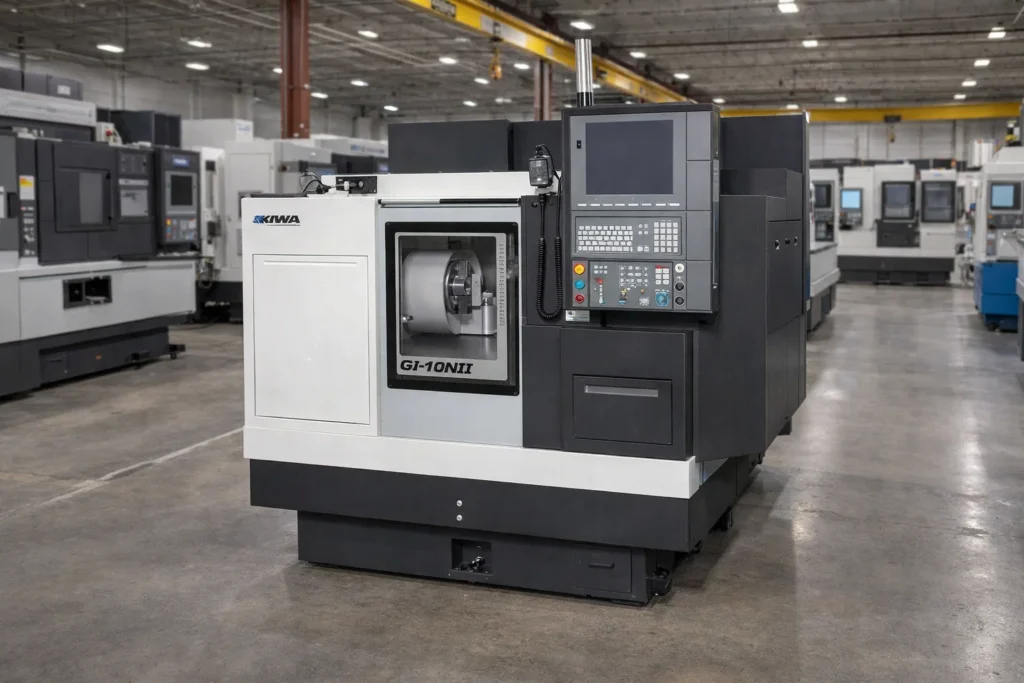
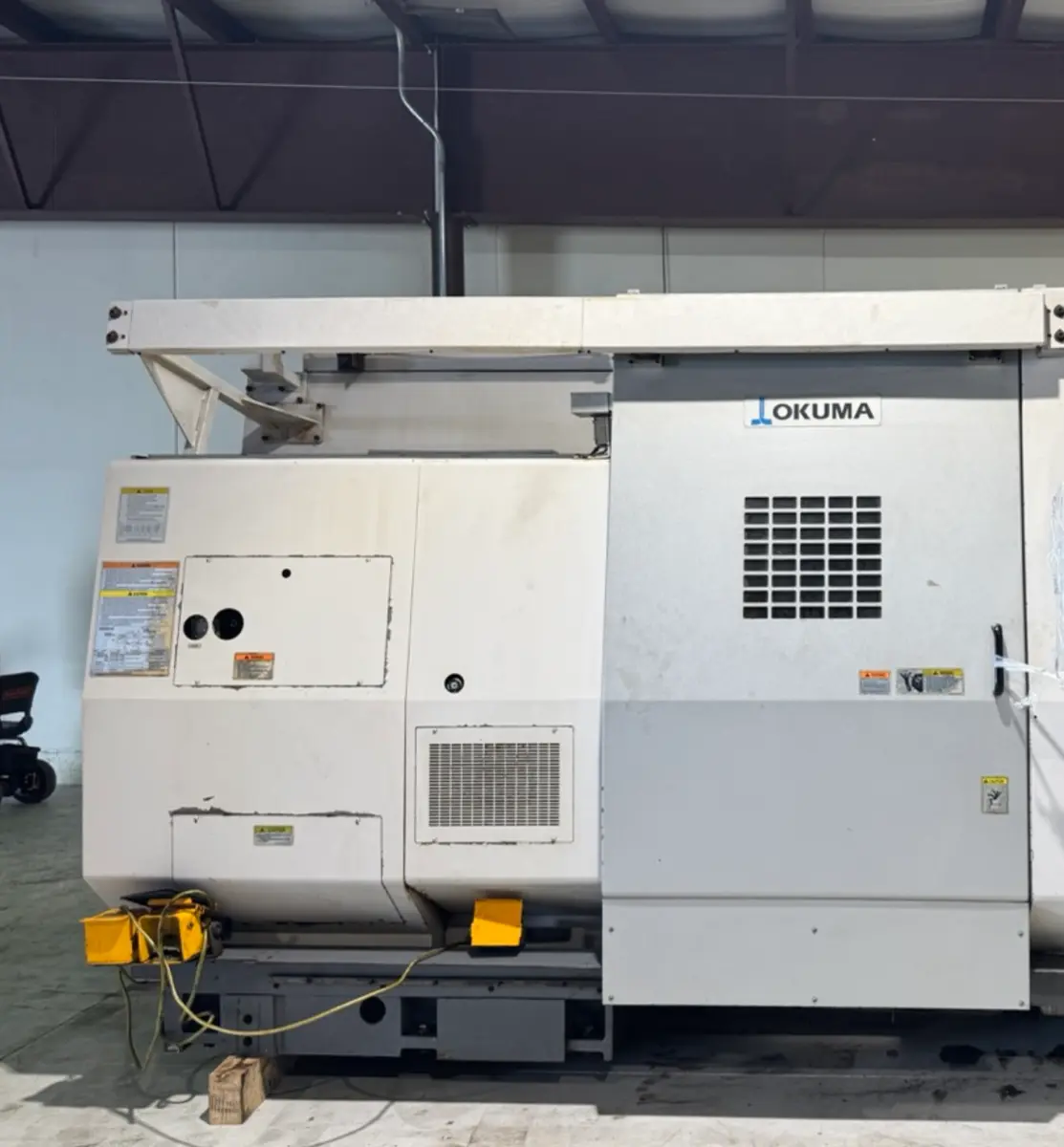
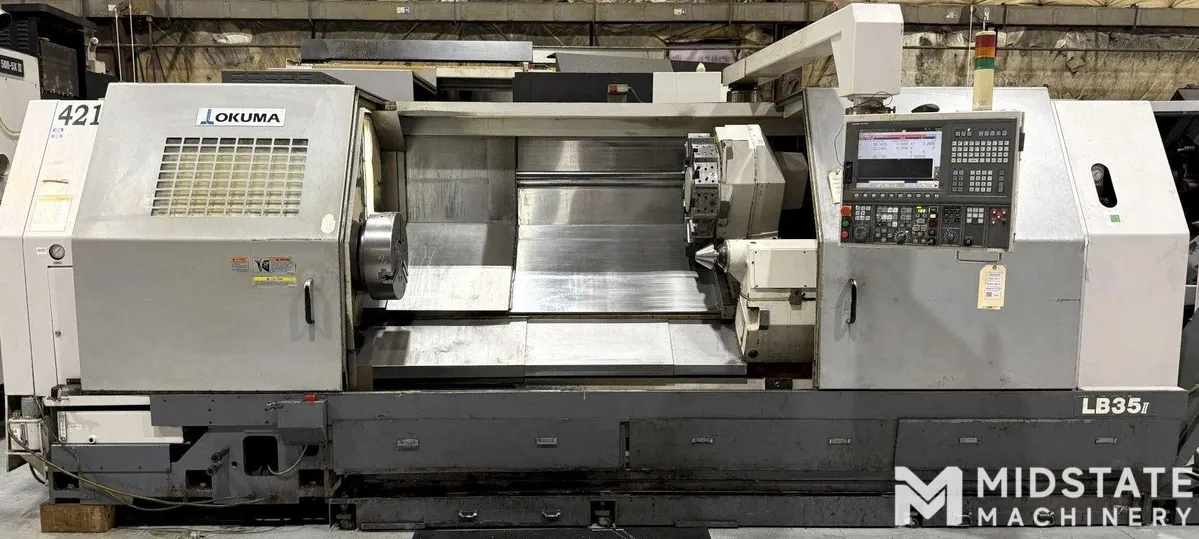
The Okuma GI-10NII is a compact, high-speed CNC internal grinding machine designed for precision grinding of small to medium-sized bores in high-production environments. As part of Okuma’s GI series, it is specifically engineered for internal diameter (ID) grinding applications where tight tolerances, high surface finish quality, and consistent repeatability are critical. It is widely used in industries such as automotive, aerospace, bearings, and precision components manufacturing.
The machine is capable of grinding bore sizes ranging from approximately 3 mm to 150 mm, with a maximum grinding length of around 150 mm. This makes it ideal for components such as bearing races, bushings, gears, and engine parts. One of its key advantages is the availability of high-speed grinding wheel spindles, including belt-driven spindles up to 40,000 rpm and high-frequency spindles reaching up to 150,000 rpm, enabling both high-speed finishing and efficient material removal.
The GI-10NII is built with a rigid structure, including 5-surface hydrostatic guideways that ensure high stability, accuracy, and long-term durability. This design minimizes vibration and thermal distortion, which is essential for maintaining precision during extended grinding cycles. Rapid traverse speeds of approximately 20 m/min (X-axis) and 30 m/min (Z-axis) help reduce idle time and improve productivity.
The machine is equipped with Okuma’s OSP-P300GA control system, featuring IGAP+ conversational programming for simplified operation and faster setup. Additionally, it supports automation integration such as loaders and robotic systems, making it ideal for high cutting (grinding) time utilization and lights-out manufacturing. Overall, the GI-10NII offers a strong combination of speed, precision, and compact design for internal grinding applications.
OKUMA GI-10NIISPECIFICATIONS
OKUMA GI-10NII – AXIS
X-Axis
Z-Axis
Simultaneous 2-Axis CNC Control
OKUMA GI-10NII – AXIS TRAVELS
X-Axis Travel: High-Speed Rapid Traverse up to 20 m/min
Z-Axis Travel: High-Speed Rapid Traverse up to 30 m/min
OKUMA GI-10NII – CAPACITY
Bore Diameter Range: Ø3 – 150 mm
Maximum Grinding Length: 150 mm
Maximum Workpiece Weight: Approx. 100 kg
Swing in Guard: Approx. 350 mm
OKUMA GI-10NII – SPINDLE
Wheel Spindle Speed: Up to 40,000 RPM (belt drive)
High-Frequency Spindle: Up to 150,000 RPM
Wheel Motor Power: Approx. 5.5 kW
High-Speed Internal Grinding Capability
OKUMA GI-10NII – TABLE
Table Type: Fixed Workhead Configuration
Guideways: 5-Surface Hydrostatic Guideways
Design: High Rigidity & Thermal Stability
OKUMA GI-10NII – TOOL TURRET
Wheel Head Type: Single / Multiple Spindle Options
Supports Internal Grinding Operations
Designed for High-Speed Production
Suitable for Small Precision Components
OKUMA GI-10NII – FEEDRATES
Rapid Traverse X-Axis: 20 m/min
Rapid Traverse Z-Axis: 30 m/min
High-Speed Oscillation for Efficient Material Removal
OKUMA GI-10NII – COOLANT & CHIP MANAGEMENT
Coolant System: Integrated Grinding Coolant
Coolant Splash Guard Enclosure
Efficient Swarf Removal System
OKUMA GI-10NII – CONTROL SYSTEM
CNC Control: OSP-P300GA
Programming: Conversational (IGAP+) & G-Code
Features: Program Help Function, Easy Setup
Supports Automation Integration
OKUMA GI-10NII – POWER & AIR REQUIREMENTS
Power Supply: 3-Phase AC
Power Consumption: Approx. 15–20 kVA
Air Requirement: Clean, Dry Compressed Air
OKUMA GI-10NII – DIMENSIONS
Machine Size (W x D x H): 2,050 x 2,100 x 1,900 mm
Compact Footprint Design
Suitable for Automated Cells
OKUMA GI-10NII – GENERAL INFORMATION
Machine Type: CNC Internal (ID) Grinder
Application: High-Speed Internal Bore Grinding
Design: Compact, High-Speed Production Machine
Automation: Easily Integrates with Gantry Loaders
Ideal for Mass Production of Small Parts
INDUSTRIES THAT USE OKUMA GI-10NII
Automotive
Aerospace
Bearing Manufacturing
Precision Engineering
Medical Devices
TYPICAL PARTS OKUMA GI-10NII CAN PRODUCE
Bearing Races
Bushings
Engine Components
Hydraulic Sleeves
Small Precision Bore Parts
WHY CHOOSE OKUMA GI-10NII
Extremely High Spindle Speeds (Up to 150,000 RPM)
Ideal for Small, High-Precision Internal Grinding
Compact Design for Automation Cells
High Productivity for Mass Production
Excellent Accuracy & Surface Finish
Reliable Thermal Stability & Rigidity
WHY BUY USED OKUMA GI-10NII
Purchasing a used Okuma GI-10NII is a highly practical choice for manufacturers seeking high-precision internal grinding capabilities at a reduced cost. Machines in the GI series are designed for production environments and built with durability in mind, making them well-suited for long-term use even in the secondary market. With proper maintenance, these machines can continue to deliver excellent accuracy and consistency over many years.
One of the primary benefits of buying used is cost efficiency. New internal grinding machines with high-speed spindle capabilities and automation features require a significant capital investment. A used GI-10NII allows businesses to access the same high-performance grinding capabilities—including high spindle speeds, compact footprint, and automation readiness—at a fraction of the original cost.
Grinding time (spindle hours) is one of the most critical factors when evaluating a used GI-10NII. Machines with lower grinding hours typically maintain better spindle condition and higher accuracy. For example, a machine from the early 2010s with moderate grinding time may offer better long-term reliability than a newer unit that has been heavily used in continuous production. Since internal grinding demands extremely tight tolerances, spindle wear and guideway condition must be carefully assessed.
Another advantage is production efficiency. The GI-10NII is designed for high-speed, repetitive grinding operations, meaning even used machines can maintain strong output levels in production environments. Additionally, Okuma’s global support network and parts availability help reduce the risks associated with purchasing older equipment.
From a financial perspective, buying used enables faster return on investment. With lower upfront costs and the ability to sustain high grinding time utilization, a used GI-10NII can quickly contribute to production capacity and profitability.
HOW MUCH DOES A USED OKUMA GI-10NIICOST?
The cost of a used Okuma GI-10NII depends on factors such as manufacturing year, machine condition, configuration, and most importantly, grinding time (spindle hours). As a specialized internal grinding machine, it typically falls within a mid-range price category compared to larger cylindrical or multi-axis grinders.
Machines built before 2000 (or earlier-generation internal grinders comparable to this platform) generally range from $8,000 to $25,000. These machines are the most affordable but may include outdated controls and higher wear levels. Grinding time is especially important in this category—machines with high spindle hours may require significant refurbishment, while low-hour units can still perform effectively for light production applications.
Models produced between 2000 and 2010 typically range from $25,000 to $70,000. These machines often provide a strong balance between price and performance, offering improved control systems, better spindle technology, and enhanced stability. Units with low to moderate grinding time are particularly desirable, as they can deliver reliable accuracy with manageable maintenance costs.
Machines from 2010 to 2025 generally range from $70,000 to $150,000 or more, depending on spindle configuration (standard vs high-frequency), automation integration, and control system upgrades. These newer machines benefit from higher spindle speeds, improved efficiency, and better consistency in high-volume production environments.
Grinding time remains the most critical pricing factor. A newer machine with excessive spindle hours may be less valuable than an older unit with minimal use. Buyers should carefully evaluate spindle condition, maintenance records, and overall machine accuracy to determine true market value and ensure long-term operational reliability.