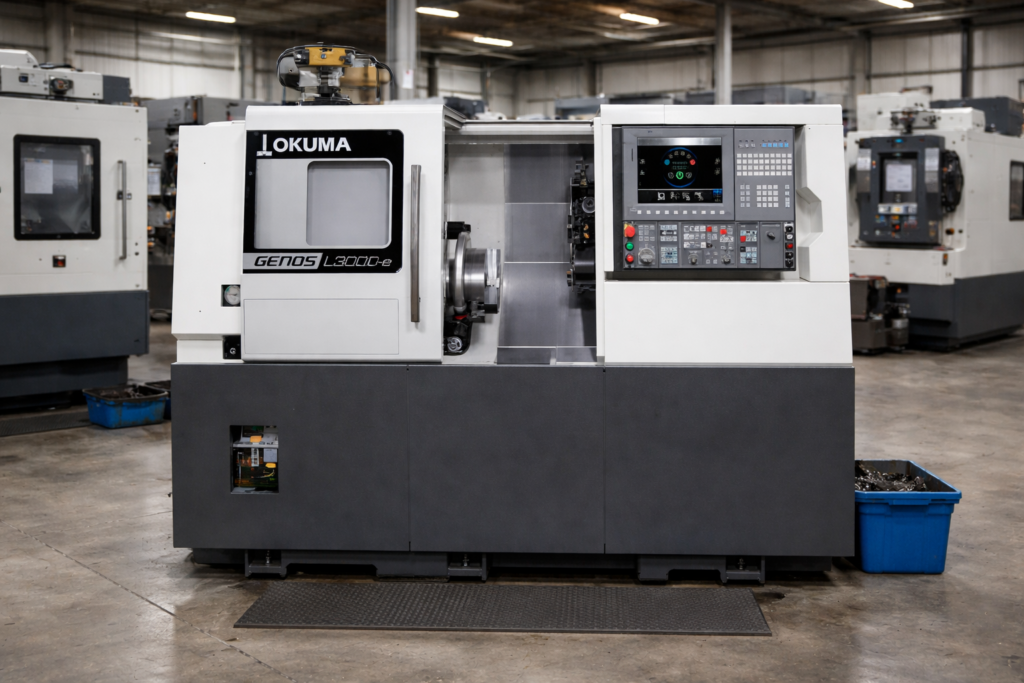
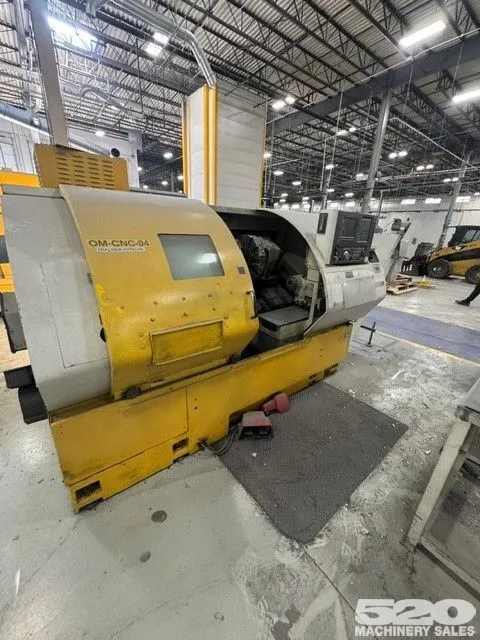
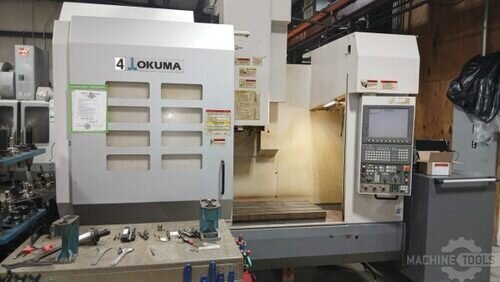
The Okuma Genos L3000-e is a high-performance CNC horizontal turning center designed for medium to larger workpieces, offering a balance between power, precision, and production efficiency. As part of Okuma’s GENOS L-series, it is built with a rigid one-saddle structure and integral spindle motor, enabling high torque cutting and stable machining even under demanding conditions. Okuma Corporation designed this model to deliver consistent accuracy through its Thermo Active Stabilizer (TAS-C), which compensates for thermal distortion during long machining cycles.
The machine typically supports a maximum turning diameter of around 300–340 mm and a turning length of up to 500 mm (with extended options available), making it suitable for industries such as automotive, energy, and heavy component manufacturing. A 12-station turret comes standard, with options for live tooling, Y-axis, and sub-spindle configurations, allowing for multi-process machining in a single setup.
With spindle speeds reaching approximately 3,800 rpm and a powerful motor output, the L3000-e is capable of both roughing and finishing operations efficiently. Its user-friendly design, easy maintenance access, and efficient chip evacuation system make it well-suited for continuous production environments. Overall, the Genos L3000-e is positioned as a reliable and versatile turning solution for shops requiring higher capacity machining with consistent repeatability.
Bed Construction: High rigidity cast iron structure
Guideways: Box-type for heavy cutting
Designed for stability and precision
OKUMA GENOS L3000-e – TOOL TURRET
Turret Type: Bolt-on slotted turret
Number of Stations: 12
Tooling: Static + Optional Live Tooling
High rigidity turret design
Fast indexing capability
OKUMA GENOS L3000-e – FEEDRATES
Rapid Traverse (X-Axis): Approx. 25 m/min
Rapid Traverse (Z-Axis): Approx. 30 m/min
Cutting Feed Rate: Programmable
High precision servo-driven system
OKUMA GENOS L3000-e – COOLANT & CHIP MANAGEMENT
Coolant System: Flood coolant
Coolant Tank: Separate tank design
Chip Conveyor: Optional
Reduced chip accumulation design
Easy maintenance and cleaning
OKUMA GENOS L3000-e – CONTROL SYSTEM
Control: Okuma OSP-P300 / OSP-P500
Programming: Conversational (IGF) + G-code
Advanced One-Touch programming
Thermo Active Stabilizer (TAS-C) for accuracy
OKUMA GENOS L3000-e – POWER & AIR REQUIREMENTS
Power Requirement: Approx. 30–40 kVA
Voltage: 200–400V (region dependent)
Air Requirement: Clean compressed air
Air Pressure: Approx. 5–6 bar
OKUMA GENOS L3000-e – DIMENSIONS
Machine Length: Approx. 2,800–3,500 mm
Machine Width: Approx. 1,800–2,000 mm
Machine Height: Approx. 1,900–2,200 mm
Machine Weight: Approx. 5,000–7,000 kg
OKUMA GENOS L3000-e – GENERAL INFORMATION
Machine Type: CNC Turning Center (Lathe)
Manufacturer: Okuma
Integral spindle design for high rigidity
Supports turning, milling, and multi-tasking
Compact footprint with high productivity
Designed for medium to heavy-duty machining
INDUSTRIES THAT USE OKUMA GENOS L3000-e
Automotive
Aerospace
Oil & Gas
Energy
General Engineering
Heavy Equipment Manufacturing
TYPICAL PARTS OKUMA GENOS L3000-e CAN PRODUCE
Shafts
Flanges
Large bushings
Hydraulic components
Valves
Precision turned heavy components
WHY CHOOSE OKUMA GENOS L3000-e
High rigidity for heavy cutting applications
Integral spindle for better performance
Flexible configurations (M, MY, sub-spindle)
Excellent thermal stability (TAS system)
Suitable for complex and large part machining
Reliable Okuma control and build quality
WHY BUY USED OKUMA GENOS L3000-e
Buying a used Okuma Genos L3000-e is a strong option for manufacturers that need higher-capacity turning capabilities without the cost of a new machine. These machines are engineered for durability, and their rigid construction, combined with thermal compensation systems, allows them to maintain accuracy even after extended operational use. This makes them highly desirable in the secondary market.
Cutting time (spindle hours) plays a critical role when evaluating a used unit. Machines with low cutting hours—typically under 5,000–7,000 hours—are considered lightly used and can perform close to new. Units with moderate usage (7,000–18,000 hours) are still dependable for most production needs if properly maintained. Machines with higher hours may require servicing of components such as turrets, spindles, or guideways, but they can still offer value for less intensive operations.
Another advantage is the availability of advanced configurations such as live tooling, Y-axis, and sub-spindle options even in used machines. This enables multi-tasking capabilities without investing in a new multi-axis lathe. Additionally, Okuma machines are known for long service life and strong parts support, reducing ownership risk.
For growing shops or those expanding capacity, a used Genos L3000-e offers a cost-effective way to access powerful CNC turning with proven reliability and flexibility.
HOW MUCH DOES A USED OKUMA GENOS L3000-eCOST?
The cost of a used Okuma Genos L3000-e depends on manufacturing year, configuration, condition, and especially cutting time. Since this model was introduced around the late 2010s, pricing is typically segmented by usage and technological generation rather than very old pre-2000 machines.
For early machines (2017–2019), prices generally range from $40,000 to $70,000. These machines often have higher cutting hours (10,000–20,000+) and may require maintenance, but they remain capable of heavy-duty turning tasks.
Machines built between 2019 and 2022 typically fall in the $70,000 to $100,000 range. These represent the most common used inventory and often include moderate cutting hours (5,000–12,000), along with options such as live tooling or Y-axis that increase versatility.
For newer machines from 2022 to 2025, prices can range from $100,000 to $160,000 or more depending on configuration, automation integration, and included tooling packages. These units usually have low cutting hours (under 5,000) and are close to new condition.
Cutting time significantly impacts value—machines with lower spindle hours command higher prices regardless of age. Buyers should also consider maintenance history, tooling, and automation compatibility to accurately assess the overall investment and long-term value.