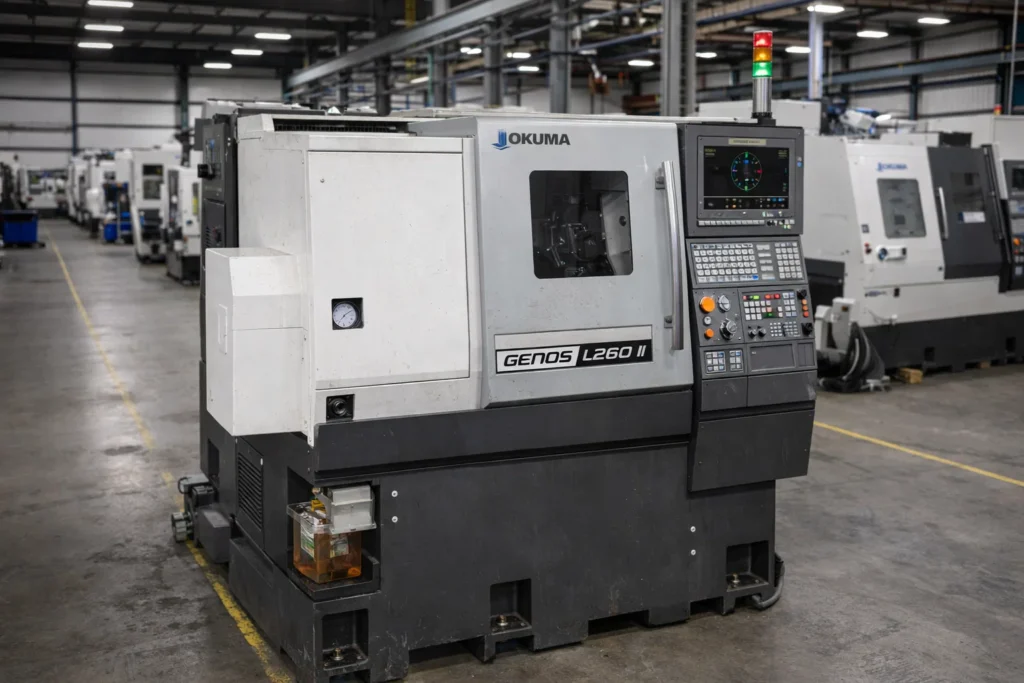
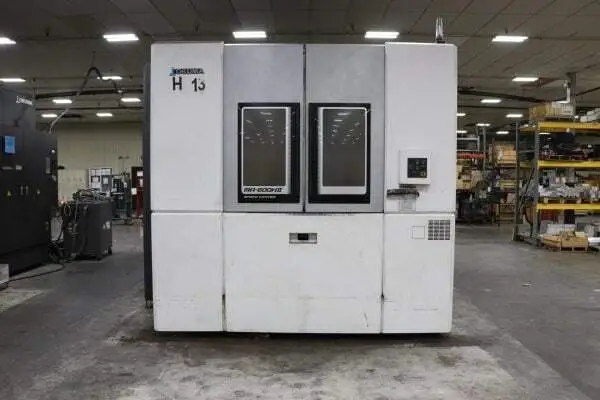
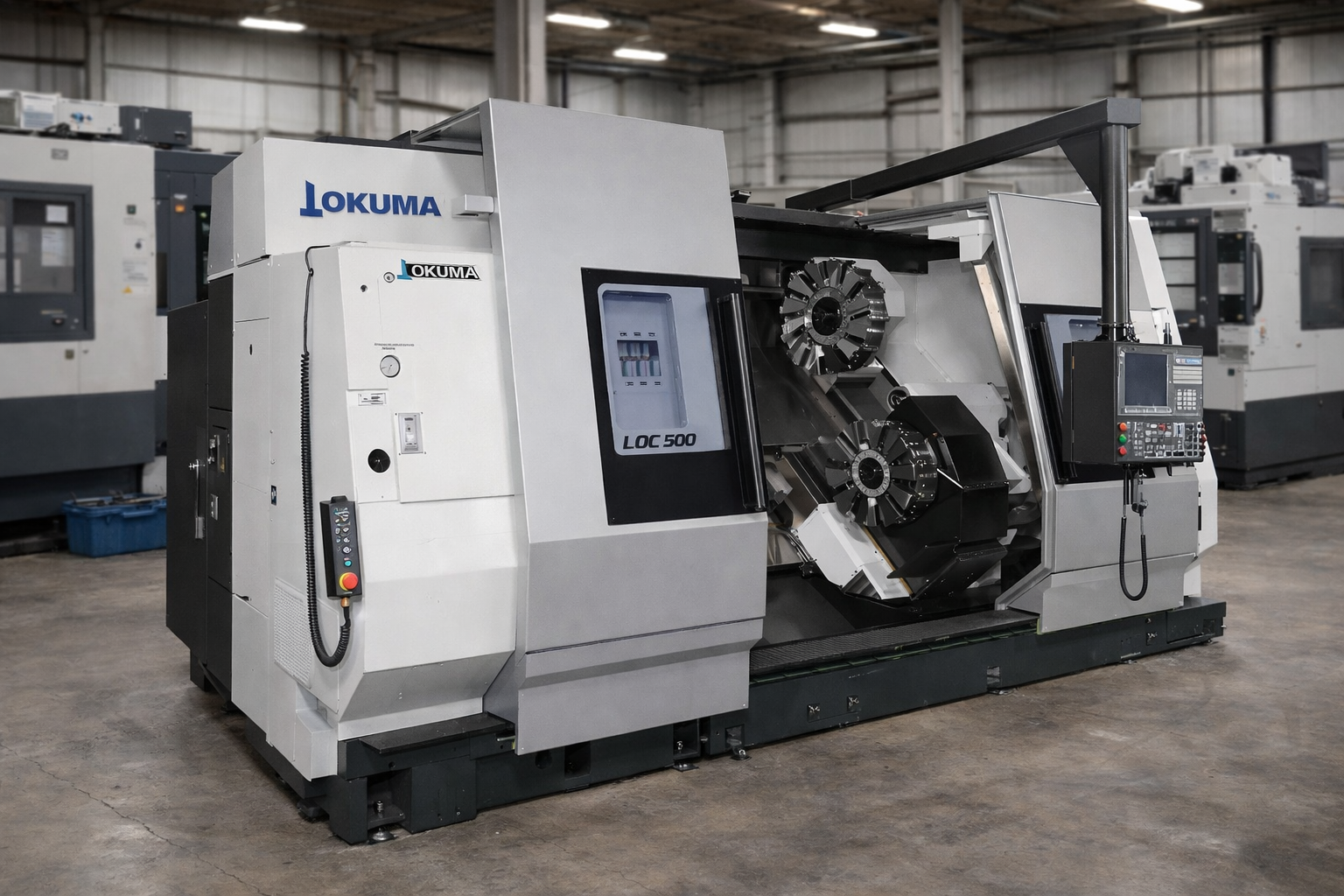
The Okuma Genos L250II is a compact, entry-level CNC horizontal turning center designed to deliver high productivity, precision, and reliability in a small footprint. Built on a one-piece cast iron base with a horizontal box way system, the machine provides excellent rigidity and vibration damping, allowing it to handle both light and moderately heavy cutting operations with consistent accuracy.
This model typically offers a maximum turning diameter of approximately 280 mm and a turning length of around 290 mm, making it suitable for small to mid-sized components across industries such as automotive, general engineering, and subcontract manufacturing. The spindle speed ranges up to about 3,000 rpm, supported by a reliable motor that balances power and efficiency.
The L250II is known for its ergonomic design, efficient chip evacuation, and ease of maintenance, including a separated coolant tank system. It also supports automation integration such as bar feeders and robotic loaders, enabling higher throughput in production environments.
Overall, the Genos L250II is positioned as an “affordable excellence” machine—ideal for shops that need dependable performance, consistent repeatability, and efficient production without the higher cost associated with premium multi-axis machines.
OKUMA GENOS L250IISPECIFICATIONS
OKUMA GENOS L250II – AXIS
2-Axis CNC Lathe (X and Z Axis)
X-Axis (Cross Travel)
Z-Axis (Longitudinal Travel)
Optional C-Axis (on advanced configurations)
OKUMA GENOS L250II – AXIS TRAVELS
X-Axis Travel: Approx. 165–180 mm
Z-Axis Travel: Up to 290 mm (standard)
Optional Extended Z Travel: Up to 500 mm
OKUMA GENOS L250II – CAPACITY
Maximum Turning Diameter: Approx. 280 mm
Maximum Turning Length: Approx. 290 mm
Bar Capacity: Approx. 51–65 mm (depending on chuck)
Maximum Swing Over Bed: Approx. 400 mm
Maximum Swing Over Cross Slide: Approx. 200 mm
OKUMA GENOS L250II – SPINDLE
Spindle Nose: A2-6
Spindle Speed Range: 30 – 3,000 RPM
Spindle Motor Power: Approx. 7.5–11 kW
Chuck Size: 6 inch / 8 inch options
High rigidity horizontal spindle design
OKUMA GENOS L250II – TABLE
Bed Type: Horizontal Slant Bed
Bed Construction: One-piece cast iron base
High rigidity structure for stability
Optimized for chip flow and accuracy
OKUMA GENOS L250II – TOOL TURRET
Turret Type: V8 / V12 turret options
Number of Stations: 8 or 12
Tool Holding: Static tooling
Boring Bar Capacity: Up to Ø32–40 mm
Fast indexing turret system
OKUMA GENOS L250II – FEEDRATES
Rapid Traverse (X-Axis): Approx. 25 m/min
Rapid Traverse (Z-Axis): Approx. 30 m/min
Cutting Feed Rate: Programmable
Servo-driven precision feed system
OKUMA GENOS L250II – COOLANT & CHIP MANAGEMENT
Coolant System: Flood coolant
Coolant Tank: Separated tank design
Chip Management: Maximized chip discharge design
Chip Conveyor: Optional
OKUMA GENOS L250II – CONTROL SYSTEM
Control: Okuma OSP Control (P300 / P500 series)
Programming: Conversational (IGF) + G-code
High-speed processing capability
User-friendly interface
OKUMA GENOS L250II – POWER & AIR REQUIREMENTS
Power Requirement: Approx. 20–30 kVA
Voltage: 200–400V (region dependent)
Air Requirement: Clean compressed air
Air Pressure: Approx. 5–6 bar
OKUMA GENOS L250II – DIMENSIONS
Floor Space: Approx. 30 sq. ft
Machine Width: Approx. 1,400 mm
Compact footprint design
Machine Weight: Approx. 3,500–4,500 kg
OKUMA GENOS L250II – GENERAL INFORMATION
Machine Type: CNC Turning Center (Lathe)
Manufacturer: Okuma
Compact, high-speed production machine
High rigidity and accuracy
Designed for entry-level to mid-volume production
INDUSTRIES THAT USE OKUMA GENOS L250II
Automotive
Aerospace
General Engineering
Oil & Gas
Medical Equipment Manufacturing
Precision Component Manufacturing
TYPICAL PARTS OKUMA GENOS L250II CAN PRODUCE
Shafts
Bushings
Flanges
Fittings
Valves
Precision turned components
WHY CHOOSE OKUMA GENOS L250II
Compact and space-efficient design
High rigidity for consistent accuracy
Affordable entry-level CNC lathe
Reliable Okuma control system
Efficient chip evacuation
Suitable for mass production and job work
WHY BUY USED OKUMA GENOS L250II
Purchasing a used Okuma Genos L250II can be a highly practical investment for machine shops aiming to maximize capability while minimizing capital expenditure. These machines are engineered with robust cast iron construction and proven Okuma control systems, which means they retain accuracy and performance even after years of operation when properly maintained.
A major factor in evaluating a used L250II is cutting time (spindle hours). Machines with low cutting hours—typically under 5,000 hours—are considered lightly used and can perform close to new condition. Units with moderate usage (5,000–15,000 hours) still provide strong reliability for most production environments, while machines exceeding 15,000–20,000 hours may require refurbishment but remain useful for less demanding applications.
Another advantage is that even older L250II machines come equipped with modern CNC controls and automation compatibility, allowing integration into current production workflows. The machine’s compact footprint and energy-efficient design also make it suitable for smaller workshops or facilities with limited floor space.
Additionally, Okuma’s reputation for durability and long service life reduces the risk typically associated with used equipment purchases. For startups or expanding operations, a used Genos L250II provides a cost-effective way to access high-quality CNC turning capabilities without the premium price of a new machine.
HOW MUCH DOES A USED OKUMA GENOS L250IICOST?
The price of a used Okuma Genos L250II varies based on manufacturing year, machine condition, configuration, and most importantly, cutting time. Since the L250II is a relatively modern machine introduced in the 2010s, pricing is generally segmented by age and usage rather than very old pre-2000 models.
For early-generation machines (2010–2015), prices typically range from $25,000 to $45,000. These units often have higher cutting hours (10,000–20,000+), and while still functional, they may require maintenance or component replacement depending on usage history.
Machines manufactured between 2015 and 2020 generally fall in the $45,000 to $75,000 range. These represent the most active segment of the used market and often feature moderate cutting hours (5,000–12,000), updated controls, and better compatibility with automation systems.
For newer machines from 2020 to 2025, pricing can range from $75,000 to over $120,000 depending on configuration, tooling, and automation features. These machines typically have low cutting hours (under 5,000) and are close to new condition.
Cutting time plays a critical role—machines with lower spindle hours command premium pricing regardless of age. Ultimately, buyers should evaluate maintenance records, tooling packages, and operational condition alongside price to determine true value.