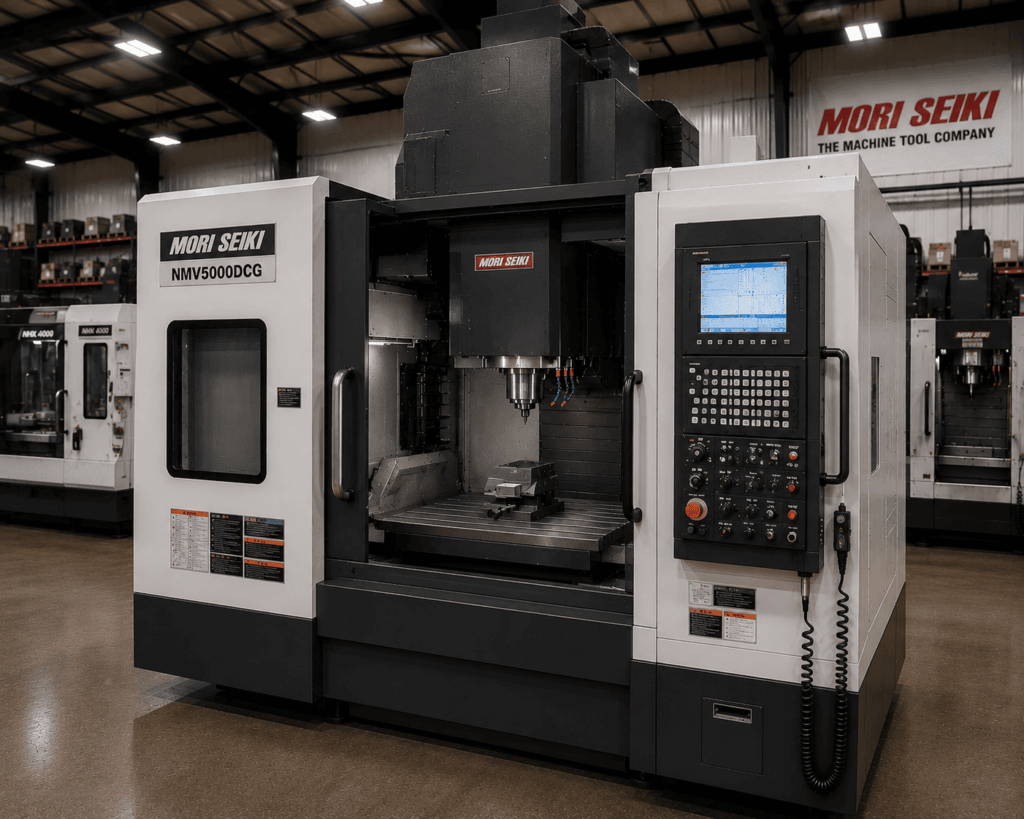
MORI SEIKI NMV5000DCG – 2008
USED MORI SEIKI NMV5000DCG – 2008
The 2008 Mori Seiki NMV5000DCG is a premium simultaneous 5-axis vertical machining center engineered for manufacturers producing complex, high-precision components in a single setup. Manufactured by Mori Seiki (now DMG MORI), the NMV Series combines advanced machine construction with innovative technologies such as DCG (Driven at the Center of Gravity) and DDM (Direct Drive Motor) on the rotary axes to achieve exceptional machining accuracy, dynamic performance, and surface finish quality. The NMV5000DCG was designed to reduce vibration, improve thermal stability, and eliminate backlash, making it one of the most respected 5-axis machining centers in the aerospace, medical, automotive, mold and die, and energy industries.
Built with a rigid cast iron structure and high-precision roller guideways, the NMV5000DCG provides outstanding rigidity while maintaining smooth, high-speed motion. The machine offers 28.7 inches (730 mm) of X-axis travel, 20.1 inches (510 mm) of Y-axis travel, and 20.1 inches (510 mm) of Z-axis travel. Its integrated trunnion-style rotary table provides a B-axis and 360° continuous C-axis, allowing complete 5-axis machining of intricate components in one setup. The machine accommodates workpieces up to 27.6 inches (700 mm) in diameter, 17.7 inches (450 mm) in height, and 661 lbs (300 kg) in weight. A BT40 direct-drive spindle operating at 12,000 RPM (with optional higher-speed configurations) delivers exceptional cutting performance across aluminum, stainless steel, titanium, hardened steels, cast iron, and composite materials. High rapid traverse rates and intelligent acceleration technology minimize cycle times while maintaining excellent accuracy and surface finish.
The 2008 model is typically equipped with the MAPPS III CNC Control, offering both conversational programming and full ISO G-code compatibility. A standard 60-tool automatic tool changer supports high-mix production environments, while optional larger tool magazines increase capacity for complex machining operations. Common features include through-spindle coolant, spindle oil cooling, Renishaw probing, automatic tool measurement, chip conveyor, rigid tapping, thermal compensation, and high-speed look-ahead machining. The machine’s advanced rotary axis technology eliminates backlash while providing exceptional contouring performance for demanding multi-axis applications.
The Mori Seiki NMV5000DCG is widely used throughout the aerospace, medical, defense, semiconductor, mold and die, and precision engineering industries. Typical applications include aerospace structural components, impellers, turbine blades, orthopedic implants, medical instruments, mold inserts, precision tooling, compressor wheels, and complex prototype parts requiring simultaneous 5-axis machining. Its ability to complete multiple operations in a single setup significantly improves dimensional accuracy while reducing setup time and production costs.
Purchasing a used 2008 Mori Seiki NMV5000DCG allows manufacturers to acquire world-class 5-axis machining technology at a fraction of the cost of a new machine. Mori Seiki machines are renowned for their exceptional engineering, long service life, precision machining capabilities, and strong resale value. A properly maintained NMV5000DCG continues to deliver outstanding productivity, accuracy, and machining flexibility, making it one of the most desirable used simultaneous 5-axis machining centers on the market.
MORI SEIKI NMV5000DCG SPECIFICATIONS
Axis
| Specification | Value |
|---|---|
| Machine Type | Simultaneous 5-Axis Vertical Machining Center |
| Controlled Axes | X, Y, Z, B, C |
| X-Axis Travel | 28.7 in (730 mm) |
| Y-Axis Travel | 20.1 in (510 mm) |
| Z-Axis Travel | 20.1 in (510 mm) |
| B-Axis Rotation | -120° to +30° |
| C-Axis Rotation | 360° Continuous (Direct Drive) |
Travels / Work Envelope
| Specification | Value |
|---|---|
| Maximum Workpiece Diameter | 27.6 in (700 mm) |
| Maximum Workpiece Height | 17.7 in (450 mm) |
| Maximum Workpiece Weight | 661 lbs (300 kg) |
| Spindle Nose to Table | Approx. 4.7–24.8 in (120–630 mm) |
Table
| Specification | Value |
|---|---|
| Table Diameter | 19.7 in (500 mm) |
| Table Type | Integrated Trunnion Rotary Table |
| Maximum Table Load | 661 lbs (300 kg) |
Spindle
| Specification | Value |
|---|---|
| Spindle Taper | BT40 |
| Maximum Spindle Speed | 12,000 RPM |
| Spindle Motor | 25 HP (18.5 kW) |
| Drive Type | Direct-Drive |
Tool Changer
| Specification | Value |
|---|---|
| Tool Changer Type | Automatic Tool Changer |
| Standard Tool Capacity | 60 Tools |
| Maximum Tool Diameter | 4.9 in (125 mm) |
| Maximum Tool Length | 11.8 in (300 mm) |
| Maximum Tool Weight | 17.6 lbs (8 kg) |
CNC Control
| Specification | Value |
|---|---|
| CNC Control | MAPPS III |
| Programming | MAPPS Conversational & ISO G-Code |
| Simultaneous 5-Axis Machining | Standard |
| High-Speed Look-Ahead | Standard |
| Ethernet / USB | Standard |
Coolant / Chip Management
| Specification | Value |
|---|---|
| Coolant System | Flood Coolant |
| Through-Spindle Coolant | Optional |
| Spindle Oil Cooling | Standard |
| Automatic Lubrication | Standard |
| Chip Conveyor | Standard |
| Renishaw Probe | Optional |
Power Requirements
| Specification | Value |
|---|---|
| Electrical Supply | 220V / 400V, 3-Phase |
| Connected Load | Approx. 40 kVA |
| Pneumatic Supply | 80–100 PSI (5.5–6.9 bar) |
Dimensions
| Specification | Value |
|---|---|
| Machine Footprint | Approx. 155 × 112 × 118 in (3.94 × 2.84 × 3.00 m) |
| Machine Weight | Approx. 28,700 lbs (13,000 kg) |
General Information
| Specification | Value |
|---|---|
| Manufacturer | Mori Seiki |
| Model | NMV5000DCG |
| Year | 2008 |
| Machine Category | Simultaneous 5-Axis Vertical Machining Center |
| Materials Machined | Aluminum, Steel, Stainless Steel, Titanium, Inconel, Cast Iron, Composite Materials |
| Typical Applications | Aerospace Components, Medical Implants, Turbine Blades, Mold & Die, Precision Tooling, Impellers, Complex Multi-Sided Parts |
HOW MUCH DOES A USED MORI SEIKI NMV5000DCG – 2008 COST?
A used 2008 Mori Seiki NMV5000DCG typically sells for $140,000 to $260,000 USD, depending on spindle hours, machine condition, maintenance history, CNC control configuration, tooling package, and installed options such as through-spindle coolant, probing systems, larger tool magazines, automation interfaces, or pallet systems. Machines with documented maintenance records and production-ready accessories generally command higher resale values because they offer immediate productivity and lower commissioning costs.
Before purchasing a used Mori Seiki NMV5000DCG, buyers should inspect spindle condition, B- and C-axis accuracy, rotary table backlash, guideways, ballscrews, automatic tool changer operation, lubrication system, and machine geometry. A properly maintained 2008 Mori Seiki NMV5000DCG offers outstanding long-term value by combining advanced 5-axis machining technology, exceptional precision, and proven Japanese engineering, making it an excellent investment for manufacturers producing complex, high-value precision components.
MORI SEIKI NMV5000 DCG VS DMG MORI NMV 5000 DCG – WHICH ONE TO BUY?
The Mori Seiki NMV5000 DCG and the DMG MORI NMV 5000 DCG are premium 5-axis CNC vertical machining centers designed for simultaneous multi-axis machining of complex precision components. Mechanically, these machines are very similar because the NMV Series continued after the merger of Mori Seiki and DMG into DMG MORI. The primary difference is the branding, control generation, software features, and production year. Later DMG MORI NMV 5000 DCG models generally feature updated CELOS interfaces, newer control options, enhanced automation compatibility, and improved digital monitoring, while the earlier Mori Seiki NMV5000 DCG models remain highly regarded for their exceptional rigidity, precision, and long-term reliability.
The Mori Seiki NMV5000 DCG utilizes DCG (Driven at the Center of Gravity) technology, which minimizes machine vibration, improves axis acceleration, and delivers exceptional machining accuracy. The machine is capable of simultaneous 5-axis milling, drilling, tapping, boring, and contour machining while reducing setup time and improving part quality.
Both machines are widely used in aerospace, medical, automotive, mold and die, semiconductor, energy, and precision engineering industries. They excel at machining turbine blades, impellers, medical implants, aerospace structural components, molds, dies, and complex aluminum or titanium parts.
If both machines are in similar condition, the decision typically comes down to machine age, maintenance history, CNC control version, spindle hours, and available automation options. Manufacturers seeking the newest software and connectivity may prefer the DMG MORI version, while buyers focused on value often find the Mori Seiki NMV5000 DCG delivers virtually identical machining performance at a lower acquisition cost.
MORI SEIKI NMV5000 DCG SPINDLE NOT TURNING – CAUSES AND TROUBLESHOOTING
If the spindle on a Mori Seiki NMV5000 DCG does not rotate, the issue may be caused by spindle drive faults, CNC control alarms, electrical failures, spindle cooling problems, lubrication issues, automatic tool changer faults, rotary axis positioning errors, or machine safety interlocks. Because this is a simultaneous 5-axis machining center, spindle operation is closely integrated with rotary axis positioning and tool management systems.
Begin by reviewing the CNC control for active alarms. Emergency stop activation, spindle drive faults, servo alarms, rotary axis errors, lubrication warnings, spindle cooling alarms, automatic tool changer faults, thermal overload conditions, or door interlock alarms may prevent spindle operation. Resolve all alarms before restarting the machine.
Inspect the spindle drive system for loose wiring, damaged encoder cables, faulty spindle amplifiers, blown fuses, overheating, or spindle motor overload conditions. Verify proper operation of the spindle cooling unit, lubrication system, compressed air supply, coolant circulation, and electrical power.
Review the machining program to ensure correct spindle commands are present. Missing M03 or M04 commands, incorrect spindle speed values, spindle orientation commands, incomplete tool changes, or rotary axis positioning errors may stop spindle rotation.
If the spindle rotates briefly before stopping, inspect spindle bearings, tool holders, drawbar clamping force, spindle taper cleanliness, tooling balance, and cutting conditions. Excessive vibration, abnormal spindle noise, overheating, or poor tool retention may indicate mechanical wear requiring professional service.
Routine spindle inspections, lubrication maintenance, spindle cooling service, and preventive maintenance significantly reduce unexpected downtime and help maximize spindle life.
MORI SEIKI NMV5000 DCG MAINTENANCE AND PREVENTIVE CARE GUIDE
The Mori Seiki NMV5000 DCG is a high-precision 5-axis machining center designed for continuous production of complex components requiring exceptional accuracy. Preventive maintenance is essential for preserving spindle performance, rotary axis accuracy, machine geometry, and overall production reliability.
Daily maintenance should include removing chips from the machining enclosure, spindle taper, rotary table, trunnion assembly, automatic tool changer, guideway covers, and chip conveyor. Operators should inspect coolant levels, coolant concentration, lubrication systems, spindle cooling equipment, compressed air supply, spindle condition, tool holders, and cutting tools before beginning production.
Weekly maintenance should include inspecting coolant pumps, chip conveyors, centralized lubrication systems, spindle cooling units, rotary axis mechanisms, automatic tool changer operation, pneumatic systems, electrical cabinet filters, and air preparation equipment. Clean chips from rotary axis covers and tool changer pockets to prevent contamination.
Monthly inspections should include spindle runout, drawbar retention force, rotary axis accuracy, ball screws, linear guideways, spindle bearings, encoder cables, lubrication lines, electrical connections, coolant filtration systems, machine leveling, and complete machine geometry verification. Five-axis calibration should also be performed at scheduled intervals to maintain simultaneous machining accuracy.
Additional preventive maintenance includes monitoring spindle vibration, checking axis backlash, replacing worn filters, servicing lubrication systems, inspecting spindle cooling equipment, verifying rotary axis alignment, and maintaining complete maintenance records. Early detection of wear minimizes repair costs and helps avoid unexpected production interruptions.
A disciplined maintenance program extends spindle life, improves machining precision, enhances surface finish quality, and ensures the Mori Seiki NMV5000 DCG continues delivering reliable five-axis machining performance.
FAQ
What is the Mori Seiki NMV5000 DCG?
The Mori Seiki NMV5000 DCG is a simultaneous 5-axis CNC vertical machining center designed for high-precision machining of complex components. It combines DCG (Driven at the Center of Gravity) technology, a high-speed spindle, trunnion-style rotary table, automatic tool changer, and advanced CNC control to perform milling, drilling, tapping, boring, and contour machining in a single setup.
The machine is widely used in aerospace, medical, automotive, mold and die, semiconductor, energy, and precision manufacturing industries. It is capable of machining turbine blades, impellers, molds, orthopedic implants, aerospace brackets, precision housings, titanium components, aluminum parts, and other intricate workpieces that require simultaneous five-axis machining.
Its rigid construction, advanced motion control, exceptional thermal stability, and high-speed machining capabilities make the Mori Seiki NMV5000 DCG one of the most respected five-axis machining centers available on the used CNC machine market.
What are the most common problems with the Mori Seiki NMV5000 DCG?
The most common problems with the Mori Seiki NMV5000 DCG include spindle alarms, automatic tool changer faults, rotary axis positioning errors, lubrication system warnings, spindle cooling issues, servo drive faults, encoder failures, drawbar problems, coolant contamination, spindle orientation faults, electrical communication errors, and five-axis calibration issues.
Machines operating continuously in demanding production environments may also experience spindle bearing wear, rotary axis backlash, thermal expansion effects, tool changer wear, coolant pump failures, and normal mechanical fatigue. Poor lubrication, contaminated coolant, worn cutting tools, excessive cutting loads, and delayed preventive maintenance can accelerate machine wear and reduce machining accuracy.
Routine spindle inspections, lubrication servicing, spindle cooling maintenance, coolant management, rotary axis calibration, machine geometry verification, electrical inspections, and scheduled preventive maintenance help minimize downtime and ensure the Mori Seiki NMV5000 DCG continues delivering exceptional precision, reliability, and long-term manufacturing performance.
Related Products
-
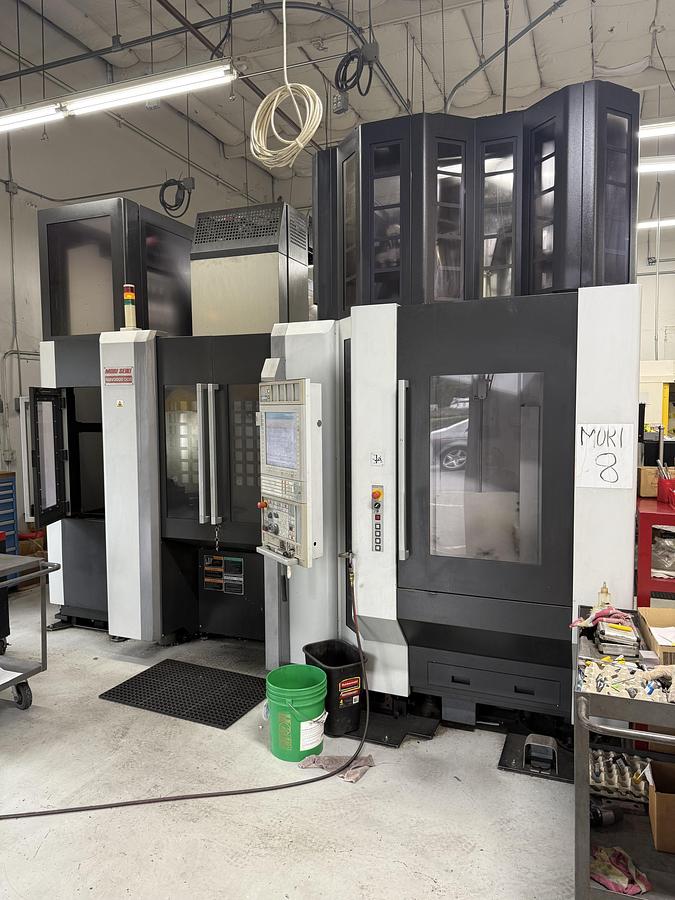
MORI SEIKI - NMV3000DCG
VIEW MACHINE -
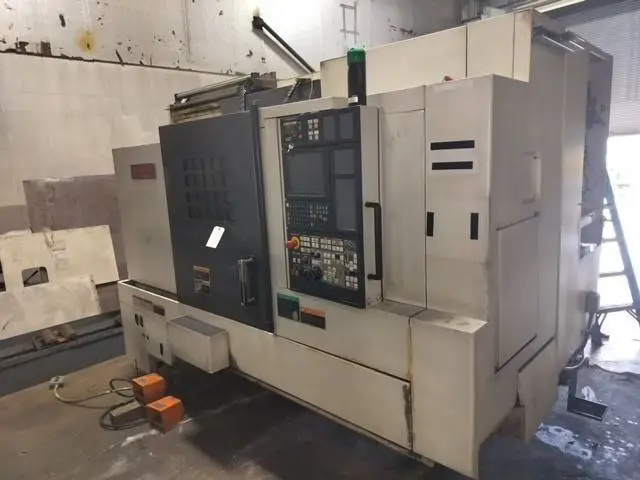
MORI SEIKI - NL2500SY/700
VIEW MACHINE -
MORI SEIKI - ZL-15S
VIEW MACHINE -
MORI SEIKI - NL1500/500
VIEW MACHINE