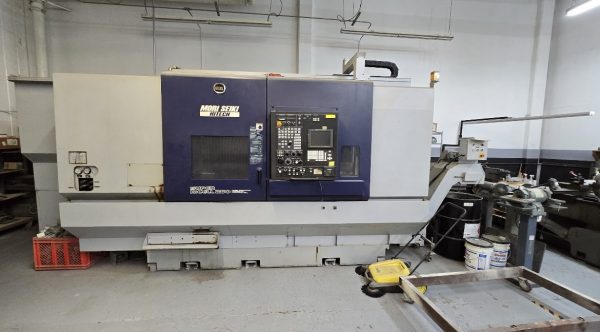
MORI SEIKI HITECH SUPER HICELL 250 – 2003
USED MORI SEIKI HITECH SUPER HICELL 250 – 2003
The 2003 MORI SEIKI HITECH SUPER HICELL 250 is a CNC turning center designed for manufacturers that need substantial turning capacity combined with advanced milling and multi-tasking capability. Developed by Mori Seiki, the SUPER HICELL series was designed to combine turning and milling operations within a single machine platform, allowing manufacturers to complete more operations in one setup and reduce the need for moving components between separate machines.
The MORI SEIKI HITECH SUPER HICELL 250 is particularly suited to production environments where components require turning, drilling, milling, tapping, boring, and other secondary operations. By combining turning and machining functions, the machine can reduce the number of setups required for complex components and can improve consistency between multiple operations.
The machine’s horizontal turning configuration provides a practical platform for machining cylindrical and irregularly shaped components. Depending on the individual configuration, the machine can use driven tooling to perform milling and drilling operations directly on the turned workpiece. This capability is especially useful for parts that require holes, slots, flats, keyways, cross-drilled features, and other secondary machining operations.
As a 2003 machine, individual SUPER HICELL 250 examples can differ in spindle configuration, turret or tool capacity, control generation, chuck size, bar capacity, milling spindle specifications, and available options. Buyers should therefore verify the serial number and original machine specification before purchasing a particular used machine.
One of the principal advantages of the SUPER HICELL concept is reduced setup time. A component that would traditionally require a CNC lathe followed by a separate vertical or horizontal machining center can potentially be completed on one machine. This can reduce work-in-process handling, improve positional accuracy between features, and simplify production flow.
The machine is also appropriate for manufacturers producing complex components in medium- and high-value applications. Components for aerospace, automotive, energy, hydraulics, industrial equipment, and general engineering can benefit from the combination of turning and milling capabilities.
Mori Seiki’s machine-tool engineering emphasized rigidity, precision, thermal stability, and operator control. On a used 2003 machine, however, the actual condition of the individual unit is more important than the original specification alone. Spindle condition, turret accuracy, milling-spindle performance, axis backlash, ballscrews, guideways, chuck condition, and CNC control operation should all be evaluated before purchase.
The SUPER HICELL 250 can also reduce the amount of floor space required for certain manufacturing processes. Instead of allocating separate space for a turning center and a machining center, a multitasking machine can perform a larger portion of the production process in one location.
The machine’s multitasking capability can be particularly valuable for shops producing families of complex parts. Once tooling, work offsets, cutting parameters, and programs have been established, the same platform can perform multiple operations with limited manual intervention.
For manufacturers looking for an older but capable multitasking CNC platform, a properly maintained 2003 MORI SEIKI HITECH SUPER HICELL 250 can provide substantial turning and milling capability. Its value in the used market depends strongly on configuration, machine condition, included tooling, control condition, spindle health, and maintenance history.
MORI SEIKI HITECH SUPER HICELL 250 – AXIS
| Specification | Details |
|---|---|
| Machine Configuration | CNC Multi-Tasking Turning Center |
| Standard Configuration | Turning + Milling |
| Main Turning Axis | X / Z |
| Milling Capability | Available |
| C-Axis | Available / Configuration Dependent |
| Y-Axis | Configuration Dependent |
| Additional Axis | Configuration Dependent |
| Servo Drives | CNC Servo Controlled |
| Axis Feedback | CNC Feedback System |
| Live Tooling | Available |
The SUPER HICELL 250 is designed around a turning platform with additional machining capability. The exact number of controlled axes depends on the machine’s original configuration.
Machines equipped with C-axis and live tooling can perform milling and drilling operations around the circumference of a component. Configurations equipped with Y-axis capability provide additional flexibility for off-center milling and drilling operations.
MORI SEIKI HITECH SUPER HICELL 250 – AXIS TRAVELS / WORK ENVELOPE
| Specification | Details |
|---|---|
| X-Axis Travel | Configuration Dependent |
| Z-Axis Travel | Configuration Dependent |
| Y-Axis Travel | Configuration Dependent |
| C-Axis | Available / Configuration Dependent |
| Turning Diameter | Approx. 10 in Class* |
| Turning Length | Configuration Dependent |
| Spindle Center Height | Configuration Dependent |
| Milling Envelope | Configuration Dependent |
| Tailstock Travel | Configuration Dependent |
*Turning capacity varies according to chuck, turret, spindle, and machine configuration.
The SUPER HICELL 250 is intended for medium-sized turned components that require multiple machining operations. Because the machine integrates turning and milling functions, the usable envelope must be considered together with chuck dimensions, toolholder clearance, live-tool configuration, and workpiece geometry.
MORI SEIKI HITECH SUPER HICELL 250 – CAPACITY / WORKHOLDING
| Specification | Details |
|---|---|
| Machine Type | CNC Turning / Milling Center |
| Main Chuck | Configuration Dependent |
| Chuck Size | Approx. 8–10 in Class* |
| Bar Capacity | Configuration Dependent |
| Maximum Turning Diameter | Configuration Dependent |
| Maximum Turning Length | Configuration Dependent |
| Tailstock | Configuration Dependent |
| Steady Rest | Optional |
| Workholding | Hydraulic Chuck / Collet / Custom Fixtures |
| C-Axis Workholding | Available |
The workholding system is critical to the performance of a multitasking turning center. Hydraulic chucks provide rapid workpiece clamping for production applications, while collets and specialized fixtures can be used for smaller or more specialized components.
When inspecting a used SUPER HICELL 250, the chuck should be checked for jaw condition, hydraulic pressure, runout, clamping consistency, and proper operation. The spindle nose and chuck mounting area should also be inspected for crash damage.
MORI SEIKI HITECH SUPER HICELL 250 – MAIN SPINDLE
| Specification | Details |
|---|---|
| Spindle Type | CNC Turning Spindle |
| Spindle Orientation | Horizontal |
| Spindle Motor | Configuration Dependent |
| Maximum RPM | Configuration Dependent |
| Spindle Bore | Configuration Dependent |
| Chuck Interface | Configuration Dependent |
| C-Axis | Available |
| Constant Surface Speed | CNC Controlled |
| Spindle Orientation | CNC Controlled |
| Bar Feeding | Available / Configuration Dependent |
The main spindle provides the turning capability of the SUPER HICELL 250. Depending on configuration, the CNC system can control spindle speed, feed synchronization, constant surface speed, and C-axis positioning for milling operations.
The main spindle should be carefully inspected on a used machine. Buyers should check spindle runout, bearing noise, vibration, temperature, hydraulic chuck operation, spindle orientation, and C-axis performance.
A test program should ideally include multiple spindle speeds and both turning and C-axis operations. This can help identify problems that may not appear during a simple visual inspection.
MORI SEIKI HITECH SUPER HICELL 250 – MILLING SPINDLE / LIVE TOOLING
| Specification | Details |
|---|---|
| Milling Capability | Integrated |
| Live Tooling | Available |
| Milling Spindle | Configuration Dependent |
| Maximum Milling RPM | Configuration Dependent |
| Tool Interface | Configuration Dependent |
| C-Axis Milling | Available |
| Y-Axis Milling | Configuration Dependent |
| Drilling | Available |
| Tapping | Available |
| Cross Milling | Available |
The integrated milling capability is one of the most important characteristics of the SUPER HICELL platform. Driven tools can perform drilling, tapping, milling, slotting, and other secondary operations without removing the workpiece from the turning center.
This allows manufacturers to machine features such as cross holes, flats, slots, bolt circles, keyways, and other milled surfaces while maintaining the workpiece in the same setup.
On a used machine, the live-tool system should be tested carefully. Buyers should inspect driven-tool bearings, toolholder interfaces, indexing, spindle rotation, lubrication, and alignment.
MORI SEIKI HITECH SUPER HICELL 250 – TOOL TURRET
| Specification | Details |
|---|---|
| Turret Type | CNC Automatic Tool Turret |
| Tool Stations | Configuration Dependent |
| Live Tool Stations | Configuration Dependent |
| Tool Clamping | Hydraulic / Mechanical Configuration |
| Turret Indexing | Automatic |
| Turret Positioning | CNC Controlled |
| Turning Tools | Supported |
| Driven Tools | Supported |
| Boring Bars | Supported |
| Tool Offset Management | CNC Controlled |
The turret provides the interface between the machine and its turning and driven tooling. Depending on the individual configuration, the turret can hold conventional turning tools as well as driven tools for milling and drilling.
Turret indexing accuracy is especially important on an older multitasking machine. Buyers should cycle the turret through every station and confirm that each position clamps correctly without unusual noise or hesitation.
The turret should also be inspected for crash damage. Even a minor collision can affect tool-center accuracy and turret alignment.
MORI SEIKI HITECH SUPER HICELL 250 – CONTROL SYSTEM
| Specification | Details |
|---|---|
| CNC Control | Mori Seiki CNC Configuration |
| Control Generation | 2003-Era Mori Seiki System |
| Programming | EIA/ISO G-Code |
| Turning Programming | Supported |
| Milling Programming | Supported |
| C-Axis Programming | Configuration Dependent |
| Tool Offsets | Yes |
| Work Offsets | Yes |
| Tool Compensation | Yes |
| Diagnostics | Integrated |
| Data Transfer | Configuration Dependent |
A 2003 SUPER HICELL 250 can have a Mori Seiki control configuration appropriate to its production year and individual specification. Buyers should verify the exact control model and software options on the machine being considered.
The control should be tested for display operation, keyboard response, program loading, memory retention, alarms, servo operation, spindle control, turret indexing, and communication functions.
Because this is an older CNC machine, the availability of replacement control components should also be considered. A machine with documented parameters, complete electrical documentation, and a functioning control is generally easier to maintain than one with missing information.
MORI SEIKI HITECH SUPER HICELL 250 – COOLANT / CHIP MANAGEMENT
| Specification | Details |
|---|---|
| Coolant System | Flood Coolant |
| Coolant Tank | Integrated / External Configuration |
| Coolant Pump | Configuration Dependent |
| Chip Conveyor | Optional |
| High-Pressure Coolant | Configuration Dependent |
| Through-Tool Coolant | Configuration Dependent |
| Chip Flushing | Available |
| Mist Collection | Optional |
| Filtration | Configuration Dependent |
Turning and milling operations can generate significant quantities of chips, making chip management important on a multitasking machine.
A chip conveyor can be particularly useful for production applications. Buyers should test the conveyor, coolant pump, tank, filters, nozzles, and chip-removal system during inspection.
The coolant system should also be checked for leaks, damaged hoses, blocked nozzles, contaminated coolant tanks, and pump wear.
MORI SEIKI HITECH SUPER HICELL 250 – POWER REQUIREMENTS
| Specification | Details |
|---|---|
| Electrical System | Industrial CNC Electrical System |
| Main Spindle Motor | Configuration Dependent |
| Milling Spindle Motor | Configuration Dependent |
| Electrical Supply | Machine / Region Dependent |
| Phase | Three-Phase Industrial Power |
| Voltage | Configuration Dependent |
| Transformer | Configuration Dependent |
| Pneumatic Supply | Required / Configuration Dependent |
| Hydraulic System | Machine Configuration Dependent |
| Installation | Industrial CNC Environment |
Electrical requirements should be confirmed from the machine’s electrical nameplate before installation.
Because the machine combines turning and milling systems, the total electrical requirement can be higher than that of a conventional basic CNC lathe. Hydraulic pumps, coolant systems, chip conveyors, live tooling, and other accessories should also be considered.
MORI SEIKI HITECH SUPER HICELL 250 – DIMENSIONS
| Specification | Details |
|---|---|
| Machine Footprint | Configuration Dependent |
| Overall Length | Configuration Dependent |
| Overall Width | Configuration Dependent |
| Overall Height | Configuration Dependent |
| Machine Weight | Configuration Dependent |
| Chip Conveyor | Additional Space Required |
| Bar Feeder | Additional Space Required |
| Hydraulic Unit | Additional Space Required |
| Coolant System | Additional Space Required |
| Shipping | Heavy Equipment Rigging |
The dimensions and weight of an individual SUPER HICELL 250 depend on machine configuration and installed accessories.
When planning installation, buyers should allow additional floor space for chip conveyors, bar feeders, hydraulic equipment, coolant systems, transformers, and operator access.
The machine should be moved and installed by experienced CNC riggers because proper lifting points, center of gravity, leveling, and foundation requirements must be considered.
MORI SEIKI HITECH SUPER HICELL 250 – GENERAL INFORMATION
| Specification | Details |
|---|---|
| Manufacturer | Mori Seiki |
| Model | HITECH SUPER HICELL 250 |
| Year | 2003 |
| Machine Category | CNC Multi-Tasking Turning Center |
| Primary Function | Turning + Milling |
| Main Spindle | Horizontal |
| C-Axis | Available |
| Y-Axis | Configuration Dependent |
| Live Tooling | Available |
| Automatic Turret | Yes |
| CNC Control | Mori Seiki Configuration |
| Workholding | Hydraulic Chuck / Collet |
| Chip Conveyor | Optional |
| Bar Feeder | Optional |
| Production Type | Production / Job Shop / Complex Parts |
The HITECH SUPER HICELL 250 should be viewed as a multitasking machining platform rather than simply a conventional CNC lathe. Its ability to combine turning and milling operations can be particularly valuable for components requiring multiple machining processes.
INDUSTRIES THAT USE MORI SEIKI HITECH SUPER HICELL 250
The SUPER HICELL 250 can be used in industries where components require both turning and secondary milling operations.
Aerospace Manufacturing
Aerospace suppliers can use multitasking equipment for complex shafts, housings, fittings, adapters, and other components requiring multiple operations. The ability to complete multiple features in one setup can be useful when positional relationships between turned and milled features are important.
Automotive Manufacturing
Automotive suppliers can use the machine for shafts, hubs, housings, adapters, brackets, and other components requiring turning and cross-machining operations.
Oil and Gas
The machine can be used for turned components, valve-related parts, fittings, adapters, and other industrial components where turning is combined with drilling, milling, or tapping.
Hydraulic and Pneumatic Equipment
Manufacturers can use the SUPER HICELL 250 for hydraulic fittings, valve components, manifolds, adapters, and cylindrical bodies that require both turning and cross-hole machining.
Industrial Equipment
Industrial machinery manufacturers can use the machine for shafts, couplings, housings, rollers, bushings, adapters, and other mechanical components.
Energy Equipment
The machine can support production of components used in pumps, power-generation equipment, industrial systems, and other energy-related machinery.
General Job Shops
Job shops can benefit substantially from multitasking capability because one machine can handle several operations that would otherwise require separate turning and milling machines.
Precision Engineering
Precision-engineering companies can use the machine for complex components requiring turning, drilling, tapping, boring, and milling operations with limited workpiece repositioning.
TYPICAL PARTS MORI SEIKI HITECH SUPER HICELL 250 CAN PRODUCE
| Part Type | Typical Examples |
|---|---|
| Shafts | Drive Shafts, Stepped Shafts |
| Housings | Cylindrical Housings, Gear Housings |
| Flanges | Turned and Drilled Flanges |
| Fittings | Hydraulic and Industrial Fittings |
| Bushings | Precision Bushings |
| Couplings | Shaft Couplings |
| Valve Components | Bodies, Plugs, Sleeves |
| Adapters | Turned and Milled Adapters |
| Automotive Parts | Hubs, Shafts, Mounting Components |
| Oil & Gas Parts | Fittings, Sleeves, Valve Components |
| Pump Components | Rotating and Cylindrical Components |
| Complex Turned Parts | Turned, Drilled, Milled Components |
WHY CHOOSE MORI SEIKI HITECH SUPER HICELL 250
The primary advantage of the MORI SEIKI HITECH SUPER HICELL 250 is its multitasking capability. Instead of separating turning and milling operations across different machines, manufacturers can perform multiple processes within a single machining platform.
This can reduce work-in-process handling. A component can remain clamped in the same chuck while turning operations are completed, followed by drilling, milling, tapping, or other secondary operations.
Maintaining the workpiece in one setup can also help improve the relationship between turned and milled features. This is particularly useful for components where cross holes, flats, slots, or bolt patterns need to be accurately positioned relative to the turned diameter.
The machine can also reduce setup time. A conventional production process may require a component to be removed from a lathe, transported to another machine, aligned, and re-fixtured. A multitasking machine can potentially eliminate several of these steps.
Live tooling provides additional flexibility. Driven tools can perform drilling and milling without requiring a separate machining center for every secondary feature.
C-axis capability can further expand the machine’s usefulness by allowing the spindle to position the workpiece accurately for circumferential machining operations.
The machine is also well suited to job shops because the same platform can be used for many different types of cylindrical components. This flexibility can be valuable where production quantities and part geometries change frequently.
Mori Seiki’s established machine-tool design and the SUPER HICELL concept make the platform particularly interesting in the used market for manufacturers looking for multitasking capability without the acquisition cost of a newer multi-tasking CNC.
WHY BUY USED MORI SEIKI HITECH SUPER HICELL 250
Buying a used 2003 MORI SEIKI HITECH SUPER HICELL 250 can provide access to turning and milling capability in one machine without the capital investment associated with a new multitasking center.
The ability to perform several operations in one setup can be particularly valuable to shops that produce complex components. Instead of purchasing both a turning center and a machining center for certain jobs, a multitasking machine can potentially handle a larger percentage of the manufacturing process.
A used machine may also already include valuable production accessories. Depending on the individual example, these can include driven tooling, C-axis capability, Y-axis capability, chip conveyors, bar feeders, hydraulic chucks, coolant systems, probing equipment, and other options.
Tooling can also be configured around a family of components. Once the correct turning and driven tools are installed, programs can perform multiple operations automatically.
However, the age of the machine means inspection is extremely important. Buyers should not evaluate a 2003 SUPER HICELL 250 solely by its model name or asking price.
The main spindle should be tested at multiple speeds. Buyers should check runout, vibration, bearing noise, temperature, spindle orientation, chuck operation, and C-axis performance.
The turret should be cycled through every position. Each station should clamp correctly and maintain proper tool-center positioning.
Live tooling should also be tested. Driven tools should be operated at different speeds, and buyers should listen for bearing noise or vibration.
Axis accuracy should be evaluated through positioning and repeatability tests. Backlash, ballscrew condition, guideway condition, servo motors, and feedback systems should be inspected.
The CNC control should be thoroughly tested because older control electronics can be expensive or difficult to replace. Buyers should verify program storage, data transfer, display operation, alarms, offsets, spindle commands, turret commands, and all controlled axes.
Hydraulic and coolant systems should also be inspected. Leaks, low pressure, contaminated oil, worn pumps, and damaged hoses can create additional costs after purchase.
A used SUPER HICELL 250 with good spindle condition, accurate axes, functional live tooling, a healthy control, and documented maintenance can provide substantial multitasking capability for a relatively modest acquisition cost.
HOW MUCH DOES A USED MORI SEIKI HITECH SUPER HICELL 250 COST?
The price of a used 2003 MORI SEIKI HITECH SUPER HICELL 250 varies significantly according to configuration and condition. Factors include spindle hours, machine hours, main-spindle condition, live-tooling condition, turret accuracy, control generation, C-axis and Y-axis capability, chuck size, bar capacity, chip conveyor, bar feeder, tooling, and location.
A reasonable used-market estimate for a 2003 MORI SEIKI HITECH SUPER HICELL 250 is approximately $25,000 to $55,000 USD, depending on configuration and condition.
Machines at the lower end of this range may require maintenance or lack important multitasking options. A machine with worn spindle bearings, damaged live tooling, control problems, turret issues, or significant axis wear can have a substantially lower practical value than a fully operational production machine.
A clean machine with functioning turning and milling systems can command a higher price because it provides capabilities that would otherwise require multiple machines.
The control system should be considered carefully when determining value. A functioning control with intact parameters, reliable display operation, program transfer, and complete machine documentation can significantly improve the machine’s usability.
The main spindle is another major value factor. Buyers should inspect spindle runout, bearing condition, vibration, thermal behavior, chuck operation, and C-axis positioning.
Live tooling can also have a significant effect on value. Driven-tool holders and live-tool stations are expensive to replace, so buyers should verify that all required stations operate correctly.
A machine equipped with Y-axis capability, chip conveyor, bar feeder, hydraulic chuck, probing, high-pressure coolant, or other production options can command a higher asking price than a basic configuration.
Machine hours should be evaluated together with maintenance records. A higher-hour machine with documented service and good test results may be preferable to a lower-hour machine with unknown history.
Buyers should also budget for transportation, rigging, installation, leveling, electrical connection, hydraulic fluids, coolant, tooling, and commissioning.
Before purchasing a used MORI SEIKI HITECH SUPER HICELL 250, buyers should request the machine serial number, exact control model, main spindle specifications, live-tool configuration, axis travels, chuck size, tool capacity, machine hours, spindle hours, maintenance history, and list of included accessories.
For manufacturers that need both CNC turning and milling capability, the used 2003 MORI SEIKI HITECH SUPER HICELL 250 can provide a flexible multitasking platform while potentially reducing the number of separate machining operations required for complex components.
Related Products
-
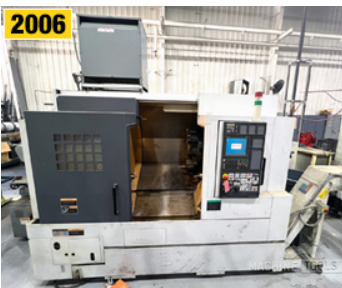
MORI SEIKI - NL2500/700
VIEW MACHINE -
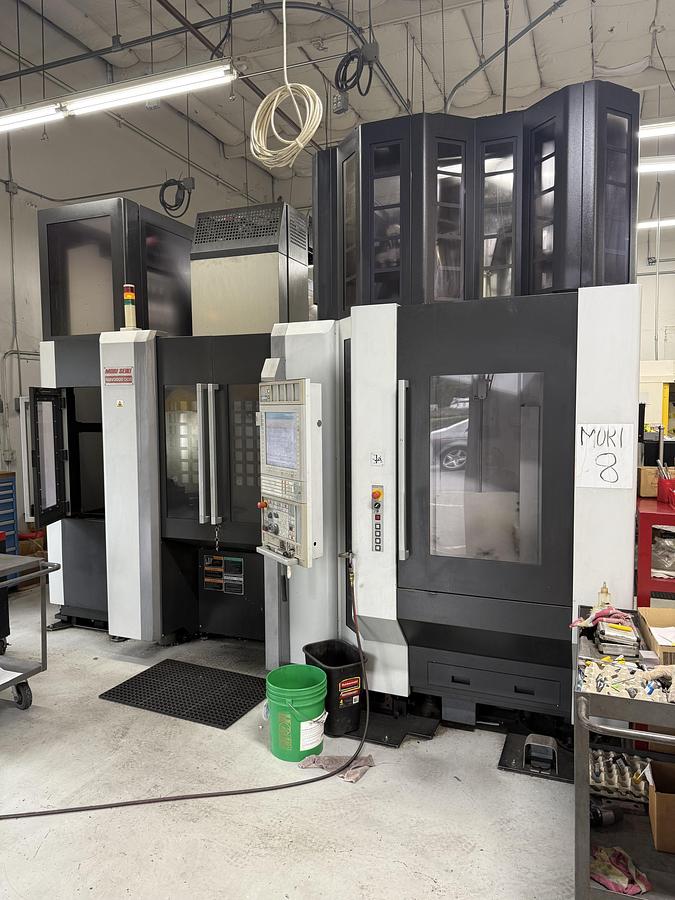
MORI SEIKI - NMV3000DCG
VIEW MACHINE -
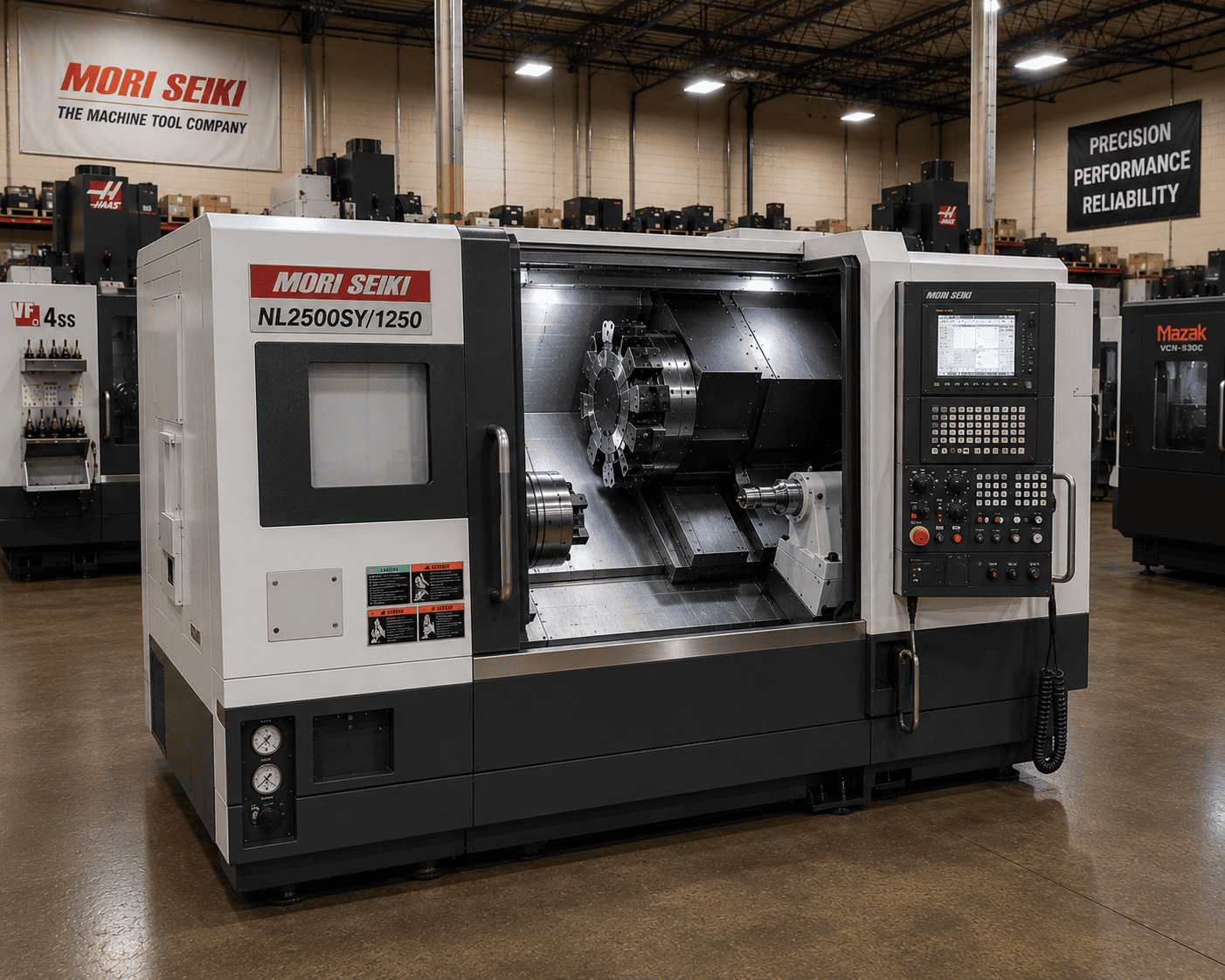
MORI SEIKI - NL2500SY/1250
VIEW MACHINE -
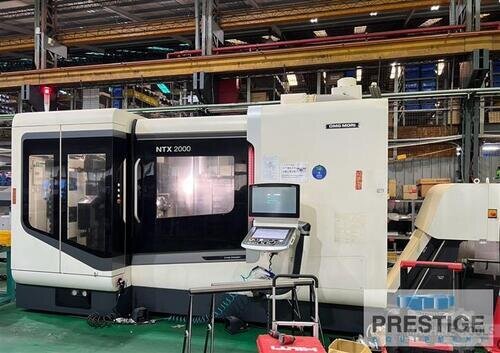
MORI SEIKI - NTX2000/1500SZ
VIEW MACHINE