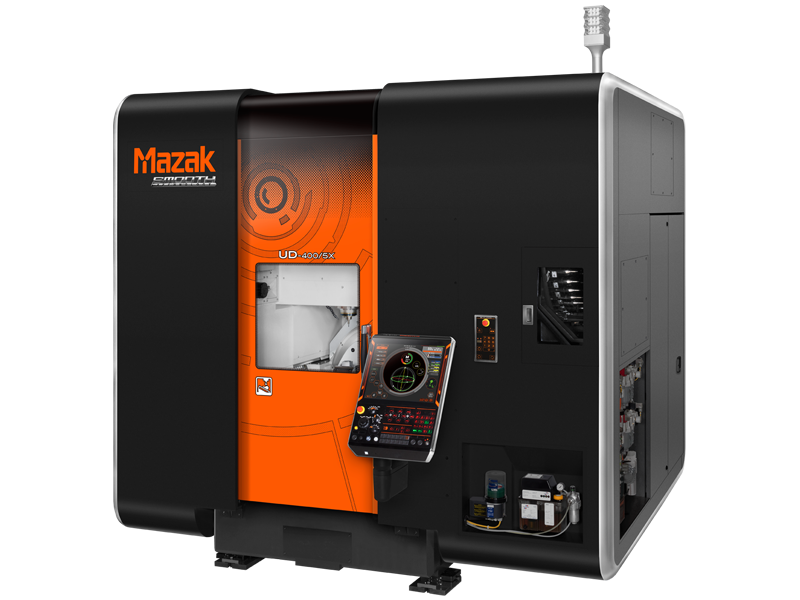
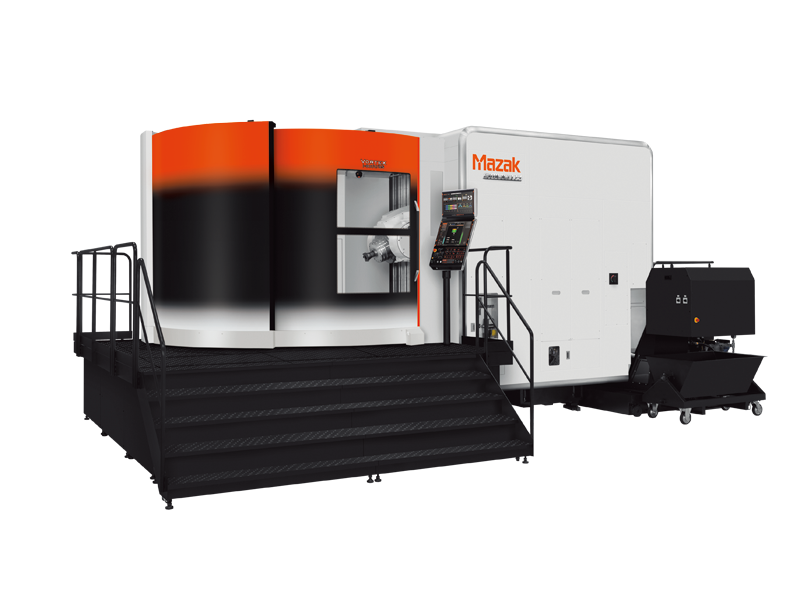
The Mazak UD-400/5X is a high-speed, ultra-precision 5-axis vertical machining center specifically designed for micro machining, mold making, and high-accuracy component manufacturing. It belongs to Mazak’s Ultimate Die & Mold (UD) series and is engineered for industries such as aerospace, medical, dental, and precision tooling. The machine features a compact footprint combined with a rigid double-column symmetrical structure and mineral cast base, which minimizes vibration and thermal distortion during high-speed operations.
A standout feature of the UD-400/5X is its extremely high-speed 45,000 rpm HSK-E40 spindle, supported by core cooling and thermal control systems that ensure consistent accuracy even during long machining cycles. The machine offers full simultaneous 5-axis capability through a tilting rotary table, allowing complex free-form surfaces to be machined in a single setup, significantly reducing setup time and improving precision.
With travels of approximately 550 mm (X), 400 mm (Y), and 350 mm (Z), and a workpiece capacity of around 400 mm diameter, it is ideal for small, intricate parts. Advanced features such as direct-drive rotary axes, thermal compensation systems, and high-accuracy scale feedback further enhance performance, making the UD-400/5X a benchmark machine for high-speed precision machining.
MAZAK UD-400/5XSPECIFICATIONS
MAZAK UD-400/5X – AXIS
Number of Axes: 5 (X, Y, Z, B, C)
Axis Configuration: Simultaneous 5-axis vertical machining center
Simultaneous Control: Full 5-axis simultaneous machining
Acceleration: Advanced servo control with vibration suppression
Motion Control: Smooth high-speed contouring
MAZAK UD-400/5X – COOLANT & CHIP MANAGEMENT
Coolant System: High-precision flood coolant
Cooling Technology: Spindle and ballscrew core cooling
Thermal Control: Thermal Shield system
Chip Handling: Compact chip evacuation system
Heat Monitoring: Multiple temperature sensors
MAZAK UD-400/5X – CONTROL SYSTEM
CNC Control: Mazatrol SmoothX
Programming: Conversational & EIA/ISO
Features: Advanced 5-axis smoothing & vibration control
Interface: Touchscreen CNC control
Accuracy Tools: MAZACHECK and thermal compensation
MAZAK UD-400/5X – POWER & AIR REQUIREMENTS
Power Requirement: Approx. 30–40 kVA
Voltage: 3-phase (region dependent)
Air Requirement: Clean, dry compressed air
Air Pressure: Approx. 5–6 bar
MAZAK UD-400/5X – DIMENSIONS
Machine Width: Approx. 2,970 mm
Machine Height: Approx. 2,800 mm
Machine Design: Compact footprint for precision machining
Structure: Double-column symmetrical design
MAZAK UD-400/5X – GENERAL INFORMATION
Machine Type: 5-axis Vertical Machining Center
Specialty: Ultra-high precision micro machining
Construction: Mineral cast base for vibration damping
Accuracy: High-precision scale feedback on all axes
Application Focus: Die, mold, and micro components
INDUSTRIES THAT USE MAZAK UD-400/5X
Aerospace & Defense
Medical & Dental
Mold & Die Industry
Electronics & Precision Engineering
Tool & Die Manufacturing
TYPICAL PARTS MAZAK UD-400/5X CAN PRODUCE
Injection molds
Precision dies
Medical implants and instruments
Micro mechanical components
Impellers and turbine parts
WHY CHOOSE MAZAK UD-400/5X
Ultra-high-speed 45,000 RPM spindle for micro machining
Exceptional surface finish and accuracy
True 5-axis simultaneous machining capability
Advanced thermal stability and vibration control
Ideal for small, complex, high-precision parts
WHY BUY USED MAZAK UD-400/5X
Buying a used Mazak UD-400/5X is a strong investment for manufacturers focused on precision machining, especially in mold, die, and micro-component production. One of the biggest advantages is the ability to acquire a high-speed 5-axis machine with advanced thermal stability and ultra-precision capabilities at a significantly reduced cost compared to new models. Since the UD-400/5X is built with a rigid double-column design and high-quality components, it maintains accuracy over long periods when properly maintained.
A critical factor when evaluating a used UD-400/5X is cutting time rather than just age. Machines used in high-speed mold machining environments often accumulate high spindle hours due to continuous 45,000 rpm operation, which can lead to spindle wear, bearing fatigue, and thermal system degradation. On the other hand, machines used for prototyping or low-volume precision work typically have lower cutting hours and retain better accuracy, making them more desirable.
Another advantage is access to advanced features such as direct-drive rotary axes, thermal compensation systems, and high-speed spindles, which are expensive in new machines. Even older units still offer superior surface finish quality and precision compared to many standard 5-axis machines. For shops entering high-speed micro machining, a used UD-400/5X provides a cost-effective way to access top-tier technology.
HOW MUCH DOES A USED MAZAK UD-400/5XCOST?
The cost of a used Mazak UD-400/5X depends heavily on year of manufacture, spindle condition, and most importantly, cutting hours. Since the UD-400/5X was introduced around 2018, machines before 2000 or even 2000–2010 do not exist in this model range. However, for comparison, early-generation high-speed 5-axis machines from similar categories may range between $60,000 and $120,000, typically with outdated controls and high usage.
For machines effectively in the 2010–2020 range (including early UD-series models), prices generally fall between $180,000 and $300,000 depending on configuration, tooling, and condition. Machines with lower cutting hours, well-maintained spindles, and documented service history command prices toward the higher end.
For newer machines from 2020 to 2025, especially those equipped with Mazatrol SmoothX control, high-speed 45,000 rpm spindle, and automation-ready configurations, prices typically range from $300,000 to $500,000 or more.
Cutting hours are the most critical pricing factor for this model. High-speed applications significantly impact spindle life, so machines with lower hours or recent spindle rebuilds are valued higher. Conversely, heavily used machines in mold production environments are priced lower due to potential refurbishment costs, particularly for spindle and thermal control systems.