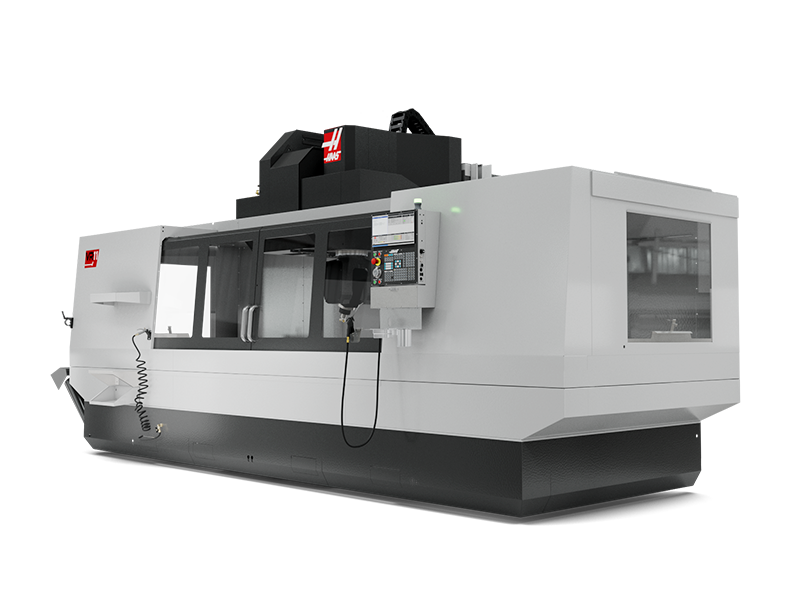
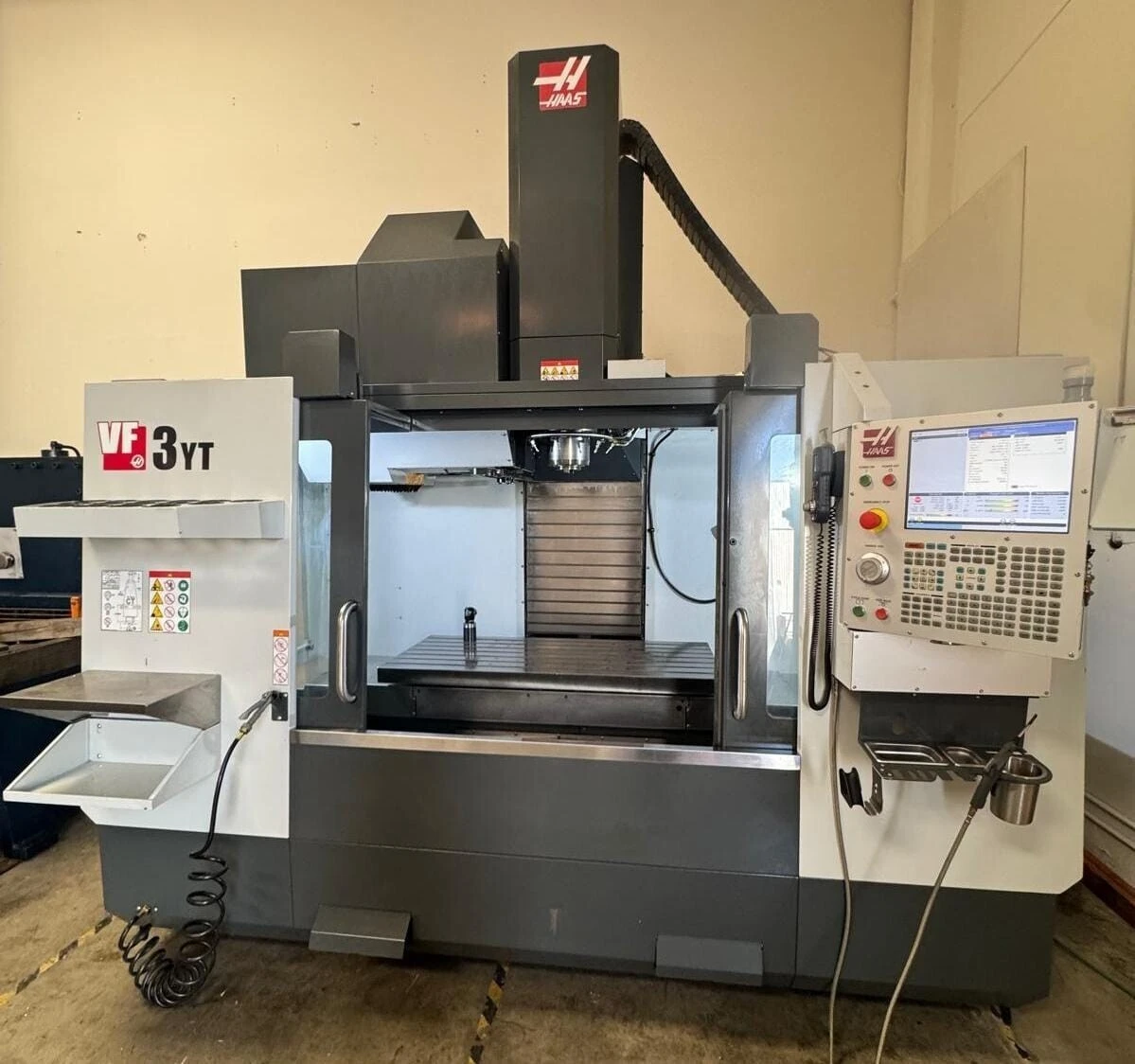
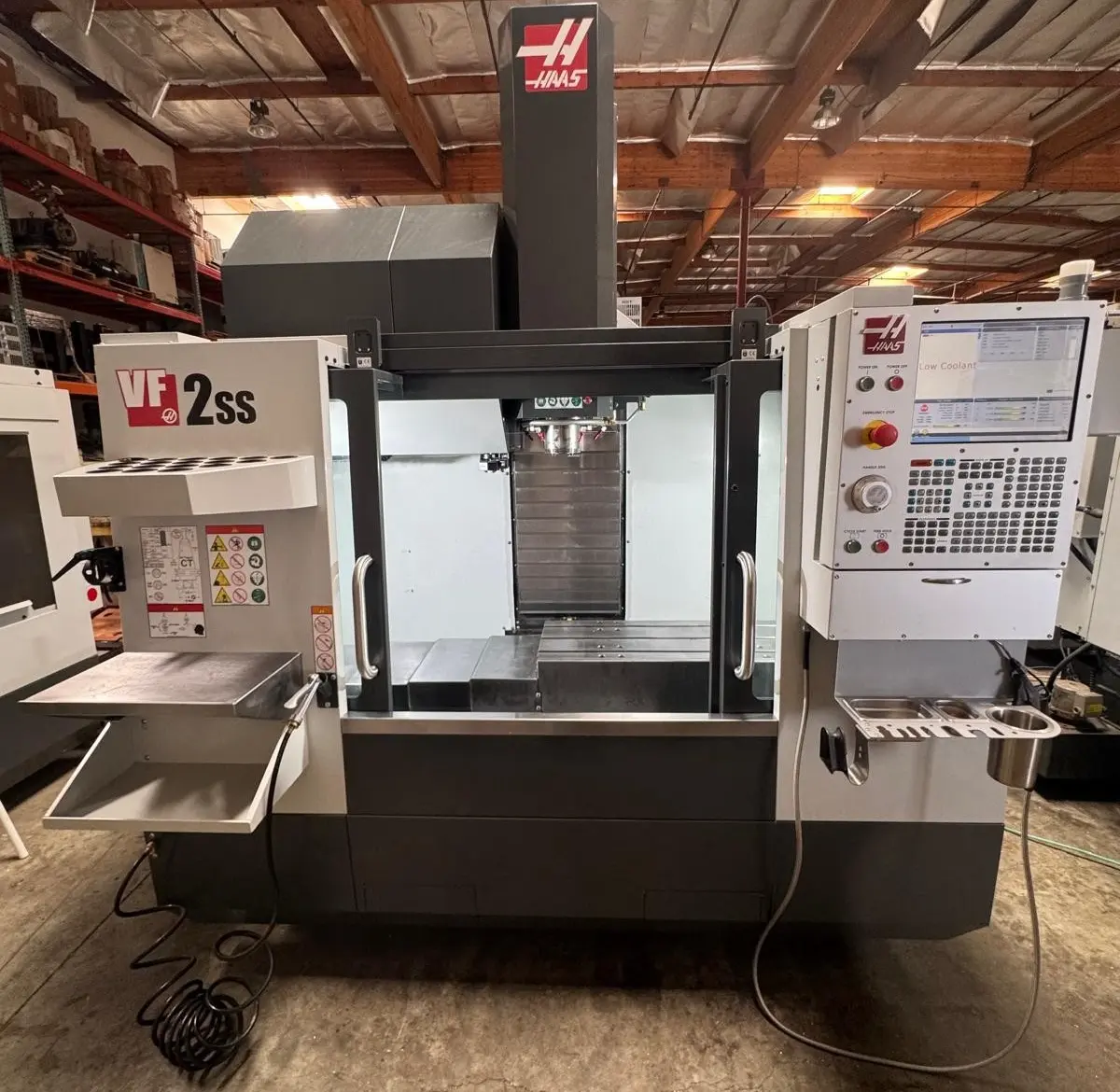
The used Haas VR-11 is a large-format 5-axis machining center built for parts that are too large, too long, or too awkward to rotate on a traditional trunnion-style machine. Instead of rotating the workpiece on a tilting table, the VR-11 uses a fixed table and a 2-axis gimbaled spindle head, allowing the cutting tool to approach the part from multiple angles while the workpiece remains stable. This machine format is especially useful for aerospace structures, composite tools, large mold work, industrial fixtures, and complex fabricated components that require multi-face machining with fewer setups. Haas describes the VR Series as a solution for 5-axis parts that are too large to rotate using conventional rotary tables and trunnions.
A used VR-11 is attractive to shops that want the reach of a very large vertical machining center combined with advanced angular machining capability. Its long X-axis travel and large table make it suitable for oversized workpieces, while the gimbaled-head design helps improve access to angled features, deep pockets, and complex surfaces. This can reduce repeated refixturing and help maintain dimensional consistency across large parts. Official Haas installation documents for the current VR-11 show 120 in X travel, 40 in Y travel, and a 120 in x 28 in table, underscoring the machine’s large-part capacity.
In the used market, the VR-11 can be a strong option for manufacturers that need large 5-axis capability without paying new-machine pricing. Buyers should focus on spindle health, gimbal-head accuracy, service history, control condition, and actual cutting time. Older listing data also shows long-running VR-11/VR-11B machines from the late 1990s through the 2000s, which means buyers may encounter a wide range of generations and conditions.
HAAS VR-11SPECIFICATIONS
HAAS VR-11 – AXIS TRAVELS
X-Axis Travel: 120 in
Y-Axis Travel: 40 in
Z-Axis Travel: 30 in
Table Size: 120 in x 28 in
5-Axis Machining via 2-Axis Gimbaled Spindle Head
Built for Large Parts That Are Difficult to Rotate
HAAS VR-11 – SPINDLE
Spindle Taper: HSK-A63
Standard Series Configuration: 20,000 rpm on current VR Series platform
Earlier Used Machines May Be Found with 10,000 rpm or 15,000 rpm Configurations
Spindle Type Varies by Generation and Configuration
Designed for Complex Angular and Multi-Face Machining
Verify Exact Spindle Package on the Specific Used Machine
HAAS VR-11 – TOOL CHANGER
Automatic Tool Changer Capacity: VR Series commonly listed in the 30 to 50 tool range
Earlier Used VR-11 Listings Commonly Show 32 Tools
Tool Changer Type: Automatic
Tool Capacity Varies by Generation and Installed Configuration
Verify Tool Count on the Specific Machine Being Evaluated
HAAS VR-11 – FEEDRATES
High-Speed Programmable Feedrate Control
Built for Efficient 5-Axis and 5-Sided Machining
Feedrate Performance Depends on Machine Generation
Actual Cutting Performance Depends on Tooling, Material, and Program Strategy
Suitable for Large-Part Contouring and Angular Milling
HAAS VR-11 – COOLANT & CHIP MANAGEMENT
Flood Coolant System
Fully Enclosed Machining Area
Chip Management Features Vary by Machine Year and Options
Through-Spindle Coolant May Be Present on Some Used Machines
Verify Coolant and Chip Conveyor Configuration Before Purchase
HAAS VR-11 – CONTROL SYSTEM
CNC Control: Haas Control
Supports 5-Axis Machining and Multi-Angle Programming
Suitable for Large-Part Setup and Production Work
Control Generation Varies by Machine Year
Verify Software Features and Options on the Specific Machine
HAAS VR-11 – POWER & AIR REQUIREMENTS
Standard Power Requirement Commonly 220 VAC, 3 Phase
Clean, Dry Shop Air Required
Utility Requirements Vary by Generation and Installed Options
Verify Electrical Data on Machine Tag Before Purchase
Foundation and installation requirements should be checked before relocation
HAAS VR-11 — GENERAL INFORMATION
Machine Type: 5-Axis CNC Vertical Machining Center
Configuration: Fixed Table with 2-Axis Gimbaled Spindle Head
Table Size: 120 in x 28 in
Built for Large Complex Parts Unsuitable for Trunnion Rotation
Supports 5-Sided and Angular Machining
Available in Multiple Generations Across the Used Market
INDUSTRIES THAT USE HAAS VR-11
Aerospace Manufacturing
Composite Tooling
Mold and Tooling
Industrial Equipment Manufacturing
Precision Job Shops
Prototype and Development Work
TYPICAL PARTS HAAS VR-11 CAN PRODUCE
Aerospace Structural Components
Large Composite Tools
Mold Bases and Mold Components
Heavy Fixture Plates
Oversized Precision Fabrications
Complex Multi-Face Machined Parts
WHY CHOOSE HAAS VR-11
Ideal for Very Large Parts
Fixed-Table Layout Supports Heavy or Awkward Workpieces
5-Axis Capability Through Gimbaled Spindle Head
Helps Reduce Re-Setup on Large Complex Parts
Strong Fit for Aerospace, Tooling, and Industrial Precision Work
Useful When Trunnion-Style Rotation Is Not Practical
WHY BUY USED HAAS VR-11
Buying a used Haas VR-11 can make excellent sense for shops that need a large-format 5-axis platform but want to keep acquisition costs under control. Machines in this category usually require substantial capital, and the total cost rises quickly once software, holders, fixtures, rigging, installation, and operator training are included. Choosing used can make this level of capability more accessible while still providing the machine architecture needed for large and complex parts. Haas positions the VR Series specifically for workpieces that are too large for traditional rotary-table or trunnion-based 5-axis setups.
Another major reason to buy used is the fixed-table, head-head style layout. For very large components, rotating the part can be impractical or even impossible. The VR-11 solves that by keeping the workpiece on a large stationary table while the spindle head provides angular motion. This can simplify fixturing, improve access to multiple sides of the part, and reduce cumulative setup error. The official Haas machine layout also shows generous travel and clearance dimensions that support large-part machining.
Used machines may also include valuable options that improve day-to-day productivity, such as probing, through-spindle coolant, chip management, or upgraded spindle packages. Listing data for used VR-11 units shows both standard 10,000 rpm machines and later or upgraded examples advertised with 15,000 rpm spindles, so buyers should verify the exact configuration instead of assuming all VR-11 machines are identical. The smartest purchase decisions come from evaluating actual cutting time, spindle and head condition, maintenance history, and prior application.
HOW MUCH DOES A USED HAAS VR-11COST?
The cost of a used Haas VR-11 varies widely because the model has existed across multiple years and configurations, including older VR-11 machines and later VR-11B-style listings. Price depends heavily on machine year, true cutting time, spindle condition, head accuracy, installed options, and service history. Older marketplace listings show working VR-11 machines from the late 1990s and 2000s, while more recent specialty-market listings show later machines and newer price levels.
For machines made before 2000, pricing is generally at the lowest end of the market because these are the oldest examples and usually carry higher wear risk, older controls, and more uncertainty around service support. Based on observed listing data, these older machines can fall roughly in the $55,000 to $90,000 range, with actual value driven heavily by cutting time, spindle noise, machine geometry, and whether the gimbaled head remains accurate under load.
For machines made from 2000 to 2010, asking prices often move into a higher band, especially for cleaner VR-11B examples or machines with strong maintenance records and useful options. A reasonable range is often around $80,000 to $160,000, with lower-cutting-time machines, better spindle condition, and documented care bringing more value. Listings from 2006 and 2007 support that general band, while sold listings from that era also confirm active resale interest.
For machines made from 2010 to 2025, pricing can rise substantially because later machines may have faster spindle configurations, newer controls, and better option packages. A practical range is often around $150,000 to $325,000+, with low-cutting-time machines, cleaner service history, and stronger option packages typically commanding the highest prices. Actual cutting time matters more than power-on hours because it better reflects mechanical wear on the spindle, tool changer, and head motion system.