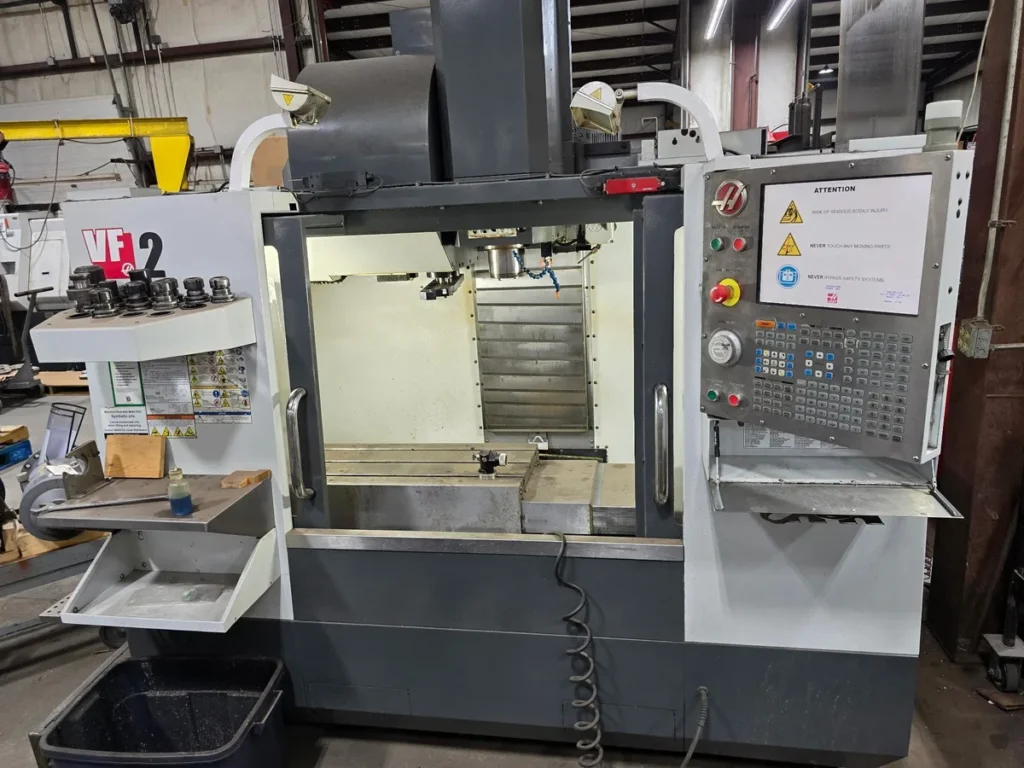
USED HAAS VF2 2011
The HAAS VF2 2011 is a proven CNC Vertical Machining Center (VMC) designed for precision machining, job shop production, and high-volume manufacturing. As one of the most successful machines in the Haas VF Series, the VF2 has earned a reputation for exceptional reliability, ease of operation, and low ownership costs. The 2011 model combines a rigid cast-iron frame, precision linear guideways, and the dependable Classic Haas CNC Control, making it an excellent choice for manufacturers producing precision components across a wide variety of industries. Its versatile design allows efficient machining of aluminum, steel, stainless steel, cast iron, titanium, brass, and engineering plastics while maintaining excellent dimensional accuracy and repeatability. The HAAS VF2 2011 continues to be one of the most sought-after used CNC machining centers thanks to its proven performance, affordable maintenance, and extensive global support network.
The 2011 HAAS VF2 features 30 inches (762 mm) of X-axis travel, 16 inches (406 mm) of Y-axis travel, and 20 inches (508 mm) of Z-axis travel, providing an ideal machining envelope for medium-sized production parts, tooling, fixtures, and prototype work. The 36″ × 14″ (914 × 356 mm) precision-ground table supports workpieces weighing up to 3,000 lbs (1,361 kg). Standard machines were equipped with an 8,100 RPM inline direct-drive spindle powered by a 30 HP (22.4 kW) vector drive motor featuring a CT40/CAT40 spindle taper, delivering an excellent balance of speed, torque, and surface finish. Optional factory equipment included 10,000 RPM spindle, 12,000 RPM spindle, 2-speed gearbox, Through-Spindle Coolant (TSC), High-Speed Machining (HSM), Renishaw probing, programmable coolant nozzle, chip conveyor, rotary tables, and additional memory upgrades. Since Haas offered numerous factory-installed options, specifications may vary depending on the machine’s original configuration.
Purchasing a used HAAS VF2 2011 provides manufacturers with an opportunity to acquire a dependable production machining center at a fraction of the cost of a new machine. Its widespread popularity means replacement parts, service technicians, software support, and operator expertise are readily available worldwide. With proper maintenance, the VF2 2011 continues to deliver excellent machining performance, making it an outstanding long-term investment for both established manufacturers and growing machine shops.
HAAS VF2 2011 – AXIS
| Specification | Value |
|---|---|
| X Axis | 762 mm (30″) |
| Y Axis | 406 mm (16″) |
| Z Axis | 508 mm (20″) |
| Number of Controlled Axes | 3 (4th & 5th Axis Ready) |
HAAS VF2 2011 – AXIS TRAVELS / WORK ENVELOPE
| Specification | Value |
|---|---|
| X Travel | 762 mm |
| Y Travel | 406 mm |
| Z Travel | 508 mm |
| Table Size | 914 × 356 mm (36″ × 14″) |
| Maximum Table Load | 1,361 kg (3,000 lbs) |
HAAS VF2 2011 – CAPACITY
| Specification | Value |
|---|---|
| Table Size | 914 × 356 mm |
| Maximum Workpiece Weight | 1,361 kg (3,000 lbs) |
| T-Slots | 3 |
| T-Slot Width | 15.9–16.0 mm |
HAAS VF2 2011 – SPINDLE
| Specification | Value |
|---|---|
| Maximum Spindle Speed | 8,100 RPM |
| Spindle Motor | 30 HP (22.4 kW) Vector Drive |
| Spindle Taper | CT40 / CAT40 |
| Spindle Type | Inline Direct Drive |
| Maximum Torque | 122 Nm (90 ft-lb) |
| Through Spindle Coolant | Optional |
| 2-Speed Gearbox | Optional |
HAAS VF2 2011 – TOOL CHANGER
| Specification | Value |
|---|---|
| Tool Capacity | 20 Tools |
| Tool Changer Type | Automatic Carousel |
| Tool Selection | Random Access |
| Tool-to-Tool Time | Approximately 4.2 Seconds |
| Chip-to-Chip Time | Approximately 4.5 Seconds |
HAAS VF2 2011 – CONTROL SYSTEM
| Specification | Value |
|---|---|
| CNC Control | Classic Haas CNC Control |
| Programming | ISO Standard G-Code |
| USB | Standard |
| Ethernet | Optional |
| Rigid Tapping | Standard |
| User Macros | Optional |
| 4th & 5th Axis Drive & Wiring | Standard |
HAAS VF2 2011 – COOLANT / CHIP MANAGEMENT
| Specification | Value |
|---|---|
| Flood Coolant | Standard |
| Automatic Lubrication | Standard |
| Window Air Blast | Standard |
| Coolant Tank | 208 L (55 gal) |
| Chip Conveyor | Optional |
| Through Spindle Coolant | Optional |
HAAS VF2 2011 – POWER REQUIREMENTS
| Specification | Value |
|---|---|
| Electrical Supply | 220–440V Three Phase |
| Connected Load | Approximately 35 kVA |
| Air Requirement | 4 SCFM @ 100 PSI |
HAAS VF2 2011 – DIMENSIONS
| Specification | Value |
|---|---|
| Length | Approximately 2,570 mm (101″) |
| Width | Approximately 2,510 mm (99″) |
| Height | Approximately 2,570 mm (101″) |
| Machine Weight | Approximately 3,540 kg (7,800 lbs) |
HAAS VF2 2011 – GENERAL INFORMATION
| Item | Details |
|---|---|
| Manufacturer | Haas Automation |
| Model | VF2 |
| Year | 2011 |
| Machine Type | CNC Vertical Machining Center |
| CNC Control | Classic Haas CNC Control |
| Spindle Taper | CT40 / CAT40 |
| Tool Capacity | 20 Tools |
| 4th & 5th Axis Ready | Yes |
INDUSTRIES THAT USE HAAS VF2 2011
The HAAS VF2 2011 is widely used in aerospace, automotive, mold and die, medical device manufacturing, industrial machinery, electronics, defense, energy, and precision contract machining. Its rigid machine construction and dependable spindle allow efficient machining of aluminum, steel, stainless steel, cast iron, titanium, brass, and engineering plastics while maintaining outstanding accuracy and surface finish.
TYPICAL PARTS HAAS VF2 2011 CAN PRODUCE
The HAAS VF2 2011 commonly manufactures aerospace brackets, hydraulic manifolds, valve bodies, mold inserts, die components, gearbox housings, production fixtures, robotic components, aluminum housings, pump bodies, tooling plates, medical device components, machine parts, electronic enclosures, and custom precision-machined products.
The machine performs face milling, contour milling, drilling, tapping, boring, thread milling, pocket milling, engraving, and precision finishing operations. When equipped with an optional rotary table or trunnion, it can efficiently machine multiple faces of complex parts in a single setup, reducing cycle times and improving productivity.
WHY CHOOSE HAAS VF2 2011
The HAAS VF2 2011 remains an excellent choice for manufacturers looking for a dependable machining center that combines proven mechanical reliability with outstanding machining performance. Its rigid construction, powerful inline spindle, intuitive Haas control, and extensive factory options make it suitable for everything from prototype work to continuous production. The machine’s affordable maintenance, excellent parts availability, and worldwide service support continue to make it one of the industry’s most trusted vertical machining centers.
WHY BUY USED HAAS VF2 2011
Purchasing a used HAAS VF2 2011 allows manufacturers to significantly reduce capital investment while acquiring a machine capable of many more years of productive service. Many used machines include valuable factory-installed options such as Through-Spindle Coolant, Renishaw probing, chip conveyor, High-Speed Machining software, rotary tables, programmable coolant nozzle, and extensive tooling packages, increasing their overall value.
Before purchasing, buyers should inspect spindle condition, spindle hours, ballscrews, guideways, lubrication system, coolant equipment, tool changer operation, machine geometry, and maintenance records. Some owners also recommend confirming that the lubrication system has been properly maintained, particularly on machines from this era.
HOW MUCH DOES A USED HAAS VF2 2011 COST?
The value of a used HAAS VF2 2011 depends on spindle hours, maintenance history, tooling package, machine condition, and installed factory options. Machines equipped with Through-Spindle Coolant, probing systems, rotary tables, chip conveyor, low spindle hours, and complete maintenance documentation generally command higher resale prices.
Depending on overall condition, spindle hours, tooling, and factory-installed options, a used HAAS VF2 2011 typically sells within an estimated price range of $28,000 to $48,000 USD. Premium machines with low operating hours, extensive options, and documented maintenance history may exceed this range, while higher-hour machines requiring refurbishment may sell below it. A properly maintained HAAS VF2 2011 continues to deliver dependable machining performance, excellent reliability, and outstanding long-term value for manufacturers seeking a versatile CNC vertical machining center.
HAAS VF-2 VS HAAS DM-2 – COMPARING TWO HAAS VERTICAL MACHINING CENTERS
The HAAS VF-2 and HAAS DM-2 are both CNC vertical machining centers, but they are intended for somewhat different machining requirements. The VF-2 is a general-purpose 40-taper VMC designed around a larger work envelope and broader production capability, while the DM-2 is a compact machining center aimed at shops that need efficient milling in a smaller footprint.
The current VF-2 provides 30 inches of X-axis travel, 16 inches of Y-axis travel, and 20 inches of Z-axis travel. Haas lists it with a 30-hp spindle, 8,100-rpm maximum speed, 40-taper tooling, and a 20-tool carousel. This makes the VF-2 suitable for general production work involving brackets, fixtures, housings, plates, tooling, and other small-to-medium industrial components.
The DM-2 is more compact and is generally attractive to shops where floor space and fast production of smaller components are important. Its compact format can make it useful for high-volume work, prototyping, and facilities that need to add machining capacity without installing a larger VMC.
The VF-2 is generally the better choice when versatility, larger workpieces, higher spindle power, and greater Z-axis capacity are priorities. Its 30-by-16-by-20-inch travel envelope gives it considerable flexibility for general machining applications.
The DM-2 can be attractive when the majority of production consists of smaller parts and the shop wants a compact machine that can deliver efficient machining without the footprint of a larger VMC. The right choice therefore depends on whether the shop values maximum work envelope or compact production capability.
For used-machine buyers, model selection should not be based solely on published specifications. Spindle condition, axis accuracy, ballscrew wear, tool changer performance, control condition, maintenance history, and previous operating environment can have a major effect on the value of either machine.
HAAS VF-2 SERVO DRIVE FAILURE – DIAGNOSIS AND REPAIR
A servo drive failure on a HAAS VF-2 can stop one or more machine axes from moving correctly and may produce alarms involving servo errors, short circuits, overloads, or excessive position error. The term “servo drive failure” does not necessarily mean that the servo amplifier itself has failed. The motor, power cable, encoder, amplifier, mechanical axis components, or electrical connections can all contribute to the same symptom.
The first step is to record the exact alarm and identify which axis is affected. Haas’s current servo troubleshooting documentation recommends inspecting the motor, power cable, and related components before replacing parts. It also emphasizes proper electrical safety and lockout/tagout procedures when working on the machine’s electrical system.
A damaged or contaminated servo motor cable is one possible cause. Haas notes that coolant contamination can contribute to drive faults and amplifier damage. The motor connector and cable should therefore be inspected for contamination, damage, pinching, or poor connections.
Mechanical resistance can produce similar symptoms. A binding ballscrew, damaged bearing, inadequate lubrication, obstruction, or misalignment can force the servo system to work harder than expected. If the axis becomes difficult to move or the alarm occurs only in certain positions, mechanical inspection becomes particularly important.
The encoder system should also be considered because the control relies on position feedback to maintain accurate axis movement. Encoder cables, connectors, and feedback signals may need to be checked when the alarm indicates a position or communication problem.
Haas provides specific diagnostic procedures for distinguishing among a motor, cable, and amplifier fault. In some alarm conditions, testing the machine with the motor and cable isolated can help determine which component is responsible.
Repairs may involve replacing a damaged cable, servo motor, amplifier, encoder-related component, or correcting a mechanical problem. Do not replace the servo amplifier solely because a servo alarm appears. Proper diagnosis can prevent unnecessary component replacement and reduce repair costs.
HAAS VF-2 INSPECTION CHECKLIST BEFORE BUYING A USED MACHINE
A thorough inspection is one of the most important steps when purchasing a used HAAS VF-2. Photographs can show the machine’s overall appearance, but they cannot reveal spindle bearing condition, axis backlash, servo performance, tool changer reliability, or control problems. Whenever possible, the machine should be powered on and demonstrated under operating conditions.
Start by recording the machine’s model, serial number, production year, control generation, spindle configuration, and installed options. Verify that the seller’s description matches the actual machine. Haas currently lists the VF-2 with 30 inches of X travel, 16 inches of Y travel, 20 inches of Z travel, a 30-hp spindle, 8,100-rpm maximum speed, and 20-tool capacity, although specifications can vary by machine generation and options.
Inspect the spindle carefully. Run it through multiple speeds and listen for grinding, rumbling, vibration, or unusual changes in sound. Check whether the spindle becomes excessively hot and examine the surface finish produced during a test cut.
Move each axis through its available travel. Listen for unusual sounds and watch for hesitation, rough movement, backlash, servo alarms, or inconsistent positioning. Haas identifies ballscrew, bearing, coupling, lubrication, motor, and encoder-related conditions among possible causes of axis problems.
Test the automatic tool changer repeatedly. Verify carousel indexing, tool release, spindle orientation, arm movement, and tool seating. A tool changer that works intermittently can become a significant source of downtime.
Inspect the coolant and lubrication systems for leaks, contamination, damaged hoses, and warning messages. Examine the enclosure, way covers, table, T-slots, and workholding surfaces for evidence of crashes or excessive wear.
Check the control for active alarms and unusual diagnostic conditions. Review maintenance records and ask about previous spindle, servo, ballscrew, control, or tool-changer repairs.
Finally, confirm what accessories are included. Probing, rotary equipment, chip conveyors, coolant systems, tooling, and workholding can substantially affect the practical value of a used VF-2.
WHAT IS THE STANDARD SPINDLE SPEED OF THE HAAS VF-2?
The current standard HAAS VF-2 is equipped with an 8,100-rpm maximum-speed spindle. Haas lists the machine with a 30-hp spindle, 8,100-rpm maximum speed, inline direct-drive system, and 40-taper tooling.
An 8,100-rpm spindle provides the VF-2 with a useful balance between general-purpose machining and higher-speed cutting applications. The machine can perform conventional milling operations while also supporting machining strategies that benefit from increased spindle speed. Actual operating speed should always be selected according to the cutting tool, workpiece material, cutter diameter, depth of cut, feed rate, and manufacturer’s tooling recommendations.
The maximum spindle speed should not be confused with the speed used for every machining operation. Large-diameter cutters generally operate at lower RPMs because their cutting speed increases significantly as spindle speed rises. Smaller tools can often benefit from higher RPMs, particularly when machining aluminum and other materials where higher surface speeds are appropriate.
Haas lists maximum spindle torque on the current VF-2 as 90 ft-lbf at 2,000 rpm, with an optional gearbox configuration capable of 250 ft-lbf at 450 rpm. This illustrates why spindle performance should be evaluated using more than the maximum RPM number alone.
Used VF-2 buyers should verify the exact spindle configuration of the machine being considered. Production year, spindle option, and machine configuration can affect specifications. A machine advertised simply as a “VF-2” may not have exactly the same spindle arrangement as another VF-2 from a different production period.
It is also important to inspect spindle condition rather than focusing exclusively on the published speed. Excessive vibration, unusual bearing noise, heat, poor surface finish, or inconsistent speed can indicate wear.
For shops considering a used VF-2, the 8,100-rpm standard spindle provides a versatile starting point for general CNC milling. However, the machine’s actual production capability depends on the complete spindle package, tooling, power, torque, machine condition, and application.
WHY IS MY HAAS VF-2 PRODUCING TAPERED CUTS?
Tapered cuts on a HAAS VF-2 can indicate a problem with machine geometry, axis movement, spindle alignment, tooling, workholding, or cutting conditions. If a feature is consistently larger or smaller at one end than the other, the cause should be investigated rather than automatically correcting the CNC program.
One possible cause is axis geometry or alignment. If an axis is not moving accurately through its travel, the cutter may gradually change position relative to the workpiece. Mechanical problems involving ballscrews, bearings, couplings, or linear motion components can contribute to positioning errors. Haas’s service documentation identifies ballscrew condition, support bearings, lubrication, alignment, and coupling issues as areas to investigate when axis motion problems occur.
Spindle alignment can also influence tapered features. If the spindle is not properly aligned relative to the machine’s axes or table, the cutting tool may remove different amounts of material at different locations. This can become particularly noticeable during side milling or when machining deep features.
Tool deflection is another common possibility. Excessive tool stick-out, a small-diameter cutter, aggressive cutting parameters, or an unsuitable tool for the material can cause the cutter to deflect during machining. Haas’s older service documentation also emphasizes checking tooling, feeds and speeds, fixturing, spindle condition, and axis backlash when investigating machining accuracy and vibration problems.
Workholding should not be overlooked. A workpiece that moves under cutting pressure can produce dimensional changes that resemble machine geometry problems. The fixture, vise, parallels, and workpiece seating should all be checked.
Thermal effects may also cause dimensional variation after the machine has been operating for an extended period. Comparing measurements when the machine is cold and after warm-up can help identify a thermal pattern.
Start by determining whether the taper occurs on one axis, across the entire work envelope, or only during a particular cutting operation. Check tool condition, holder runout, workholding, axis backlash, spindle alignment, and machine geometry before making compensation changes.
If the taper is repeatable and remains after tooling and cutting conditions have been eliminated as causes, a qualified technician should perform a machine accuracy and alignment inspection.
Related Products
-
HAAS - VF6B
VIEW MACHINE -
HAAS - VF3D
VIEW MACHINE -
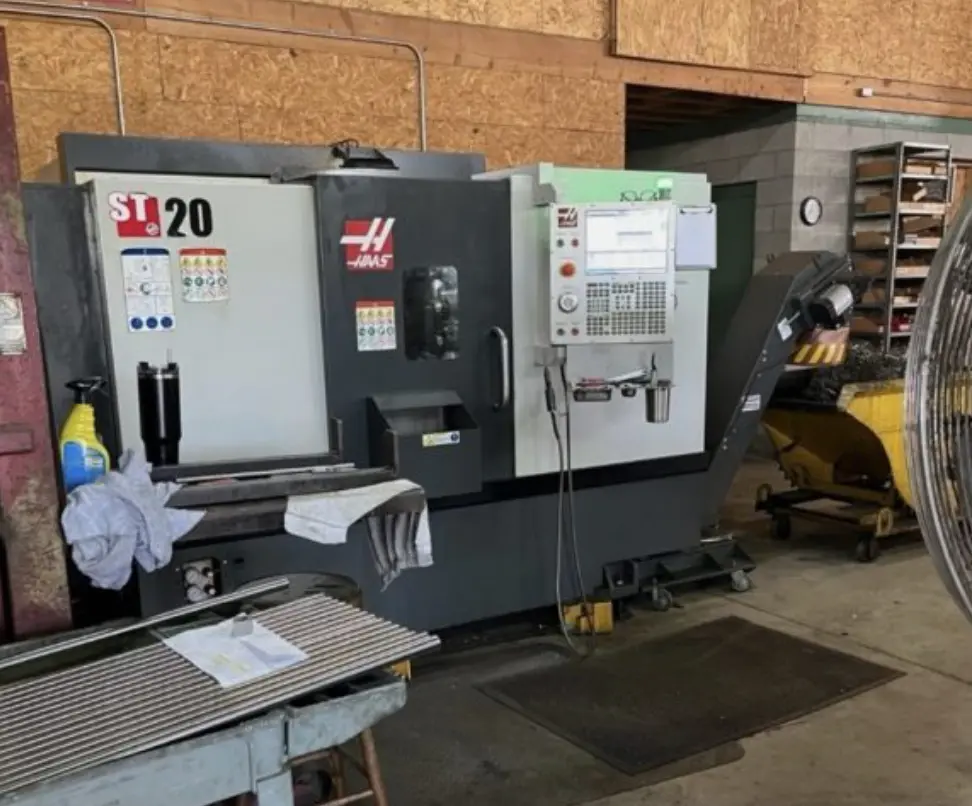
HAAS - ST20
VIEW MACHINE -
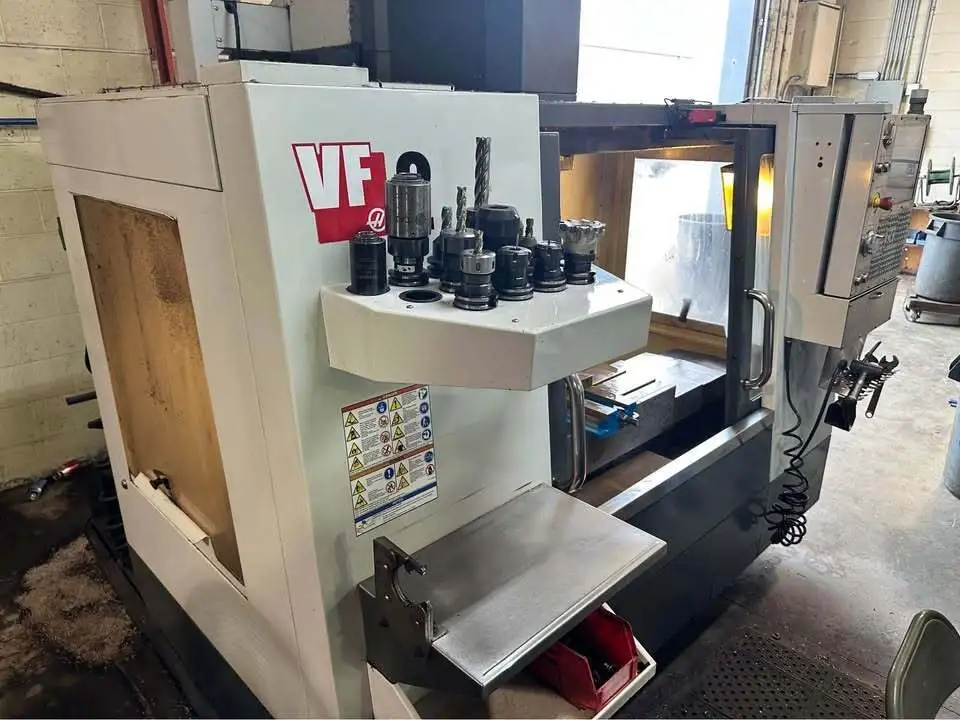
HAAS - VF2
VIEW MACHINE