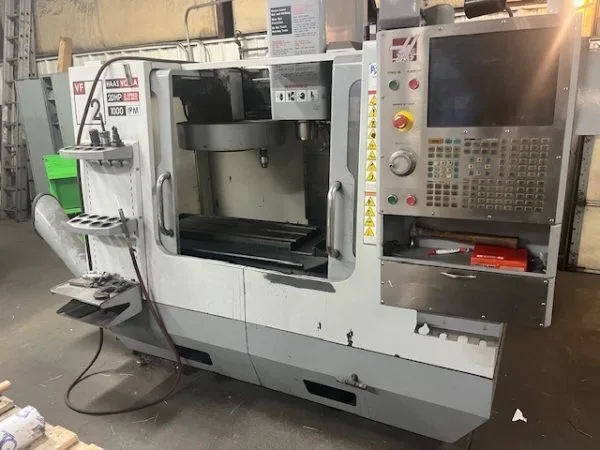
USED HAAS VF2 2007
The 2007 HAAS VF2 is a dependable 3-axis Vertical Machining Center (VMC) designed for precision milling, drilling, tapping, and production machining across a wide range of industries. As one of the most successful models in the Haas VF Series, the VF2 combines a rigid cast-iron frame, precision linear guideways, an inline direct-drive spindle, and the proven Haas CNC Control to deliver outstanding machining accuracy, repeatability, and long-term reliability. The 2007 HAAS VF2 remains a favorite among job shops, OEM manufacturers, mold makers, and contract machining facilities because of its versatility, ease of operation, and affordable ownership costs.
The machine features 30 inches of X-axis travel, 16 inches of Y-axis travel, and 20 inches of Z-axis travel, providing an ideal work envelope for machining tooling plates, fixtures, mold inserts, aerospace components, automotive parts, and precision production work. Its heavy-duty cast-iron construction minimizes vibration during aggressive cutting operations, while precision linear guideways and oversized ballscrews ensure excellent positioning accuracy and repeatability. Whether machining aluminum, stainless steel, cast iron, titanium, or engineering plastics, the 2007 HAAS VF2 consistently delivers high-quality surface finishes and tight dimensional tolerances.
Powering the machine is an 8,100 RPM CAT40 inline direct-drive spindle producing 30 HP and approximately 90 ft-lb of torque. The standard 20-pocket automatic carousel tool changer provides fast and dependable tool changes, while 1,000 IPM rapid traverse rates reduce cycle times and improve machining efficiency. Many used machines are equipped with factory-installed options such as through-spindle coolant (TSC), programmable coolant nozzle, probing systems, rotary tables, chip augers, chip conveyors, and fourth-axis preparation, allowing manufacturers to expand machining capabilities without investing in a newer machine.
The dependable Haas CNC Control offers intuitive programming, rigid tapping, USB connectivity, and straightforward machine operation. Many machines have also been upgraded with expanded memory and software enhancements, allowing them to remain productive in modern manufacturing environments.
Today, the 2007 HAAS VF2 continues to be one of the best values in the used CNC market by combining proven reliability, affordable maintenance, excellent parts availability, and consistent machining performance.
HAAS VF2 SPECIFICATIONS
HAAS VF2 – AXIS
| Specification | Value |
|---|---|
| Number of Axes | 3 Axis |
| X-Axis Travel | 30 in |
| Y-Axis Travel | 16 in |
| Z-Axis Travel | 20 in |
| Rapid Traverse (X/Y/Z) | 1,000 IPM |
HAAS VF2 – AXIS TRAVELS / WORK ENVELOPE
| Specification | Value |
|---|---|
| X Travel | 30 in (762 mm) |
| Y Travel | 16 in (406 mm) |
| Z Travel | 20 in (508 mm) |
| Spindle Nose to Table (Maximum) | 24 in |
| Spindle Nose to Table (Minimum) | 4 in |
HAAS VF2 – TABLE
| Specification | Value |
|---|---|
| Table Size | 36 × 14 in |
| Maximum Table Load | 3,000 lbs |
| T-Slots | 3 |
| T-Slot Width | 5/8 in |
HAAS VF2 – SPINDLE
| Specification | Value |
|---|---|
| Maximum Spindle Speed | 8,100 RPM |
| Spindle Power | 30 HP |
| Maximum Torque | 90 ft-lb @ 2,000 RPM |
| Spindle Taper | CAT40 |
| Drive Type | Inline Direct Drive |
HAAS VF2 – TOOL CHANGER
| Specification | Value |
|---|---|
| Tool Capacity | 20 Tools |
| Tool Changer Type | Automatic Carousel |
| Maximum Tool Diameter | 3.5 in |
| Maximum Tool Length | 16 in |
| Maximum Tool Weight | 12 lbs |
| Tool-to-Tool Time | Approx. 4.2 sec |
| Chip-to-Chip Time | Approx. 4.5 sec |
HAAS VF2 – CONTROL SYSTEM
| Specification | Value |
|---|---|
| CNC Control | Haas CNC Control |
| USB Interface | Standard |
| Ethernet Connectivity | Optional |
| Rigid Tapping | Standard |
| Memory | Expandable |
| Fourth-Axis Ready | Optional |
HAAS VF2 – COOLANT / CHIP MANAGEMENT
| Specification | Value |
|---|---|
| Flood Coolant | Standard |
| Coolant Tank Capacity | 55 gal |
| Through-Spindle Coolant | Optional |
| Programmable Coolant Nozzle | Optional |
| Chip Washdown | Standard |
| Chip Auger | Optional |
| Chip Conveyor | Optional |
HAAS VF2 – POWER REQUIREMENTS
| Specification | Value |
|---|---|
| Electrical Supply | 220V / 440V 3-Phase |
| Air Requirement | 100 PSI |
| Main Disconnect | Included |
HAAS VF2 – DIMENSIONS
| Specification | Value |
|---|---|
| Machine Footprint | Approx. 101 × 99 in |
| Machine Height | Approx. 101 in |
| Machine Weight | Approx. 7,800 lbs |
HAAS VF2 – GENERAL INFORMATION
| Specification | Value |
|---|---|
| Manufacturer | Haas Automation |
| Model | VF2 |
| Year | 2007 |
| Machine Type | Vertical Machining Center |
| Spindle Taper | CAT40 |
| CNC Control | Haas CNC Control |
| Primary Application | Precision Milling, Drilling & Tapping |
WHY BUY USED HAAS VF2 2007
Purchasing a used 2007 HAAS VF2 gives manufacturers access to one of the industry’s most proven vertical machining centers at a fraction of the cost of a new machine. Its rigid machine construction, dependable 30 HP inline direct-drive spindle, versatile work envelope, and user-friendly Haas CNC Control make it suitable for both prototype work and continuous production machining.
Many used machines are equipped with valuable factory-installed options including through-spindle coolant, probing systems, rotary tables, programmable coolant nozzles, chip conveyors, and fourth-axis preparation. These features improve productivity, reduce setup times, and expand machining capabilities. Haas machines are recognized worldwide for affordable maintenance, readily available replacement parts, and dependable long-term reliability, making the 2007 HAAS VF2 an excellent investment for shops of all sizes.
HOW MUCH DOES A USED HAAS VF2 2007 COST?
The value of a used 2007 HAAS VF2 depends on spindle hours, overall machine condition, installed options, tooling packages, and maintenance history. Machines equipped with through-spindle coolant, probing systems, rotary tables, chip conveyors, and documented service records generally command higher resale values.
Before purchasing, buyers should inspect spindle condition, guideways, ballscrews, lubrication system, tool changer operation, coolant system, CNC diagnostics, and machine geometry. Machines that have been well maintained and serviced regularly typically provide the best long-term value.
A used 2007 HAAS VF2 typically sells between $22,000 and $38,000, depending on spindle hours, tooling, installed options, machine condition, and maintenance history.
INDUSTRIES THAT USE HAAS VF2
- Aerospace Manufacturing
- Automotive Manufacturing
- Medical Device Manufacturing
- Mold & Die Industry
- Tool & Die Shops
- Industrial Equipment Manufacturing
- Electronics Manufacturing
- Energy Equipment Manufacturing
- Contract Manufacturing
- Precision Engineering
- General Manufacturing
- Research & Development
TYPICAL PARTS HAAS VF2 CAN PRODUCE
- Aerospace Components
- Mold Inserts
- Tooling Plates
- Precision Fixtures
- Hydraulic Manifolds
- Medical Device Components
- Automotive Components
- Electronic Enclosures
- Prototype Parts
- Production Fixtures
- Precision Machine Components
- Custom Machined Parts
WHY CHOOSE HAAS VF2 2007
The 2007 HAAS VF2 combines a rigid cast-iron frame, dependable 30 HP CAT40 inline direct-drive spindle, proven Haas CNC Control, and a versatile machining envelope into one of the most trusted vertical machining centers available. Its excellent machining accuracy, straightforward operation, low maintenance requirements, and broad application range make it an outstanding solution for both job shops and production facilities.
Manufacturers continue to choose the HAAS VF2 because of its durability, affordable operating costs, excellent parts availability, and strong resale value. Whether machining aerospace components, tooling, molds, fixtures, or precision production parts, the used 2007 HAAS VF2 delivers reliable performance, high productivity, and excellent long-term return on investment.
HAAS VF-2 VS DOOSAN DNM 4000 – WHICH VMC IS RIGHT FOR PRODUCTION MACHINING?
The HAAS VF-2 and Doosan DNM 4000, now part of the DN Solutions product line, are both compact vertical machining centers designed for general-purpose production. Both use 40-taper tooling and offer three-axis machining, but their specifications and machine characteristics make them better suited to different production environments.
The current HAAS VF-2 provides 30 inches of X-axis travel, 16 inches of Y-axis travel, and 20 inches of Z-axis travel. Haas lists a 30-hp, 8,100-rpm inline direct-drive spindle, a 36-by-14-inch table, and a standard 20-tool carousel. The machine also provides 1,000-ipm rapid traverse rates on all three axes.
The DNM 4000 provides 20 inches of X travel, 16 inches of Y travel, and 19 inches of Z travel. DN Solutions lists it with a 12,000-rpm, 25-hp spindle, ISO #40 tooling, 48 m/min rapid traverse rates, and a 650-by-400-mm table capable of handling up to 400 kg.
For shops machining larger components, the VF-2 has an advantage because its X-axis travel is substantially greater. Its 30-inch X travel can be valuable when machining longer plates, fixtures, housings, and multiple components in one setup.
The DNM 4000 becomes particularly attractive for production work where higher spindle speed and rapid axis movement are priorities. Its 12,000-rpm spindle and 48-m/min rapid rates can benefit smaller components and high-throughput machining applications.
The choice therefore depends on the production mix. The VF-2 is an excellent general-purpose option when versatility and work envelope are important. The DNM 4000 can be attractive for shops emphasizing compact production, high-speed machining, and rapid positioning.
For a used-machine purchase, condition should ultimately be compared alongside specifications. Spindle condition, ballscrew wear, axis accuracy, tool changer operation, control condition, maintenance history, and available service support can have a greater effect on productivity than the model name alone.
HAAS VF-2 LUBRICATION SYSTEM ALARM – CAUSES AND SOLUTIONS
A lubrication system alarm on a HAAS VF-2 should be investigated promptly because the machine’s moving components depend on proper lubrication to minimize friction and wear. Ignoring a lubrication warning can allow problems involving the ballscrews, linear guides, bearings, or other moving components to develop into expensive mechanical failures.
The first step is to identify the exact alarm displayed by the CNC control. A general lubrication-related warning does not automatically mean that the lubrication pump has failed. The issue may involve low lubricant level, a blocked line, incorrect pressure, a failed pump, a sensor, or another part of the lubrication circuit.
Check the lubricant reservoir first. If the level is low, determine why the machine has reached that condition rather than simply filling the reservoir and continuing production. A leak, incorrect lubricant, or abnormal consumption can indicate an underlying problem.
The lubrication lines should also be inspected for visible damage, disconnected tubing, leakage, or contamination. A pump may operate correctly while lubricant fails to reach a particular lubrication point because of a restriction or damaged line.
The lubrication pump itself should be checked when the system does not generate the expected pressure or cycle. Electrical problems, a failed motor, contamination, or mechanical wear can prevent proper operation.
Another important area is the lubrication pressure or flow feedback system. The control needs confirmation that the lubrication cycle has occurred correctly. A faulty pressure switch or sensor can therefore generate an alarm even when lubricant is physically reaching some components.
Haas identifies lubrication as an important factor in axis performance and lists insufficient lubrication among possible contributors to ballscrew and axis-motion problems.
Do not bypass the lubrication alarm simply to keep the machine running. If lubrication is inadequate, continued operation can accelerate wear and potentially damage expensive components. Check the reservoir, lubricant type, lines, pump, pressure feedback, and machine-specific alarm information.
If the alarm returns after the basic checks, the lubrication system should be professionally diagnosed. Correcting the underlying fault is far safer than repeatedly resetting the control.
HAAS VF-2 CNC CONTROL FEATURES AND PROGRAMMING OVERVIEW
The CNC control is one of the most important parts of a HAAS VF-2 because it coordinates axis movement, spindle operation, tool changes, coolant functions, offsets, alarms, and machining programs. Haas has developed its control system around shop-floor operation, allowing operators to create, edit, verify, and execute CNC programs directly from the machine.
A VF-2 program typically uses standard G-code and M-code commands to control machining operations. G-codes define movements and machining functions, while M-codes control machine-related functions such as spindle operation, coolant, tool changes, and program control. Operators can combine these commands with work offsets, tool offsets, feeds, speeds, and canned cycles to produce complete machining programs.
The control also supports graphical and conversational-style functions on applicable configurations, making it easier to set up jobs without manually writing every line of code. Haas provides features intended to simplify setup, programming, diagnostics, and operator interaction.
Work offsets are particularly important in production machining. They allow the programmer to establish the relationship between the machine coordinate system and the workpiece. Tool length and diameter offsets provide additional control over how each cutting tool interacts with the part.
Program verification is another valuable capability. Operators can review toolpaths and identify potential problems before cutting material. This is particularly useful when working with unfamiliar programs or complex geometry.
Modern VF-2 configurations can also incorporate options such as probing, tool measurement, high-speed machining functions, wireless connectivity, and other productivity features. The exact control capabilities depend on the machine’s generation and installed options.
For used VF-2 buyers, the control generation should be documented carefully. Older machines may have substantially different control capabilities from newer VF-2 models even though the basic machine model remains the same.
Operators should also inspect the control keypad, display, USB or data-transfer functionality, memory, alarm history, and program storage during a used-machine evaluation.
The CNC control ultimately determines how effectively the VF-2 can be programmed and integrated into a shop’s workflow. A machine with good mechanical condition but an outdated or problematic control may require additional investment, so control condition should be considered alongside spindle and axis condition when purchasing used equipment.
HOW MUCH WEIGHT CAN THE HAAS VF-2 TABLE HOLD?
The current HAAS VF-2 table is rated to support 3,000 pounds (1,361 kg) when the load is evenly distributed. Haas lists the VF-2 table as 36 inches long by 14 inches wide, with three standard T-slots.
The phrase “evenly distributed” is important. The 3,000-pound specification should not automatically be interpreted as meaning that any 3,000-pound object can be placed anywhere on the table. Load distribution, workpiece dimensions, fixture design, positioning, and how the component is secured all influence the practical setup.
For example, a large casting supported across multiple appropriate contact points distributes its weight differently from a concentrated load positioned on a small section of the table. The fixture and workholding equipment also contribute to the total load being placed on the machine.
The table’s T-slots provide the attachment points needed for vises, clamps, fixtures, and other workholding equipment. Haas specifies three standard T-slots with approximately 4.92 inches of center-to-center spacing.
When machining heavy components, the weight of the workholding system should be included in the setup calculation. A heavy vise, fixture plate, rotary device, or fourth-axis unit adds to the total load.
Used VF-2 buyers should also inspect the physical condition of the table before relying on its rated capacity. Deep gouges, damaged T-slots, crash marks, corrosion, or significant surface damage can affect workholding and setup quality.
The maximum table load should also be considered alongside the machine’s axis travel and spindle clearance. A component may technically be within the table’s weight rating but still be unsuitable because of its physical size, height, fixture arrangement, or available machining envelope.
For production planning, the 3,000-pound evenly distributed rating gives the VF-2 substantial capacity for a machine of this size. However, heavy setups should always be planned according to Haas’s machine-specific requirements, appropriate workholding practices, and safe loading procedures.
WHAT SPARE PARTS SHOULD I KEEP IN STOCK FOR A HAAS VF-2?
Keeping selected spare parts on hand can reduce downtime when a HAAS VF-2 develops a problem. The ideal inventory depends on the machine’s age, production schedule, operating environment, installed options, and availability of local service support. A shop running the machine continuously may justify a larger critical-spares inventory than a facility using the VF-2 occasionally.
Start with routine maintenance items. Lubrication supplies, filters, coolant-system consumables, hoses, fittings, seals, and other frequently replaced maintenance components are generally more practical to stock than expensive electronic assemblies that may rarely fail.
Tool-changer-related components can also be important for production shops. Sensors, switches, commonly replaced mechanical components, and other small tool-changer parts can help reduce downtime from indexing or tool-change problems. The exact parts should be identified from the specific VF-2 configuration.
Electrical components are another category worth considering. Depending on machine age and availability, shops may choose to keep selected fuses, relays, switches, fans, sensors, and cables available. Servo motors, amplifiers, and control boards are much more expensive, so they should generally be stocked based on failure history and the criticality of the machine rather than purchased blindly.
Coolant-system spares can be useful, particularly for shops that rely heavily on flood or through-tool coolant. Pumps, hoses, filters, fittings, and related components should be selected according to the installed coolant configuration.
For machines operating in demanding production environments, it can also be worthwhile to identify critical spindle and axis components and document their current availability. Haas lists the VF-2 with a 30-hp, 8,100-rpm direct-drive spindle and three linear axes, making spindle and axis-system condition particularly important to production reliability.
The most effective spare-parts strategy is based on the machine’s actual maintenance history. Review previous failures and identify which components caused the longest periods of downtime. Those parts should receive priority.
Before ordering, always verify the machine serial number, production year, control generation, and installed options. VF-2 configurations can vary, and a part that fits one generation may not be appropriate for another.
A well-organized spare-parts inventory should also include part numbers, supplier information, compatibility notes, and replacement history so technicians can identify the correct component quickly when a failure occurs.
Related Products
-
HAAS - VF2B
VIEW MACHINE -
HAAS - VF8/50
VIEW MACHINE -
HAAS - ST15
VIEW MACHINE -
HAAS - VS1
VIEW MACHINE