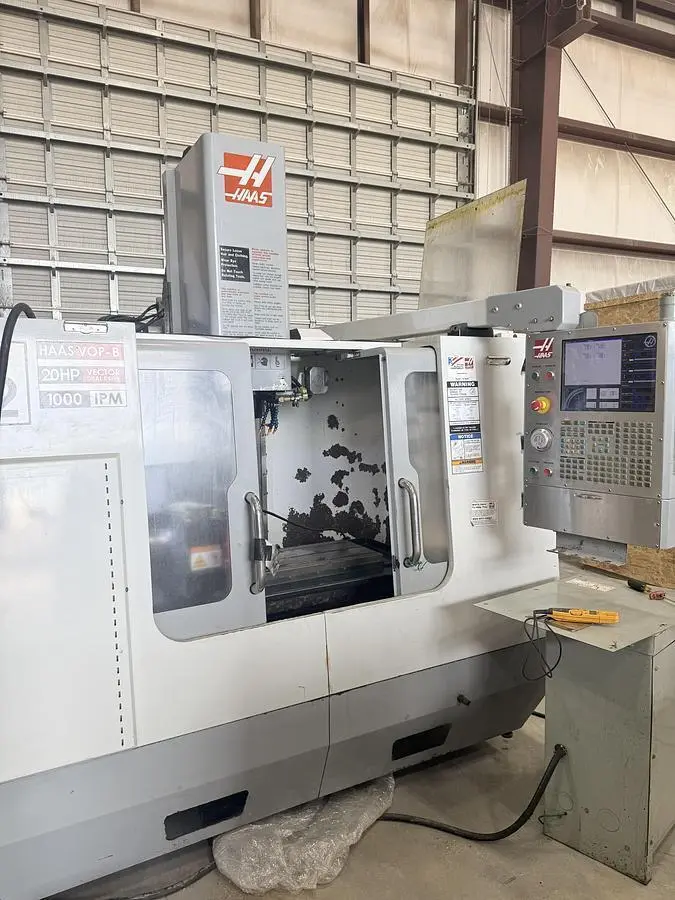
USED HAAS VF2 – 2006
The HAAS VF2 is a 3-axis vertical machining center designed for general-purpose CNC milling, production machining, prototyping, tooling, repair work, and job-shop manufacturing. The 2006 HAAS VF2 is an older generation of the highly popular VF-series platform and remains attractive in the used CNC market because of its practical work envelope, 40-taper tooling, automatic tool changing, and relatively compact footprint.
The VF2 platform provides approximately 30″ of X-axis travel, 16″ of Y-axis travel, and 20″ of Z-axis travel. The standard VF2 specification is built around a 30 HP, 8,100 RPM spindle, although older 2006 machines can have different spindle configurations depending on the exact model and options. Haas’s current VF2 specifications list a 36″ x 14″ table, 20-tool carousel, and 3,000 lb maximum evenly distributed table load.
A 2006 VF2 may be equipped with options such as 4th-axis capability, rigid tapping, programmable coolant, probing, chip auger, and other production features. Exact specifications should be verified from the machine’s serial number because equipment from this period can differ substantially in configuration.
Age is particularly important when evaluating a 2006 machine. Buyers should inspect spindle hours, power-on hours, spindle runout, ballscrews, linear guides, axis backlash, machine geometry, tool changer operation, control electronics, coolant system, lubrication system, and maintenance records.
HAAS VF2 – AXIS
| Specification | Details |
|---|---|
| Machine Type | Vertical Machining Center |
| Axis Configuration | 3-Axis |
| X-Axis Travel | 30″ |
| Y-Axis Travel | 16″ |
| Z-Axis Travel | 20″ |
| 4th-Axis Capability | Optional |
| 5th-Axis Capability | Available with Optional Rotary Equipment |
| CNC Interpolation | 3-Axis Standard |
HAAS VF2 – AXIS TRAVELS / WORK ENVELOPE
| Specification | Details |
|---|---|
| X-Axis Travel | 30″ |
| Y-Axis Travel | 16″ |
| Z-Axis Travel | 20″ |
| Spindle Nose to Table Maximum | Approx. 24″ |
| Spindle Nose to Table Minimum | Approx. 4″ |
| Work Envelope | Approx. 30″ x 16″ x 20″ |
| Rotary Compatibility | Available / Configuration Dependent |
The 30″ x 16″ x 20″ travel envelope makes the VF2 suitable for a broad range of small- and medium-sized components. Haas identifies these travels as the standard VF2 work envelope.
HAAS VF2 – CAPACITY / TABLE
| Specification | Details |
|---|---|
| Table Type | Fixed T-Slot Table |
| Table Length | 36″ |
| Table Width | 14″ |
| Number of Standard T-Slots | 3 |
| T-Slot Center Distance | Approx. 4.92″ |
| T-Slot Width | Approx. 0.626″–0.630″ |
| Maximum Table Load | Approx. 3,000 lbs |
| Workholding | Vises, Fixtures, and Custom Tooling |
| Rotary Compatibility | Available / Configuration Dependent |
The 36″ x 14″ table provides adequate space for production vises, fixtures, tooling plates, and compatible rotary equipment. Haas lists approximately 3,000 lb maximum evenly distributed table load for the VF2 platform.
HAAS VF2 – SPINDLE
| Specification | Details |
|---|---|
| Spindle Type | Direct-Drive / Configuration Dependent |
| Spindle Taper | CT40 / BT40 |
| Spindle Motor Power | Up to Approx. 30 HP |
| Maximum Spindle Speed | Up to Approx. 8,100 RPM |
| Maximum Torque | Approx. 90 ft-lb @ 2,000 RPM |
| Spindle Cooling | Configuration Dependent |
| Bearing Lubrication | Configuration Dependent |
| Rigid Tapping | Available / Configuration Dependent |
| High-Speed Machining | Optional / Configuration Dependent |
| Through-Spindle Coolant | Optional / Configuration Dependent |
Important: The 2006 VF2 should not automatically be assumed to have the exact same spindle specification as a current VF2. The current Haas VF2 is rated at 30 HP and 8,100 RPM, while older VF2 machines could have different configurations.
When inspecting a 2006 used machine, check spindle runout, bearing noise, vibration, temperature rise, taper condition, drawbar operation, and spindle performance across its speed range.
HAAS VF2 – TOOL CHANGER
| Specification | Details |
|---|---|
| Tool Changer Type | Automatic Carousel |
| Tool Capacity | Approx. 20 Tools |
| Tool Taper | CT40 / BT40 |
| Tool Selection | Automatic |
| Maximum Tool Diameter | Configuration Dependent |
| Maximum Tool Weight | Configuration Dependent |
| Automatic Tool Change | Standard |
| Tool Changer Condition | Should Be Tested Before Purchase |
The VF2 uses a carousel automatic tool changer, with the current model specified with 20 tool positions. Older machines should be checked individually for actual tool capacity and tool changer configuration.
For a 2006 machine, repeated tool changes should be performed during inspection to check for pocket alignment, carousel movement, drawbar release, tool-clamp operation, sensor faults, and ATC arm problems.
HAAS VF2 – CONTROL SYSTEM
| Specification | Details |
|---|---|
| CNC Control | Haas CNC Control |
| Control Generation | Haas Control, 2006 Era |
| Display | Color LCD / Configuration Dependent |
| Program Memory | Configuration Dependent |
| USB Connectivity | Configuration Dependent |
| Ethernet Connectivity | Configuration Dependent |
| Rigid Tapping | Available / Configuration Dependent |
| High-Speed Machining | Optional / Configuration Dependent |
| User-Definable Macros | Configuration Dependent |
| Coordinate Rotation & Scaling | Configuration Dependent |
| Probing | Optional |
| 4th-Axis Control | Optional |
The control is an important consideration on a 2006 VF2. Buyers should identify the exact control generation, memory capacity, communication options, software version, and availability of replacement electronic components.
A machine with a well-maintained control and updated communications capability can be considerably more attractive than another 2006 VF2 with outdated or problematic electronics.
HAAS VF2 – FEEDRATES
| Specification | Details |
|---|---|
| X-Axis Rapid Traverse | Up to Approx. 1,000 IPM |
| Y-Axis Rapid Traverse | Up to Approx. 1,000 IPM |
| Z-Axis Rapid Traverse | Up to Approx. 1,000 IPM |
| Maximum Cutting Feedrate | Approx. 650 IPM |
| High-Speed Machining | Configuration Dependent |
| Rapid Traverse Metric Equivalent | Approx. 25.4 m/min |
The current VF2 specification lists 1,000 IPM rapid traverse on X, Y, and Z and approximately 650 IPM maximum cutting feedrate. Actual performance of a 2006 machine will depend on its original configuration and present condition.
HAAS VF2 – COOLANT / CHIP MANAGEMENT
| Specification | Details |
|---|---|
| Flood Coolant System | Standard / Configuration Dependent |
| Coolant Capacity | Approx. 55 Gallons |
| Coolant Pump | Multi-Stage / Configuration Dependent |
| Programmable Coolant Nozzle | Optional |
| Chip Auger | Optional |
| Chip Conveyor | Optional |
| Through-Spindle Coolant | Optional |
| High-Pressure Coolant | Configuration Dependent |
| Chip Washdown | Available / Configuration Dependent |
| Window Air Blast | Available / Configuration Dependent |
The current VF2 specification includes a 55-gallon coolant tank, multi-stage coolant pump, window air blast, and chip washdown.
On a 2006 machine, inspect the coolant tank, pump, hoses, nozzles, chip auger or conveyor, and coolant leaks carefully.
HAAS VF2 – PROBING & AUTOMATION OPTIONS
| Specification | Details |
|---|---|
| Work Probe | Optional |
| Tool Setter | Optional / Configuration Dependent |
| Renishaw Probing | Available / Configuration Dependent |
| Wireless Probing | Configuration Dependent |
| 4th-Axis Drive | Optional |
| 4th-Axis Wiring | Optional |
| Rotary Table Integration | Available |
| Robotic Integration | Possible |
| Automation Compatibility | Configuration Dependent |
A properly equipped VF2 with fourth-axis capability and probing can perform considerably more complex work than a basic 3-axis configuration.
HAAS VF2 – POWER REQUIREMENTS
| Specification | Details |
|---|---|
| Electrical Configuration | 3-Phase |
| Standard Input Voltage | Approx. 220 VAC |
| Full-Load Current | Machine Specific |
| High-Voltage Configuration | Configuration Dependent |
| Minimum Air Pressure | Approx. 80 PSI |
| Air Consumption | Configuration Dependent |
| Electrical Requirement | Verify Machine Data Plate |
Haas’s current VF2 specification lists 220 VAC, 3-phase and 70 A for its low-voltage configuration and a minimum air pressure of 80 PSI. The electrical requirements of a 2006 machine should be confirmed from its actual electrical data plate.
HAAS VF2 – DIMENSIONS
| Specification | Details |
|---|---|
| Machine Construction | Vertical Machining Center |
| Approximate Dimensions | Configuration Dependent |
| Approximate Machine Weight | Approx. 7,000–8,000 lbs |
| Installation Type | Industrial Installation Recommended |
| Floor Space Requirement | Configuration Dependent |
| Chip Conveyor Space | Additional Space Required |
Exact machine dimensions and weight depend on the machine’s enclosure, coolant system, chip management equipment, rotary accessories, and other options.
HAAS VF2 – GENERAL INFORMATION
| Specification | Details |
|---|---|
| Manufacturer | Haas Automation |
| Model | VF2 |
| Year | 2006 |
| Machine Category | Vertical Machining Center |
| Axis Configuration | 3-Axis |
| Spindle Taper | CT40 / BT40 |
| Spindle Speed | Configuration Dependent; Up to Approx. 8,100 RPM |
| Spindle Power | Configuration Dependent; Up to Approx. 30 HP |
| Tool Capacity | Approx. 20 |
| X-Axis Travel | 30″ |
| Y-Axis Travel | 16″ |
| Z-Axis Travel | 20″ |
| Table Size | 36″ x 14″ |
| Maximum Table Load | Approx. 3,000 lbs |
| Primary Application | General-Purpose CNC Milling |
| Production Environment | Job Shop to Production Manufacturing |
INDUSTRIES THAT USE HAAS VF2
The HAAS VF2 is suitable for aerospace, automotive, medical, defense, electronics, industrial equipment, automation, tooling, mold and die, energy, and general contract manufacturing.
The machine’s compact footprint and 30″ x 16″ x 20″ work envelope make it particularly useful for job shops that manufacture a variety of components rather than specializing in only one product.
Aerospace manufacturers can use the VF2 for brackets, fixtures, housings, and tooling. Automotive manufacturers can use it for prototypes, fixtures, production components, and replacement parts. Industrial manufacturers can machine mounting plates, brackets, machine components, tooling, and custom parts.
TYPICAL PARTS HAAS VF2 CAN PRODUCE
The HAAS VF2 can produce:
- Aerospace brackets
- Automotive components
- Aluminum housings
- Medical components
- Electronics enclosures
- Machine components
- Tooling plates
- Production fixtures
- Mold components
- Automation parts
- Industrial brackets
- Prototype components
- Repair and replacement parts
Typical machining operations include face milling, pocketing, contouring, drilling, tapping, reaming, roughing, finishing, slotting, chamfering, and fixture machining.
WHY CHOOSE HAAS VF2
The HAAS VF2 is popular because it combines a useful 30″ x 16″ x 20″ work envelope, 40-taper tooling, automatic tool changing, and a compact vertical machining center design. The current VF2 is specified with a 30 HP, 8,100 RPM spindle and 20-tool carousel.
For buyers looking specifically at a 2006 VF2, the main attraction is usually acquisition cost. A properly maintained machine can provide useful production capability without the investment required for a newer VMC.
Its 40-taper tooling also provides access to a broad range of standard tooling, making it relatively easy to integrate into an existing machine shop.
However, buyers should evaluate an older machine based on condition rather than simply year and model. A well-maintained 2006 VF2 can be significantly more valuable than a poorly maintained machine that appears cheaper initially.
WHY BUY USED HAAS VF2
Buying a used 2006 HAAS VF2 can provide manufacturers with an affordable entry into 3-axis CNC machining.
The machine is suitable for job shops, contract manufacturers, maintenance departments, prototype shops, small manufacturers, automotive suppliers, industrial manufacturers, and tooling operations.
Its 30″ x 16″ x 20″ work envelope is large enough for many common small- and medium-sized components, while the 40-taper spindle supports widely available tooling.
The major advantage is the lower acquisition cost compared with newer Haas VMCs. The major consideration is age. A 2006 machine is now approximately two decades old, so mechanical wear and electronic condition should be evaluated carefully.
Before purchasing, inspect spindle runout, spindle bearings, ballscrews, linear guides, axis backlash, machine geometry, tool changer operation, control electronics, coolant system, lubrication system, way covers, and electrical cabinet.
The machine should be tested under power whenever possible. Run all axes through their complete travel, check repeatability, run the spindle at different speeds, perform multiple tool changes, and verify coolant and lubrication functions.
HOW MUCH DOES A USED HAAS VF2 COST?
A reasonable estimated market range for a used HAAS VF2 – 2006 is approximately $15,000 to $25,000 USD, depending heavily on condition, spindle hours, control generation, options, tooling, maintenance history, and location.
There is useful market evidence for machines from this exact period. A 2006 HAAS VF2B was offered in 2025 for approximately $24,500–$26,500, equipped with a 20 HP, 10,000 RPM spindle, 20-tool changer, chip auger, programmable coolant, rigid tapping, and coolant tank/pump.
However, that asking price appears to have been considered high by some experienced buyers, particularly given the age of the machine. One commenter reported paying $45,000 for a much newer 2018 VF2SS and suggested a 2006 machine would need to be in exceptional condition to justify $25,000.
For an inventory listing, $15,000–$25,000 is therefore a practical estimated range for a functional 2006 HAAS VF2. A clean, low-hour example with 10,000 RPM spindle, probing, chip auger/conveyor, fourth-axis capability, good tooling, and excellent maintenance history may command the upper end or potentially more.
A high-hour machine with spindle problems, ballscrew wear, significant backlash, outdated controls, crash damage, or missing accessories could be worth considerably less.
For a machine with excellent mechanical condition and low hours, a price around $20,000–$25,000 may be reasonable. For a normal, fully operational machine with average wear, $15,000–$20,000 is a more conservative target.
Before purchasing, verify power-on hours, spindle hours, spindle runout, axis accuracy, ballscrew condition, control generation, tool changer operation, probing system, coolant system, chip-management equipment, maintenance records, and included tooling.
Transportation, rigging, installation, electrical work, tooling, inspection, and repairs should be considered separately from the machine purchase price.
A properly maintained 2006 HAAS VF2 can still be a useful production machine, but its value depends much more on actual condition, hours, configuration, and control/mechanical health than on the model name alone.
HAAS VF2 VS DN SOLUTIONS DNM 4000 – WHICH CNC MILL SHOULD YOU BUY?
The HAAS VF2 and DN SOLUTIONS DNM 4000 are both popular CNC vertical machining centers designed for milling, drilling, tapping, boring, and general precision machining. Both machines are commonly used in job shops, production facilities, aerospace suppliers, automotive manufacturers, toolrooms, and other machining environments. However, the two machines differ in construction, performance characteristics, control systems, operating philosophy, and long-term ownership considerations. Choosing between them depends largely on the type of work being performed and the priorities of the buyer.
The HAAS VF2 is well known for its combination of affordability, operator-friendly controls, broad availability, and versatility. It has become one of the most recognizable vertical machining centers in North American manufacturing. The HAAS control is generally easy to learn, making the VF2 attractive to smaller machine shops, first-time CNC buyers, prototype departments, and companies that want to minimize operator training requirements. The large installed base also means that used machines, tooling, service technicians, and replacement parts are widely available.
The DN SOLUTIONS DNM 4000 is typically regarded as a more production-focused machine with a rigid machine structure and strong machining capabilities. Depending on the configuration, the DNM 4000 may offer higher-performance spindle options, faster cutting capabilities, and a heavier-duty construction suited for demanding production environments. Shops machining harder materials or running extended production cycles may find these characteristics particularly attractive.
Cost should also be considered beyond the initial purchase price. A HAAS VF2 may provide lower acquisition costs and straightforward maintenance, while the DN SOLUTIONS DNM 4000 may justify a higher investment through rigidity, performance, and productivity in certain applications.
The best choice ultimately depends on the shop. Buyers focused on affordability, simple operation, and widespread support may prefer the HAAS VF2. Those prioritizing production capability, rigidity, and demanding machining applications may lean toward the DN SOLUTIONS DNM 4000. Comparing the exact year, spindle configuration, machine condition, options, and maintenance history is essential before purchasing either machine.
HAAS VF2 LINEAR GUIDE WEAR AND AXIS MOVEMENT PROBLEMS
Linear guideways play an essential role in the accuracy and movement of the HAAS VF2. The guideways support and guide the machine axes while allowing the table, saddle, and spindle head to move smoothly under machining loads. Over time, linear guides can experience wear or damage caused by heavy production, inadequate lubrication, contamination, crashes, excessive loading, or poor maintenance practices. When guideway problems develop, they can affect positioning accuracy, surface finish, repeatability, and overall machine performance.
One common symptom of linear guide wear is rough or inconsistent axis movement. An operator may notice vibration, unusual resistance, jerking, or noise while an axis is moving. Grinding or clicking sounds can indicate contamination or mechanical damage within the linear bearing blocks. However, these symptoms should not automatically be blamed on the linear guides because ball screws, bearings, couplings, servo motors, and lubrication systems can produce similar problems.
Reduced machining accuracy may also indicate excessive guideway wear. If the machine develops inconsistent dimensions, poor circular interpolation, tapering, or changes in surface finish, the linear guide system should be included in the diagnostic process. Excessive clearance or mechanical looseness can allow components to move differently under cutting loads.
Proper lubrication is critical to guideway life. A malfunctioning lubrication system can allow metal-to-metal contact and significantly accelerate wear. Operators should regularly verify lubrication levels and ensure that the lubrication system is functioning correctly. Chips and coolant contamination should also be controlled because foreign material can damage seals and enter sensitive mechanical areas.
Diagnosing linear guide problems usually requires more than a visual inspection. A qualified technician may check axis movement, backlash, servo load, alignment, vibration, and mechanical condition before identifying the source of the problem.
If replacement becomes necessary, the process can involve significant machine disassembly and precise realignment. Replacing only the visibly damaged component without identifying the original cause may result in repeated failures. Proper maintenance, lubrication, and early troubleshooting can help extend the service life of HAAS VF2 linear guideways and maintain smooth, accurate axis movement.
HAAS VF2 MACHINE LIFE EXPECTANCY AND RELIABILITY
The life expectancy of a HAAS VF2 depends on how the machine has been used, maintained, and operated rather than simply on its age or total number of years in service. A properly maintained VF2 can remain productive for many years, while a poorly maintained machine subjected to crashes, inadequate lubrication, contamination, or excessive loads may require major repairs much sooner. For used machine buyers, condition and maintenance history are generally more important than the manufacturing date alone.
The HAAS VF2 is widely used because of its relatively straightforward design and broad suitability for general machining applications. The machine can perform drilling, tapping, milling, pocketing, contouring, and other operations across a wide variety of industries. Because of its large installed base, experienced operators and service technicians are familiar with many common maintenance and reliability issues.
Major components that influence long-term reliability include the spindle, spindle bearings, ball screws, linear guideways, servo motors, tool changer, lubrication system, coolant system, electrical components, and CNC control hardware. These components do not necessarily wear out at the same time. A machine may continue operating productively after individual components have been repaired or replaced.
Preventive maintenance is one of the most important factors affecting machine life. Regular lubrication, cleaning, inspection of way covers, monitoring spindle performance, checking for unusual noises, maintaining coolant systems, and addressing alarms promptly can help prevent small problems from becoming major repairs. Avoiding machine crashes and operating within appropriate cutting parameters is equally important.
Reliability also depends on the production environment. A VF2 used occasionally for prototype work may experience very different wear patterns from a machine running multiple shifts every day. Heavy machining of difficult materials can place additional stress on the spindle, tooling, bearings, and mechanical systems.
When evaluating a used HAAS VF2, buyers should inspect machine hours, spindle condition, axis movement, backlash, lubrication performance, tool changer operation, and maintenance records. Test cuts can also provide valuable information about machine accuracy.
Overall, a HAAS VF2 can provide a long and productive service life when maintained properly. Even older machines may remain economically viable if major mechanical and electrical systems are in good condition and replacement parts are available.
WHAT MATERIALS CAN THE HAAS VF2 MACHINE?
The HAAS VF2 is a versatile CNC vertical machining center capable of machining a wide range of materials. The specific materials and machining results depend on the machine configuration, spindle option, tooling, workholding, cutting parameters, coolant strategy, and overall condition of the machine. With proper setup and programming, the VF2 can be used for both prototype and production machining applications.
Aluminum is one of the most common materials machined on the HAAS VF2. The machine is frequently used for aluminum components in aerospace, automotive, electronics, robotics, general manufacturing, and consumer product applications. Proper high-speed tooling and cutting strategies can allow efficient material removal while maintaining good surface finish.
The VF2 can also machine carbon steel, alloy steel, and various stainless steels. These materials generally require more careful control of spindle speed, feed rate, tool selection, coolant, and depth of cut. Stainless steel and tougher alloys can generate significant heat and cutting forces, making rigid workholding and appropriate tooling especially important.
Cast iron is another material commonly machined on vertical machining centers. However, cast iron can produce abrasive dust and fine particles, so proper machine cleaning and maintenance are important to prevent contamination of sensitive components.
Depending on the specific machining application, the HAAS VF2 can also work with brass, bronze, copper, plastics, composites, and certain engineering materials. Softer materials may require specialized workholding and cutting tools to prevent deformation, while abrasive materials can accelerate tool wear.
The VF2 can machine more demanding materials, including some hardened steels and high-temperature alloys, but success depends heavily on the specific grade and hardness of the material. Extremely difficult materials may require slower cutting parameters, specialized tooling, high-pressure coolant, or a machine with greater rigidity and spindle torque.
Material selection should always be matched to the machine’s capabilities and the required production volume. A part that can technically be machined on a HAAS VF2 may not always be the most economical choice for that machine.
With the correct tooling, workholding, programming, and cutting strategy, the HAAS VF2 can serve as a flexible platform for machining aluminum, steel, stainless steel, cast iron, non-ferrous metals, plastics, and many other engineering materials.
HOW LONG DO HAAS VF2 SPINDLE BEARINGS TYPICALLY LAST?
The service life of spindle bearings in a HAAS VF2 can vary significantly depending on operating conditions, spindle speed, machining loads, maintenance practices, lubrication condition, machine crashes, and the type of materials being machined. There is no single number of operating hours that guarantees when spindle bearings will require replacement. Some spindles can operate reliably for many years, while others may experience bearing problems earlier because of demanding production conditions or improper operation.
High-speed operation can place additional stress on spindle bearings, particularly when the machine spends extended periods operating near maximum RPM. Heavy cutting, interrupted cuts, aggressive toolpaths, unbalanced tooling, and crashes can also reduce bearing life. Machining hard materials may generate higher cutting forces and heat, which can further increase stress on the spindle assembly.
One of the earliest signs of spindle bearing wear can be unusual noise. A healthy spindle should generally operate smoothly, while worn bearings may produce whining, rumbling, grinding, or other abnormal sounds. Excessive vibration can also affect surface finish and may become more noticeable at certain spindle speeds.
Temperature changes can provide another indication of potential spindle problems. Excessive heat during normal operation may suggest bearing damage or other spindle-related issues. However, spindle temperature should be evaluated carefully because operating conditions and machine design can influence normal temperature levels.
Surface finish problems and reduced machining accuracy may also develop as spindle bearings deteriorate. Excessive radial or axial movement can affect tool stability, particularly during precision machining operations. In severe cases, the spindle may generate alarms or experience complete failure.
Preventive practices can help extend bearing life. Operators should use balanced and properly maintained toolholders, avoid unnecessary high-speed operation, follow recommended cutting parameters, minimize crashes, and investigate unusual spindle noise promptly.
When bearing failure is suspected, a qualified spindle technician can perform vibration analysis, runout checks, temperature testing, and other inspections. Depending on the spindle condition, rebuilding may involve replacing bearings and restoring other worn components.
A well-maintained HAAS VF2 spindle can provide many productive years of service, but bearing life ultimately depends on how the machine is operated and maintained rather than following a fixed replacement schedule.
Related Products
-
HAAS - UMC1000
VIEW MACHINE -
HAAS - VF0E
VIEW MACHINE -
HAAS - VM2
VIEW MACHINE -
HAAS - TL1
VIEW MACHINE