USED DMG MORI USG-2
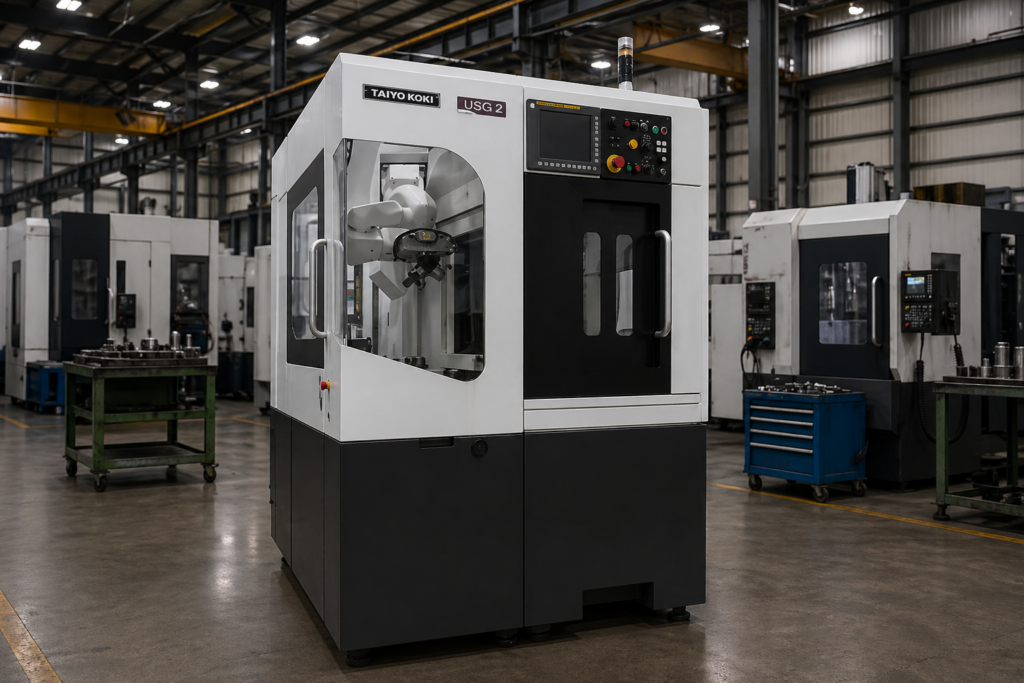
The DMG MORI USG-2 is an ultra-compact CNC vertical grinding machine designed for high-speed, high-precision machining of very small components. Developed under DMG MORI in collaboration with Taiyo Koki, it belongs to the USG (Ultra Small Grinding) series, which focuses on maximizing productivity in minimal floor space while maintaining extremely high accuracy. The USG-2 is widely used in industries such as automotive, watchmaking, medical components, precision bearings, and micro-mechanical parts where ultra-small diameters and tight tolerances are required.
The machine is designed for very small workpieces, with a swing diameter of 220 mm and a maximum grinding diameter of 100 mm. It supports a maximum workpiece height of 230 mm and grinding length of 80 mm. The work spindle operates at speeds up to 1,500 rpm, while the grinding spindle reaches extremely high speeds of up to 75,000 rpm, enabling ultra-fine surface finishes and precision internal grinding of micro-components.
A key feature of the USG-2 is its ultra-compact footprint and space-saving vertical structure. The machine is designed for high-density factory layouts where floor space is limited but production demand is high. Its vertical configuration also improves stability by using gravity-assisted positioning, which reduces workpiece deformation and improves roundness accuracy.
The USG-2 is strongly automation-oriented, often integrated with a ceiling-mounted robot system for automatic loading and unloading. This design allows continuous production with minimal operator intervention, making it ideal for lights-out manufacturing. It also supports high-speed cam and non-circular grinding applications, enabled by advanced linear motor-driven axes and high-thrust positioning systems.
Overall, the USG-2 is a specialized ultra-small grinding solution focused on extreme precision, high-speed operation, and compact automated production environments.
DMG MORI USG-2 SPECIFICATIONS
| DMG MORI USG-2 – AXIS |
|---|
| Number of Axes: 2 (X, Z) + optional C-axis |
| Axis Configuration: Vertical ultra-small grinding |
| Control Type: CNC controlled grinding |
| Axis Drive: Linear motor (X-axis) + servo drives |
| Guideway Type: High-precision linear guideways |
| DMG MORI USG-2 – AXIS TRAVELS |
|---|
| X-Axis Travel: Approx. 200 mm |
| Z-Axis Travel: Approx. 200 mm |
| C-Axis (Optional): High-resolution rotary axis |
| Rapid Traverse: Approx. 15–20 m/min |
| Positioning Accuracy: Sub-micron level |
| DMG MORI USG-2 – CAPACITY |
|---|
| Swing Diameter: 220 mm |
| Maximum Grinding Diameter: 100 mm |
| Maximum Workpiece Height: 230 mm |
| Maximum Grinding Length: 80 mm |
| Maximum Workpiece Weight: Approx. 150–200 kg |
| DMG MORI USG-2 – SPINDLE |
|---|
| Work Spindle Speed: Up to 1,500 RPM |
| Grinding Spindle Speed: Up to 75,000 RPM |
| Spindle Type: Ultra-high-speed grinding spindle |
| Configuration: Single spindle with high-speed capability |
| Cooling: Integrated spindle cooling |
| DMG MORI USG-2 – TABLE |
|---|
| Table Type: Vertical rotary work table |
| Construction: Compact high-rigidity structure |
| Workholding: Precision chuck or fixture system |
| Load Capacity: Up to approx. 150–200 kg |
| Stability: Optimized for ultra-small precision parts |
| DMG MORI USG-2 – TOOL TURRET |
|---|
| Turret Type: Fixed or optional multi-spindle configuration |
| Tool Type: Internal and external grinding spindles |
| Tool Capacity: Multiple spindle options |
| Tool Change: Manual or optional |
| Capability: ID, OD, and non-round grinding |
| DMG MORI USG-2 – FEEDRATES |
|---|
| Grinding Feed Rate: High-precision programmable |
| Rapid Feed: Approx. 15–20 m/min |
| Feed Control: CNC controlled |
| Accuracy: High roundness and contour precision |
| DMG MORI USG-2 – COOLANT & CHIP MANAGEMENT |
|---|
| Coolant System: High-pressure grinding coolant |
| Filtration: Fine filtration system |
| Mist Collection: Optional |
| Chip Handling: Sludge collection system |
| Dressing System: Rotary or single-point dresser |
| DMG MORI USG-2 – CONTROL SYSTEM |
|---|
| CNC Control: Fanuc |
| Programming: Conversational + G-code |
| Interface: Advanced operator panel |
| Automation: Compatible with SRS (Smart Robot System) |
| DMG MORI USG-2 – POWER & AIR REQUIREMENTS |
|---|
| Power Supply: 400V, 3-phase |
| Power Consumption: Approx. 15–25 kVA |
| Air Pressure Required: Approx. 5–6 bar |
| Air Consumption: Low to moderate |
| DMG MORI USG-2 – DIMENSIONS |
|---|
| Machine Width (Front): Approx. 750 mm |
| Machine Depth: Approx. 3,400–3,500 mm |
| Machine Height: Approx. 2,000–2,300 mm |
| Machine Weight: Approx. 3,000–5,000 kg |
| DMG MORI USG-2 – GENERAL INFORMATION |
|---|
| Machine Type: CNC Ultra-Small Vertical Grinding Machine |
| Manufacturer: DMG MORI |
| Application: High-speed, high-precision grinding of small components |
| Capability: Non-round, ID, and OD grinding |
| Design Advantage: Compact footprint with high automation capability |
| INDUSTRIES THAT USE DMG MORI USG-2 |
|---|
| Automotive manufacturing |
| Bearing manufacturing |
| Electronics and micro-components |
| Medical device manufacturing |
| Precision engineering |
| Tool and die industry |
| TYPICAL PARTS DMG MORI USG-2 CAN PRODUCE |
|---|
| Small bearing rings |
| Micro bushings |
| Precision sleeves |
| Cam rings |
| Non-round precision components |
| Small cylindrical parts |
| WHY CHOOSE DMG MORI USG-2 |
|---|
| Ultra-compact design for space-saving production |
| Extremely high spindle speed up to 75,000 RPM |
| Ideal for micro and high-precision components |
| Supports non-round and cam grinding applications |
| Automation-ready with Smart Robot System |
| High productivity in limited floor space |
WHY BUY USED DMG MORI USG-2
Buying a used DMG MORI USG-2 is a practical choice for manufacturers targeting micro-precision grinding applications without the high investment required for a new ultra-compact automation system. One of the biggest advantages is cost reduction. New USG-series machines are highly specialized and expensive due to their ultra-high-speed spindles, automation systems, and precision engineering, while used units provide similar performance at a significantly lower cost.
Another key advantage is proven precision capability. The USG-2 is designed for extremely small components where micron-level accuracy is required. Even after years of use, the machine can maintain high precision if it has been properly maintained, because grinding involves relatively low cutting forces and minimal structural wear compared to other machining processes.
Cutting time (machine hours) is particularly important when evaluating a used USG-2. Machines with lower operating hours typically offer better spindle condition, higher accuracy, and longer remaining service life, especially for the 75,000 rpm ultra-high-speed spindle system. However, even high-hour machines can remain valuable if they have undergone spindle refurbishment, axis recalibration, or control system updates.
Another advantage is quick integration into production. Used machines can often be deployed faster than new ones, avoiding long lead times associated with specialized manufacturing. Many USG-2 systems also include integrated automation such as robot loaders and stockers, which reduces setup effort and improves productivity immediately after installation.
Depreciation also works strongly in favor of buyers. Ultra-precision grinding machines lose significant value over time while retaining core functional capability. This makes the USG-2 an attractive option for companies entering micro-grinding applications or expanding high-volume precision production at a controlled investment level.
HOW MUCH DOES A USED DMG MORI USG-2 COST?
The cost of a used DMG MORI USG-2 varies depending on manufacturing year, condition, cutting hours, spindle wear, and included automation systems. As an ultra-compact high-precision grinding machine, it typically falls into the specialized mid-range segment of the used CNC grinding market due to its niche application and advanced spindle technology.
For machines manufactured before 2000, prices generally range from $25,000 to $60,000. These units often have higher cutting hours and may require refurbishment such as spindle rebuilding, linear motor servicing, or control system upgrades. However, they can still be suitable for lower-volume or non-critical precision applications if properly maintained.
Machines from the 2000–2010 period typically range between $60,000 and $120,000. These versions often include improved control systems and more stable automation integration. At this stage, cutting time becomes a key pricing factor—machines with lower operating hours or recent maintenance tend to command higher prices due to better reliability and precision retention.
For newer machines manufactured between 2010 and 2025, prices can range from $120,000 to $250,000 or more, especially for fully automated configurations with robotic loading systems, high-speed cam grinding capability, and upgraded spindle systems. These machines are highly desirable in micro-precision mass production environments requiring continuous operation.
Cutting time remains one of the most important pricing drivers. Lower-hour machines command a premium due to better spindle condition and reduced maintenance risk, while high-hour machines may require additional investment in refurbishment or recalibration. Buyers should also consider installation complexity, automation integration, and tooling costs when evaluating total ownership. Overall, the USG-2 represents a highly specialized but valuable investment for ultra-precision grinding applications.
Related Products
-
DMG MORI - DMC 1035V
VIEW MACHINE -
DMG MORI - NZ DUE FORMULA
VIEW MACHINE -
DMG MORI - CVG6
VIEW MACHINE -
DMG MORI - IGH-10NT
VIEW MACHINE