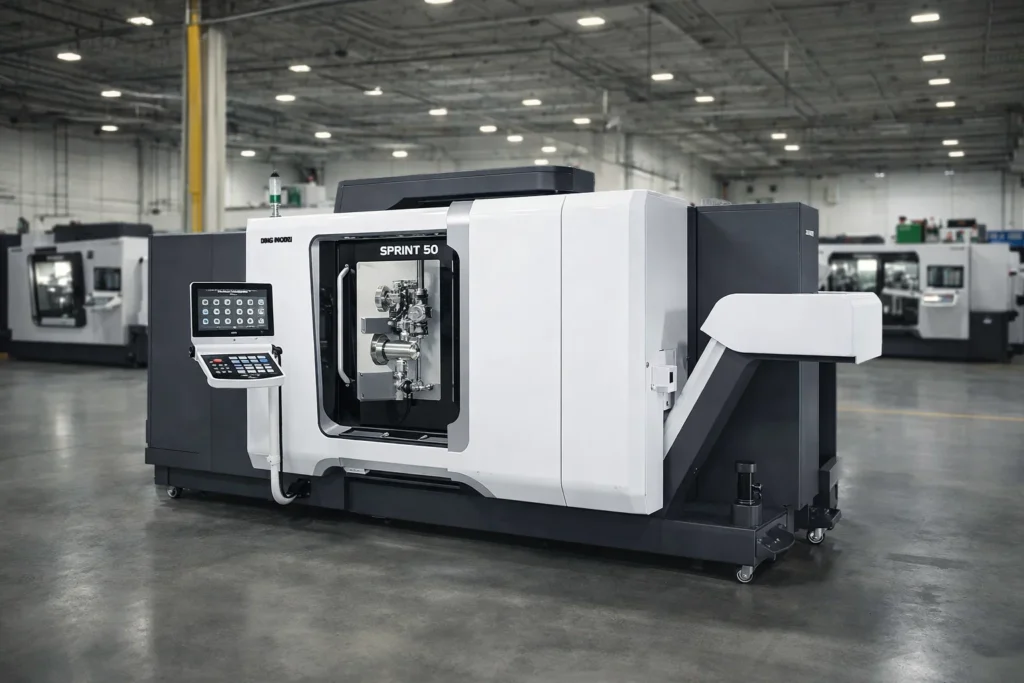
USED DMG MORI SPRINT 50
The DMG MORI SPRINT 50 is a compact, high-performance multi-axis production turning center designed for fast, precise, and high-volume machining of small to medium-sized components. It is part of the SPRINT turret series and is widely used in automotive, medical, and precision engineering industries where cycle time reduction and process reliability are critical.
The machine supports workpieces up to approximately 140 mm in diameter and 235 mm in length, with a maximum bar capacity of 50 mm, making it ideal for shaft-type and chuck components in small batch or mass production environments. Its compact footprint and vertical chip flow design allow efficient chip evacuation and stable thermal behavior during long production runs.
A key feature of the SPRINT 50 is its multi-turret architecture with up to 3 turrets and optional B-axis configuration, enabling simultaneous machining operations. Depending on configuration, the machine can handle up to 36 driven tools, allowing turning, milling, drilling, and grooving in a single setup. This dramatically reduces cycle time and eliminates the need for secondary operations.
The machine is equipped with main and counter spindles reaching up to 7,000 rpm, providing high-speed machining capability for both roughing and finishing operations. Driven tools can reach up to 8,000 rpm, enabling efficient milling of complex features within the same cycle.
The rigid machine bed is designed for high stability with a thermally stable and vibration-damped structure, ensuring consistent accuracy during continuous production. The twin-spindle configuration allows simultaneous machining of both ends of the workpiece, further improving productivity.
The SPRINT 50 also supports advanced automation integration, including bar feeders and robotic loading systems, making it suitable for 24/7 unattended production. Control systems such as Siemens and FANUC with CELOS integration provide modern programming, monitoring, and simulation capabilities.
Overall, the SPRINT 50 is a compact yet highly productive turning solution designed for high-speed, multi-axis manufacturing with strong emphasis on cycle time reduction and automation readiness.
DMG MORI SPRINT 50 SPECIFICATIONS
| DMG MORI SPRINT 50 – AXIS |
|---|
| X-Axis (Radial Movement) |
| Z-Axis (Longitudinal Movement) |
| Optional C-Axis (Spindle Indexing) |
| DMG MORI SPRINT 50 – AXIS TRAVELS |
|---|
| X-Axis Travel: approx. 165 mm |
| Z-Axis Travel: approx. 300 mm |
| C-Axis Rotation: 360° (optional) |
| DMG MORI SPRINT 50 – CAPACITY |
|---|
| Maximum Turning Diameter: approx. 300 mm |
| Maximum Turning Length: approx. 300 mm |
| Bar Capacity: approx. 50 mm |
| Compact machine for small to medium parts |
| DMG MORI SPRINT 50 – SPINDLE |
|---|
| Main Spindle Speed: up to 5,000 rpm |
| Spindle Bore: approx. 65 mm |
| High-speed precision turning |
| Optional sub-spindle for back working |
| DMG MORI SPRINT 50 – TABLE / WORKHOLDING |
|---|
| Hydraulic chuck system |
| Bar feeder compatibility |
| Optional sub-spindle support |
| Designed for batch and production work |
| DMG MORI SPRINT 50 – TOOL TURRET |
|---|
| 12-station turret |
| VDI tool interface |
| Optional live tooling |
| Fast indexing for high productivity |
| DMG MORI SPRINT 50 – FEEDRATES |
|---|
| Rapid Traverse (X/Z): approx. 24 m/min |
| Smooth and fast positioning |
| Optimized for cycle time reduction |
| DMG MORI SPRINT 50 – COOLANT & CHIP MANAGEMENT |
|---|
| Flood Coolant System |
| Optional high-pressure coolant |
| Chip conveyor (optional) |
| Efficient chip evacuation |
| DMG MORI SPRINT 50 – CONTROL SYSTEM |
|---|
| Control System: Siemens / Fanuc |
| User-friendly CNC interface |
| Reliable for production environments |
| DMG MORI SPRINT 50 – POWER & AIR REQUIREMENTS |
|---|
| Power Requirement: approx. 20–30 kVA |
| Air Supply: approx. 5–6 bar |
| DMG MORI SPRINT 50 – DIMENSIONS |
|---|
| Machine Length: approx. 2,500 mm |
| Machine Width: approx. 1,600 mm |
| Machine Height: approx. 1,800 mm |
| Machine Weight: approx. 3,500–4,500 kg |
| DMG MORI SPRINT 50 – GENERAL INFORMATION |
|---|
| Machine Type: Compact CNC Turning Center |
| Designed for high-speed production |
| High precision and repeatability |
| Suitable for automated setups |
| INDUSTRIES THAT USE DMG MORI SPRINT 50 |
|---|
| Automotive |
| Electronics |
| General Engineering |
| Medical |
| TYPICAL PARTS DMG MORI SPRINT 50 CAN PRODUCE |
|---|
| Bushings |
| Shafts |
| Fittings |
| Small Precision Components |
| WHY CHOOSE DMG MORI SPRINT 50 |
|---|
| Compact & Space Efficient |
| High-Speed Production Capability |
| Reliable & Cost-effective |
| Easy Automation Integration |
WHY BUY USED DMG MORI SPRINT 50
Buying a used DMG MORI SPRINT 50 is a practical option for manufacturers looking to enter or expand high-volume small-part production without investing in a brand-new machine. Since it is designed for continuous production, it retains strong structural value in the used market when properly maintained.
One of the biggest advantages is the high productivity-to-cost ratio. Even in used condition, the SPRINT 50’s multi-turret architecture allows simultaneous machining operations, meaning multiple tools can work on the part at the same time. This significantly reduces cycle times and increases output compared to conventional lathes.
Cutting time is a key factor when evaluating a used SPRINT 50. These machines are often used in 24/7 production environments, so accumulated hours can vary widely. Machines with lower cutting time (under 20,000–25,000 hours) generally offer better long-term reliability. Units under 10,000–15,000 hours are especially valuable because spindle wear, turret backlash, and guideway degradation are typically minimal.
Another advantage is access to advanced multi-axis production capability at a lower cost, including twin-spindle machining, Y-axis operations, and high-speed driven tooling. These features allow manufacturers to produce complex parts in a single setup, reducing labor and handling costs.
Additionally, DMG MORI machines benefit from strong global service support and spare parts availability. Many used SPRINT 50 machines can also be upgraded with newer control systems or automation interfaces, extending their operational life.
Because of its compact design and rigid construction, the SPRINT 50 is particularly effective for high-precision, repeatable production runs. Even older machines can deliver strong performance if maintenance history is good.
In summary, a used SPRINT 50 offers excellent value through high-speed machining capability, automation readiness, and cost efficiency, making it ideal for manufacturers focused on small-part mass production.
HOW MUCH DOES A USED DMG MORI SPRINT 50 COST?
The cost of a used DMG MORI SPRINT 50 depends on several factors, including manufacturing year, configuration (number of turrets, B-axis option, automation), condition, and most importantly, total cutting time.
For machines manufactured before 2000, comparable small-part production lathes typically range from $40,000 to $90,000, depending on condition and retrofits. These older systems generally lack modern multi-turret synchronization, advanced driven tooling, and CELOS integration.
Machines produced between 2000 and 2010 usually fall within the $90,000 to $180,000 range. These machines offer improved CNC systems and better productivity but may not match the efficiency and rigidity of newer SPRINT models. Units with lower cutting time (under 20,000–25,000 hours) are priced higher due to better mechanical condition.
For actual SPRINT 50 machines from 2010–2025, used prices typically range from $180,000 to $400,000+, depending on turret configuration, spindle options, and automation systems such as bar feeders or robotic loading units. Fully equipped machines with multi-turret and B-axis configurations are at the upper end of this range.
Cutting time is a decisive factor in valuation. Since these machines often run in continuous production, wear can occur in spindles, turret indexing systems, and linear guides. Machines with low cutting time (under 10,000–15,000 hours) are considered premium due to longer remaining service life and better machining precision.
Buyers should always evaluate maintenance logs, spindle vibration, turret alignment, and overall machine condition rather than relying only on age or appearance.
Overall, the cost of a used SPRINT 50 is determined by configuration, age, and usage history, with cutting time being the most important indicator of long-term value and production reliability.
Related Products
-
DMG MORI - DMU 125 P DUOBLOCK
VIEW MACHINE -
DMG MORI - CTX450-4A
VIEW MACHINE -
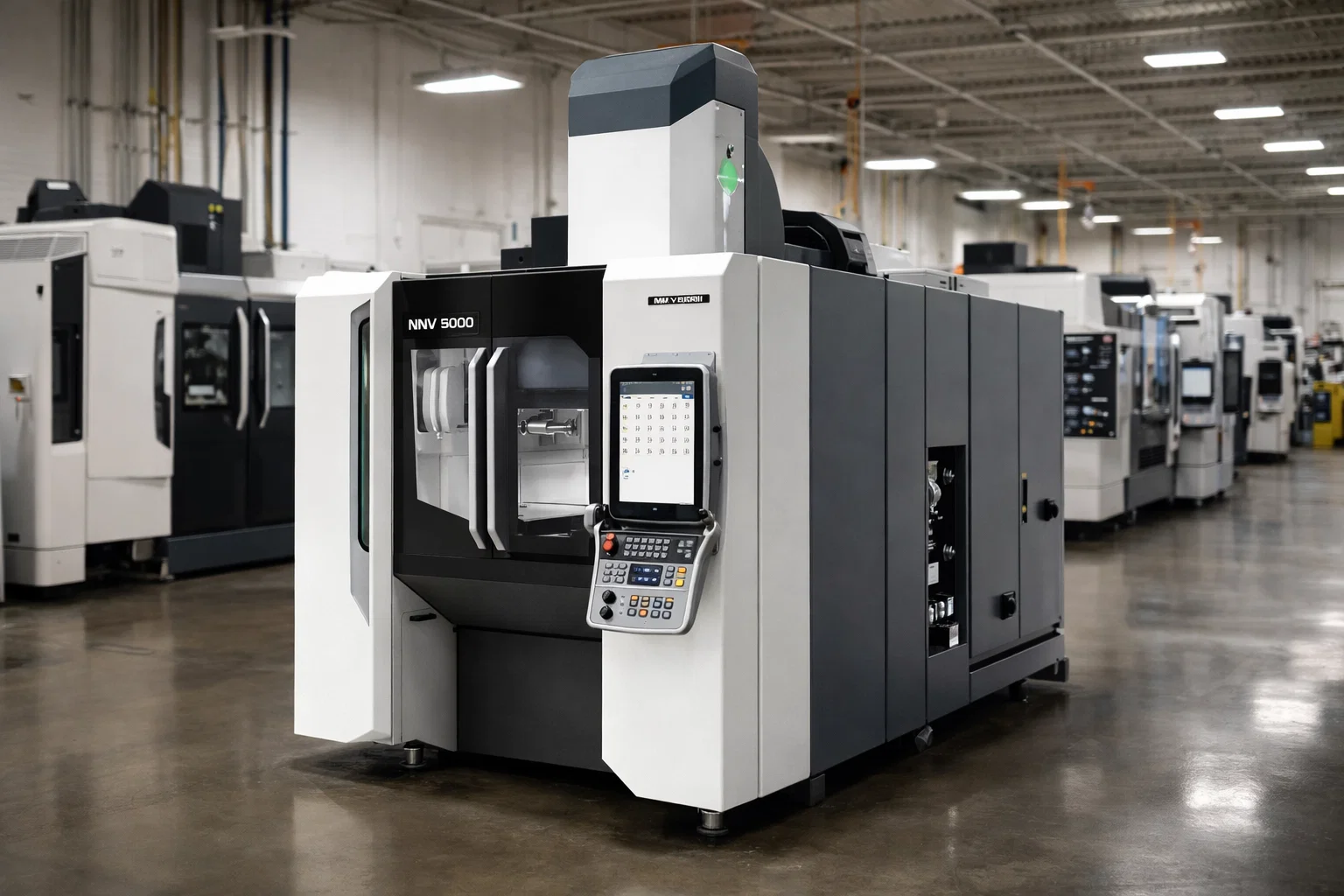
DMG MORI - NMV 5000 DCG 2nd Generation
VIEW MACHINE -
DMG MORI - DMU 60 EVO
VIEW MACHINE