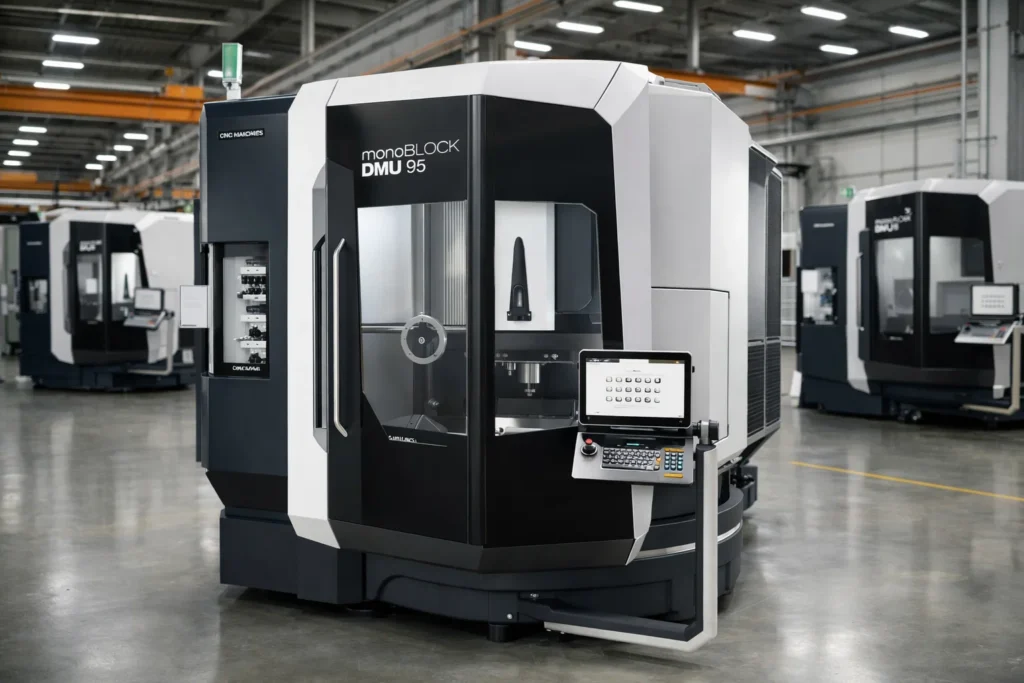
DMG MORI DMU 95 MONOBLOCK 2ND GENERATION
USED DMG MORI DMU 95 MONOBLOCK 2ND GENERATION
The DMG MORI DMU 95 monoBLOCK 2nd Generation is a large-format, high-performance 5-axis machining center designed for precision machining of heavy and complex components. As part of the advanced monoBLOCK series, the machine is built using a one-piece cast construction that ensures exceptional rigidity, vibration damping, and long-term thermal stability. It is widely used in demanding industries such as aerospace, energy, automotive, and general engineering, where large workpieces and tight tolerances are common requirements.
The machine offers an expansive working envelope, with axis travels of approximately 1,050 mm in X, 900 mm in Y, and 650 mm in Z. It can accommodate workpieces up to 1,250 mm in diameter, 900 mm in height, and weighing up to 2,000 kg, making it suitable for heavy-duty machining applications. The integrated swivel rotary table enables full simultaneous 5-axis machining, allowing complex geometries to be produced in a single setup, improving accuracy and reducing cycle times.
A key feature of the DMU 95 monoBLOCK 2nd Generation is its powerful spindle options, including high-torque variants for heavy material removal and high-speed spindles up to 20,000 RPM for precision finishing. The machine incorporates direct-driven ball screws, advanced cooling systems, and multi-sensor thermal compensation, ensuring consistent positioning accuracy even during long machining cycles.
The machine supports large tool magazine capacities—often up to 240 tools—and is compatible with advanced automation solutions such as pallet changers and robotic systems. Modern CNC controls such as Siemens SINUMERIK ONE and Heidenhain TNC7, integrated with the CELOS X platform, provide advanced programming, real-time monitoring, and seamless digital integration.
Overall, the DMU 95 monoBLOCK 2nd Generation is a robust and future-ready machining solution. Its combination of size, power, precision, and automation capability makes it ideal for manufacturers handling large, high-value components in complex production environments.
DMG MORI DMU 95 MONOBLOCK 2ND GENERATION SPECIFICATIONS
| DMG MORI DMU 95 MONOBLOCK 2ND GENERATION – AXIS |
|---|
| 5-axis universal machining center |
| Simultaneous 5-axis machining capability |
| Axes: X, Y, Z (linear) + B, C (rotary) |
| Swivel rotary table for full 5-axis machining |
| Direct drive rotary axes for high precision |
| DMG MORI DMU 95 MONOBLOCK 2ND GENERATION – AXIS TRAVELS |
|---|
| X-axis travel: 950 mm |
| Y-axis travel: 850 mm |
| Z-axis travel: 650 mm |
| Large travel range for heavy-duty machining |
| High rigidity axis system |
| DMG MORI DMU 95 MONOBLOCK 2ND GENERATION – CAPACITY |
|---|
| Maximum workpiece diameter: 1,040 mm |
| Maximum workpiece height: 590 mm |
| Maximum workpiece weight: 1,000 kg |
| Suitable for large and complex components |
| DMG MORI DMU 95 MONOBLOCK 2ND GENERATION – SPINDLE |
|---|
| speedMASTER spindle technology |
| Standard spindle: up to 20,000 rpm |
| Optional higher torque spindle (~200 Nm class) |
| High-speed and heavy-duty cutting capability |
| Designed for precision and long tool life |
| DMG MORI DMU 95 MONOBLOCK 2ND GENERATION – TABLE |
|---|
| Swivel rotary table design |
| Maximum table load: 1,000 kg |
| Direct drive rotary axes |
| High rigidity for heavy machining |
| Designed for multi-face complex parts |
| DMG MORI DMU 95 MONOBLOCK 2ND GENERATION – TOOL TURRET |
|---|
| Automatic Tool Changer (ATC) |
| Tool magazine capacity: 60 tools (standard) |
| Optional: up to 240 tools |
| Integrated magazine design |
| Suitable for complex multi-operation machining |
| DMG MORI DMU 95 MONOBLOCK 2ND GENERATION – FEEDRATES |
|---|
| High dynamic axis performance |
| Optimized for heavy-duty cutting |
| Smooth multi-axis interpolation |
| Reduced machining cycle times |
| DMG MORI DMU 95 MONOBLOCK 2ND GENERATION – COOLANT & CHIP MANAGEMENT |
|---|
| High-performance coolant system |
| Optional high-pressure coolant |
| Integrated chip conveyor system |
| Efficient chip evacuation |
| Designed for long machining cycles |
| DMG MORI DMU 95 MONOBLOCK 2ND GENERATION – CONTROL SYSTEM |
|---|
| Siemens SINUMERIK control |
| Heidenhain control option |
| CELOS / CELOS X interface |
| Advanced 5-axis programming and automation support |
| Digital integration and monitoring |
| DMG MORI DMU 95 MONOBLOCK 2ND GENERATION – POWER & AIR REQUIREMENTS |
|---|
| Power supply: approx. 400V, 3-phase |
| High power requirement for heavy machining |
| Air requirement: approx. 6 bar |
| Stable industrial power required |
| DMG MORI DMU 95 MONOBLOCK 2ND GENERATION – DIMENSIONS |
|---|
| Footprint: approx. 12.3 m² |
| Robust monoBLOCK construction |
| Excellent accessibility with wide door opening |
| Suitable for automation integration |
| DMG MORI DMU 95 MONOBLOCK 2ND GENERATION – GENERAL INFORMATION |
|---|
| Manufacturer: DMG MORI |
| Machine type: 5-axis machining center |
| monoBLOCK design for maximum rigidity |
| Positioning accuracy: approx. 5 µm |
| VCS Complete for volumetric accuracy improvement |
| Supports milling, gear cutting, and in-process measurement |
| INDUSTRIES THAT USE DMG MORI DMU 95 MONOBLOCK 2ND GENERATION |
|---|
| Aerospace |
| Energy and power generation |
| Automotive |
| Medical device manufacturing |
| Tool and die |
| Heavy precision engineering |
| TYPICAL PARTS DMG MORI DMU 95 MONOBLOCK 2ND GENERATION CAN PRODUCE |
|---|
| Large aerospace structural components |
| Turbine housings and impellers |
| Complex mold and die parts |
| Automotive structural components |
| Precision mechanical assemblies |
| Multi-face machined heavy components |
| WHY CHOOSE DMG MORI DMU 95 MONOBLOCK 2ND GENERATION |
|---|
| High load capacity (1,000 kg) for large parts |
| Excellent rigidity from monoBLOCK construction |
| Advanced spindle with high torque and speed |
| Large work envelope with precision (~5 µm) |
| High tool capacity up to 240 tools |
| Ideal for heavy-duty, high-precision 5-axis machining |
WHY BUY USED DMG MORI DMU 95 MONOBLOCK 2ND GENERATION
Purchasing a used DMG MORI DMU 95 monoBLOCK 2nd Generation is a strategic decision for manufacturers seeking large-format 5-axis machining capability without the significant capital investment required for a new machine. As a premium monoBLOCK platform, it offers exceptional rigidity, precision, and long-term reliability, making it highly valuable in the used equipment market.
One of the primary advantages is cost efficiency. New machines of this size and capability are among the most expensive in the CNC market due to their heavy-duty construction and advanced technology. However, when these machines enter the used market, their price becomes significantly more accessible, allowing companies to invest in high-performance machining solutions at a reduced cost.
Another key benefit is immediate availability. New machines often involve long lead times due to customization and manufacturing schedules, whereas used machines are typically ready for quicker delivery and installation. This enables manufacturers to expand capacity or replace aging equipment without prolonged downtime.
The DMU 95 monoBLOCK 2nd Generation is built with a rigid structure and high-quality components, ensuring long service life. Machines with moderate cutting hours—typically between 5,000 and 25,000 hours—can still deliver strong performance when properly maintained. Lower-hour machines are especially desirable, while higher-hour machines remain viable if supported by a solid maintenance history.
From a productivity standpoint, the ability to perform full 5-axis machining in a single setup significantly reduces setup time, improves accuracy, and increases throughput. This is particularly valuable for large and complex components that would otherwise require multiple setups.
Additionally, depreciation works in favor of the buyer. Since CNC machines experience the steepest value drop in their early years, purchasing used allows companies to avoid major depreciation while still benefiting from advanced machining technology, making it a cost-effective and practical investment.
HOW MUCH DOES A USED DMG MORI DMU 95 MONOBLOCK 2ND GENERATION COST?
The cost of a used DMG MORI DMU 95 monoBLOCK 2nd Generation depends on several factors, including year of manufacture, configuration, condition, and most importantly, cutting time (spindle hours). As a large and high-end 5-axis machining center, it typically commands a premium price in the used machinery market.
For machines before 2000, the DMU 95 monoBLOCK platform was not available. However, comparable early-generation large 5-axis machines generally fall within the $40,000 to $100,000 range. These machines typically have very high cutting hours (40,000–60,000+ hours) and may require significant upgrades such as control retrofits or spindle rebuilds.
Machines from the 2000 to 2010 period, including early large-format 5-axis machines, generally range between $120,000 and $200,000. Pricing within this range depends heavily on cutting time. Machines with lower spindle hours (under 25,000 hours) command higher prices due to reduced wear, while high-hour machines are discounted due to expected maintenance costs.
For 2010 to 2025 models, which include most DMU 95 monoBLOCK 2nd Generation units, prices typically range from $250,000 to $450,000+ depending on configuration and condition. Machines equipped with larger tool magazines, automation systems, and high-performance spindle options are positioned at the higher end of this range. Units with low cutting hours (below 10,000–15,000 hours) are considered premium and retain strong resale value.
Cutting time is one of the most critical factors influencing price. Lower-hour machines generally require minimal refurbishment, while high-hour machines may involve additional costs such as spindle servicing, rotary table maintenance, or axis calibration.
In conclusion, the DMU 95 monoBLOCK 2nd Generation occupies a premium segment of the used CNC market. By carefully evaluating age, cutting time, and maintenance history, buyers can secure a powerful and reliable machine that delivers excellent long-term productivity and value.
Related Products
-
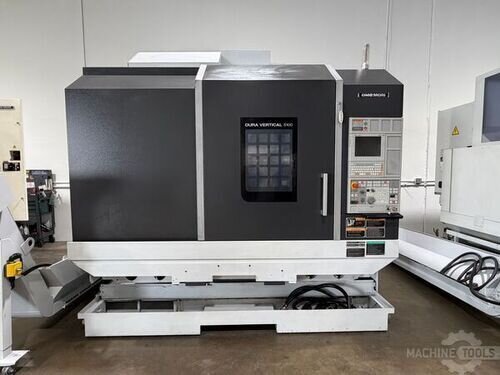
DMG MORI - DURAVERTICAL 5100
VIEW MACHINE -
DMG MORI - NH 4000
VIEW MACHINE -
DMG MORI - NLX 2500/700
VIEW MACHINE -
DMG MORI - NZ DUE
VIEW MACHINE