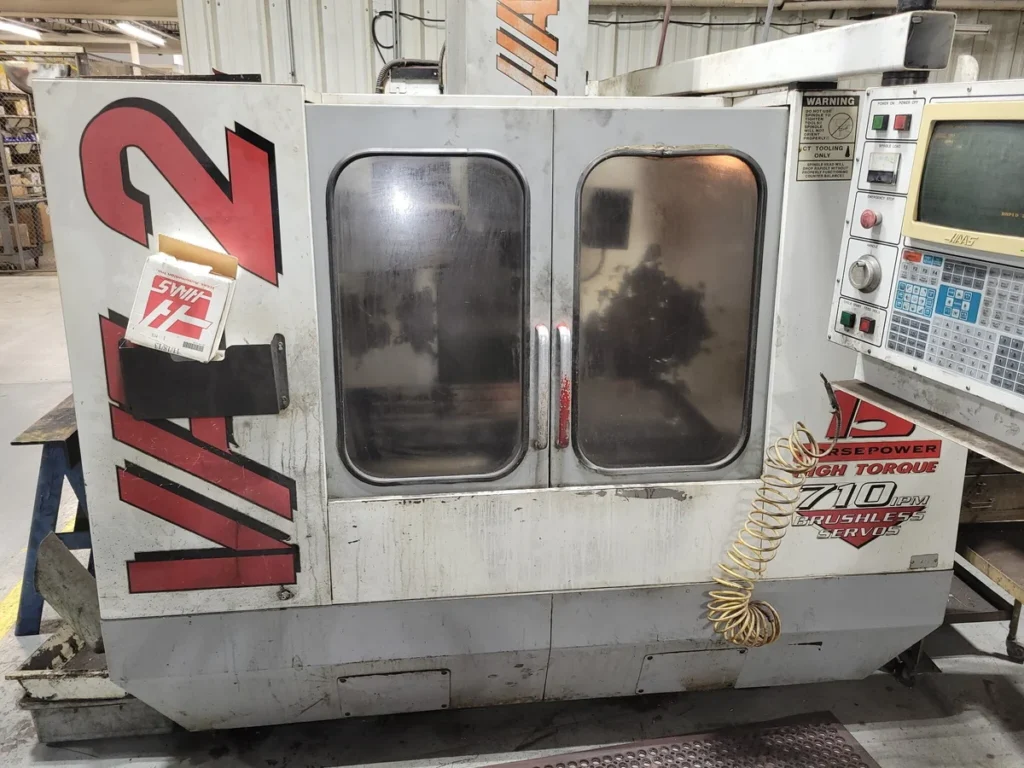
USED HAAS VF2 1997
The 1997 HAAS VF2 is a proven 3-axis Vertical Machining Center (VMC) that helped establish the Haas VF Series as one of the most widely used machining platforms in North America. Designed for precision milling, drilling, tapping, and general production machining, the VF2 combines a rigid cast-iron frame, precision linear guideways, a CAT40 spindle, and the dependable Haas CNC Control to deliver reliable performance across a wide range of manufacturing applications. Even decades after its introduction, the 1997 HAAS VF2 remains a popular choice for job shops, prototype manufacturers, educational institutions, and small production facilities looking for an affordable CNC machining solution.
The machine offers 30 inches of X-axis travel, 16 inches of Y-axis travel, and 20 inches of Z-axis travel, making it suitable for machining tooling plates, fixtures, mold components, aerospace parts, automotive components, and custom precision parts. Its heavy-duty cast construction helps reduce vibration during machining, while precision ballscrews provide excellent positioning accuracy and repeatability. The 1997 HAAS VF2 is capable of machining aluminum, steel, stainless steel, cast iron, brass, engineering plastics, and many other materials with consistent results.
The standard machine is equipped with a CAT40 spindle capable of speeds up to 7,500 RPM (many machines have since been upgraded or retrofitted), producing approximately 20 HP. A 20-pocket automatic carousel tool changer provides efficient tool changes, while rapid traverse rates allow quick positioning between machining operations. Depending on the original configuration and subsequent upgrades, many used machines may include options such as through-spindle coolant, fourth-axis wiring, rotary tables, chip augers, coolant systems, or probing packages. Because these machines are over 25 years old, equipment specifications and installed options can vary significantly between individual machines.
The classic Haas CNC Control is known for its straightforward programming and ease of use. Although older than today’s Next Generation Control, it remains familiar to many machinists and continues to support efficient production for shops performing general machining operations. With proper maintenance, many 1997 HAAS VF2 machines continue to operate reliably in production environments.
HAAS VF2 SPECIFICATIONS
HAAS VF2 – AXIS
| Specification | Value |
|---|---|
| Number of Axes | 3 Axis |
| X-Axis Travel | 30 in |
| Y-Axis Travel | 16 in |
| Z-Axis Travel | 20 in |
| Rapid Traverse (X/Y/Z) | Up to 710 IPM |
HAAS VF2 – AXIS TRAVELS / WORK ENVELOPE
| Specification | Value |
|---|---|
| X Travel | 30 in (762 mm) |
| Y Travel | 16 in (406 mm) |
| Z Travel | 20 in (508 mm) |
| Spindle Nose to Table (Maximum) | Approx. 24 in |
| Spindle Nose to Table (Minimum) | Approx. 4 in |
HAAS VF2 – TABLE
| Specification | Value |
|---|---|
| Table Size | 36 × 14 in |
| Maximum Table Load | 3,000 lbs |
| T-Slots | 3 |
| T-Slot Width | 5/8 in |
HAAS VF2 – SPINDLE
| Specification | Value |
|---|---|
| Maximum Spindle Speed | 7,500 RPM |
| Spindle Power | 20 HP |
| Maximum Torque | Approx. 75 ft-lb |
| Spindle Taper | CAT40 |
| Drive Type | Vector Drive |
HAAS VF2 – TOOL CHANGER
| Specification | Value |
|---|---|
| Tool Capacity | 20 Tools |
| Tool Changer Type | Automatic Carousel |
| Maximum Tool Diameter | 3.5 in |
| Maximum Tool Length | 16 in |
| Maximum Tool Weight | 12 lbs |
| Tool-to-Tool Time | Approx. 5 sec |
| Chip-to-Chip Time | Approx. 6 sec |
HAAS VF2 – CONTROL SYSTEM
| Specification | Value |
|---|---|
| CNC Control | Haas CNC Control |
| USB Interface | Not Standard |
| Ethernet Connectivity | Not Available |
| Rigid Tapping | Optional / Machine Dependent |
| Memory | Standard Internal Memory |
| Fourth-Axis Ready | Optional |
HAAS VF2 – COOLANT / CHIP MANAGEMENT
| Specification | Value |
|---|---|
| Flood Coolant | Standard |
| Coolant Tank Capacity | Approx. 55 gal |
| Through-Spindle Coolant | Optional |
| Programmable Coolant Nozzle | Not Available |
| Chip Washdown | Optional |
| Chip Auger | Optional |
| Chip Conveyor | Optional |
HAAS VF2 – POWER REQUIREMENTS
| Specification | Value |
|---|---|
| Electrical Supply | 220V / 440V 3-Phase |
| Air Requirement | 100 PSI |
| Main Disconnect | Included |
HAAS VF2 – DIMENSIONS
| Specification | Value |
|---|---|
| Machine Footprint | Approx. 101 × 99 in |
| Machine Height | Approx. 101 in |
| Machine Weight | Approx. 7,200 lbs |
HAAS VF2 – GENERAL INFORMATION
| Specification | Value |
|---|---|
| Manufacturer | Haas Automation |
| Model | VF2 |
| Year | 1997 |
| Machine Type | Vertical Machining Center |
| Spindle Taper | CAT40 |
| CNC Control | Haas CNC Control |
| Primary Application | Precision Milling, Drilling & Tapping |
WHY BUY USED HAAS VF2 1997
Purchasing a used 1997 HAAS VF2 offers manufacturers an economical way to add CNC machining capacity without the investment required for a newer machine. Despite its age, the VF2 remains a capable machining center for prototype work, repair operations, tooling, fixtures, and low-to-medium volume production. Its rigid construction, proven mechanical design, and user-friendly Haas control have allowed many of these machines to remain productive for decades.
Replacement components, aftermarket support, and experienced independent service technicians are widely available for older Haas machines, helping owners keep operating costs relatively low. Buyers should carefully evaluate spindle condition, control electronics, lubrication systems, guideways, and maintenance history before purchasing, as machine condition varies significantly with age.
HOW MUCH DOES A USED HAAS VF2 1997 COST?
The value of a used 1997 HAAS VF2 depends on spindle condition, maintenance history, control upgrades, tooling, installed options, and overall mechanical condition. Machines with documented maintenance records, upgraded controls, and lower operating hours typically command higher resale values.
Before purchasing, buyers should inspect spindle bearings, ballscrews, guideways, lubrication systems, tool changer operation, electrical components, and CNC diagnostics. Older control boards and electronic components should also be evaluated carefully because replacement availability may vary.
A used 1997 HAAS VF2 typically sells between $10,000 and $22,000, depending on machine condition, tooling, upgrades, installed options, and service history.
INDUSTRIES THAT USE HAAS VF2
- Aerospace Manufacturing
- Automotive Manufacturing
- Tool & Die Shops
- Mold Making
- Industrial Equipment Manufacturing
- Prototype Manufacturing
- General Machine Shops
- Educational Institutions
- Contract Manufacturing
- Maintenance & Repair Operations
- Research & Development
- Precision Engineering
TYPICAL PARTS HAAS VF2 CAN PRODUCE
- Tooling Plates
- Mold Components
- Precision Fixtures
- Hydraulic Manifolds
- Machine Components
- Aerospace Parts
- Automotive Components
- Prototype Parts
- Custom Brackets
- Electronic Enclosures
- Repair Components
- General Precision Machined Parts
WHY CHOOSE HAAS VF2 1997
The 1997 HAAS VF2 continues to be a practical choice for manufacturers seeking an affordable and dependable vertical machining center. Its rigid construction, proven mechanical platform, familiar Haas control, and wide availability of replacement parts have helped make it one of the longest-running and most respected machining centers in the used CNC market.
For shops looking to expand machining capacity without making a major capital investment, the used 1997 HAAS VF2 offers an excellent balance of performance, serviceability, and value. When properly maintained, it remains capable of producing accurate, high-quality parts for a wide variety of manufacturing applications.
HAAS VF2 VS MAZAK VCN-510C – COMPARING TWO POPULAR CNC VMCS
The HAAS VF2 and MAZAK VCN-510C are two popular CNC vertical machining centers used for milling, drilling, tapping, boring, and precision machining applications. Both machines are capable of producing complex components for job shops and production environments, but they differ in machine construction, control systems, spindle configurations, overall rigidity, operating philosophy, and initial investment. Choosing between the two depends on the type of work being performed and the priorities of the manufacturing operation.
The HAAS VF2 is widely recognized for its combination of affordability, versatility, and ease of operation. It has a large installed base and is commonly used by job shops, prototype manufacturers, educational institutions, and production facilities. The HAAS CNC control is generally straightforward to learn, allowing operators to become familiar with machine functions and programming relatively quickly. The availability of used machines, tooling, service providers, and replacement components can also make the VF2 an attractive choice for buyers focused on long-term operating costs.
The MAZAK VCN-510C is generally designed with a stronger emphasis on advanced manufacturing performance and production capability. MAZAK vertical machining centers are known for their rigid construction, engineering quality, and ability to support demanding machining applications. Depending on the machine configuration, the VCN-510C may include advanced spindle options, high-speed machining capabilities, automation compatibility, and control features designed to improve productivity.
Rigidity can be an important factor when machining harder materials or performing aggressive cutting operations. The MAZAK VCN-510C may appeal to manufacturers that require consistent performance during extended production cycles and demanding metal removal operations. However, the HAAS VF2 can also be highly productive when properly configured and operated within appropriate machining parameters.
Budget is another major consideration. A HAAS VF2 often represents a lower-cost investment, particularly in the used CNC machinery market. The MAZAK VCN-510C may require a greater initial investment but can offer advantages for manufacturers seeking premium construction and production-oriented capabilities.
The best machine depends on the application. A shop seeking affordability, straightforward programming, and broad versatility may prefer the HAAS VF2. A manufacturer focused on demanding production work, rigidity, and advanced machine features may find the MAZAK VCN-510C more suitable. Comparing the exact year, spindle configuration, options, maintenance history, and condition of each machine is essential before making a purchasing decision.
HAAS VF2 ZERO RETURN PROBLEMS – CAUSES AND SOLUTIONS
Zero return, also known as axis homing or machine referencing, is an essential process on the HAAS VF2. During the zero return procedure, the machine establishes the reference position of the X, Y, and Z axes. If an axis cannot successfully complete this procedure, the machine may be unable to operate normally. Zero return problems can be caused by mechanical issues, encoder faults, limit switch problems, servo-related conditions, obstructions, or incorrect recovery procedures following an overtravel condition.
One common cause of a zero return problem is an axis obstruction. Chips, damaged way covers, tools, fixtures, or other foreign material can interfere with axis movement. Before attempting repeated zero return commands, the operator should inspect the machine for obvious mechanical interference. Repeatedly forcing an axis against an obstruction can damage ball screws, guideways, couplings, or servo components.
Overtravel conditions can also prevent normal axis movement and referencing. If an axis has reached its travel limit or exceeded its allowable position, the machine may require a specific recovery procedure before it can be returned to its normal reference position. The correct procedure should be followed carefully for the machine and control generation involved.
Encoder or servo problems may also affect zero return. If the control cannot correctly determine axis position, it may generate an alarm or stop the referencing process. Possible causes include damaged encoder cables, loose electrical connections, failed encoders, servo motor issues, or drive-related faults.
Mechanical problems such as damaged ball screws, seized bearings, worn linear guideways, or coupling failures can also interfere with axis movement. A machine crash can create mechanical misalignment or component damage that becomes apparent during the zero return process.
Troubleshooting should begin by recording all alarms and determining whether the problem affects one axis or multiple axes. The machine should then be inspected for obstructions and obvious mechanical damage. Electrical and servo-related diagnostics may require a qualified CNC technician.
The solution depends entirely on the root cause. Clearing an obstruction may restore normal operation, while a damaged encoder, servo system, or mechanical component may require repair or replacement. Proper diagnosis is important because replacing components without identifying the actual cause can increase repair costs and downtime.
HAAS VF2 PREVENTIVE MAINTENANCE CHECKLIST
Preventive maintenance is one of the most effective ways to improve the reliability and service life of a HAAS VF2. Regular inspection and cleaning can help identify developing problems before they result in unexpected downtime, damaged components, or expensive repairs. A structured maintenance program should be based on machine usage, production hours, operating environment, and the recommendations applicable to the specific machine configuration.
Daily maintenance should begin with a general visual inspection of the machine. Operators should check for coolant leaks, unusual noises, damaged way covers, loose components, and excessive chip accumulation. The spindle taper and toolholders should be kept clean to prevent contamination and maintain proper tool contact. Coolant levels and concentration should also be monitored to support machining performance and reduce corrosion or bacterial growth.
The lubrication system requires regular attention. Operators should verify lubricant levels and investigate any lubrication alarms or signs of inadequate lubrication. Proper lubrication is essential for protecting moving components such as ball screws and linear guideways. Ignoring lubrication issues can significantly accelerate mechanical wear.
The coolant system should also be cleaned periodically. Chips and sludge can accumulate in coolant tanks, filters, pumps, and lines. Regular cleaning helps maintain coolant flow and reduces the possibility of clogged passages or pump-related problems.
Weekly or scheduled inspections should include checking pneumatic connections, air supply condition, hoses, fittings, and filters. The machine should receive clean, dry air at the appropriate operating pressure. Moisture and contamination in the air supply can affect pneumatic components.
Operators should monitor axis movement and machining accuracy over time. Increasing backlash, unusual servo loads, vibration, or changes in surface finish may indicate developing mechanical problems. Spindle noise and temperature should also be observed during normal operation.
Additional maintenance may include inspecting belts, electrical cabinets, fans, filters, tool changer components, and chip management systems. Electrical cabinets should be kept clean and properly ventilated to prevent overheating.
A useful preventive maintenance checklist should include daily, weekly, monthly, and periodic tasks based on operating hours. Keeping maintenance records can help identify recurring issues and establish replacement schedules for wear components.
Consistent preventive maintenance reduces unexpected downtime and helps protect the significant investment represented by the HAAS VF2. A clean, properly lubricated, and regularly inspected machine is more likely to maintain accuracy and provide dependable long-term service.
WHAT ARE THE ADVANTAGES OF THE HAAS VF2?
The HAAS VF2 offers several advantages that have made it one of the most widely recognized CNC vertical machining centers in the manufacturing industry. Its combination of versatility, accessible operation, competitive pricing, and broad availability makes it suitable for job shops, production facilities, prototype manufacturers, educational institutions, and companies entering CNC machining for the first time.
One of the primary advantages of the HAAS VF2 is its versatility. The machine can perform milling, drilling, tapping, boring, pocketing, contouring, and other machining operations on a wide variety of materials. With appropriate tooling and workholding, the VF2 can machine aluminum, steel, stainless steel, cast iron, brass, bronze, plastics, and other engineering materials.
The HAAS CNC control is another major advantage. The interface is generally considered straightforward and user-friendly, allowing operators to access machine functions, offsets, programs, tooling information, and diagnostics without the complexity associated with some other control platforms. Shops with multiple HAAS machines can also benefit from control consistency, making it easier for operators to move between machines.
Cost is another important consideration. The HAAS VF2 has historically offered manufacturers a competitive balance between machine capability and purchase price. Used HAAS VF2 machines are also commonly available, giving buyers additional options at different price levels.
The large installed base provides practical ownership benefits. Many machinists are familiar with HAAS controls, and there is a broad market for used tooling, accessories, replacement components, and service support. This can simplify machine ownership and reduce the challenges associated with finding experienced operators.
The VF2 is also available with various options and configurations that can improve productivity. Depending on the machine generation, these may include higher-speed spindles, probing systems, chip conveyors, coolant upgrades, fourth-axis or fifth-axis capability, and automation compatibility.
Another advantage is its relatively compact footprint compared with larger machining centers. This can make the VF2 suitable for shops where floor space is valuable.
Overall, the HAAS VF2 provides a practical combination of machining capability, ease of operation, flexibility, and cost efficiency. While it may not be the ideal machine for every high-volume or extreme-duty application, it remains a strong option for manufacturers seeking a versatile CNC vertical machining center capable of handling a broad range of everyday machining requirements.
HOW DO I TROUBLESHOOT SERVO ALARMS ON A HAAS VF2?
Servo alarms on a HAAS VF2 can occur when the CNC control detects a problem involving an axis motor, encoder, drive system, electrical connection, mechanical load, or axis positioning condition. Because servo systems control the movement of the X, Y, and Z axes, these alarms should be investigated carefully. Simply clearing an alarm and repeatedly restarting the machine without identifying the cause can result in additional damage or unexpected machine movement.
The first step is to record the exact alarm number and message displayed on the control. The specific alarm can provide important information about whether the issue involves overcurrent, excessive following error, encoder communication, motor overload, drive faults, or another servo-related condition. The alarm should be documented before resetting the machine.
Next, determine whether the problem affects a single axis or multiple axes. A fault affecting only one axis may point toward a localized servo motor, encoder, cable, amplifier, ball screw, or mechanical issue. Multiple axis problems may suggest a broader electrical, power, control, or safety-related condition.
Mechanical resistance should also be considered. A damaged ball screw, failed bearing, contaminated linear guideway, machine crash, or physical obstruction can increase the load required to move an axis. This additional resistance may cause the servo system to generate an overload or following error alarm.
Electrical connections should be inspected for loose, damaged, or contaminated cables. Encoder and motor cables can be affected by wear, vibration, accidental damage, or poor connections. Electrical troubleshooting should be performed safely, and internal electrical cabinet work should generally be handled by qualified personnel.
Servo drive components may also require inspection. Depending on the machine generation, the issue could involve an amplifier, power supply, motor, encoder, or control-related component. Swapping components without proper diagnosis can create additional problems and make troubleshooting more difficult.
After the cause has been identified and repaired, the machine should be tested carefully. Axis movement, zero return, positioning, and servo load should be monitored before returning the VF2 to full production.
A systematic troubleshooting process is the best approach: record the alarm, identify the affected axis, inspect for mechanical resistance, evaluate cables and electrical components, and verify the repair before resuming production. Early diagnosis can reduce downtime and help prevent more serious damage to the HAAS VF2 servo system.
I can also create an image explaining the HAAS VF2 preventive maintenance and servo troubleshooting workflow.
Related Products
-
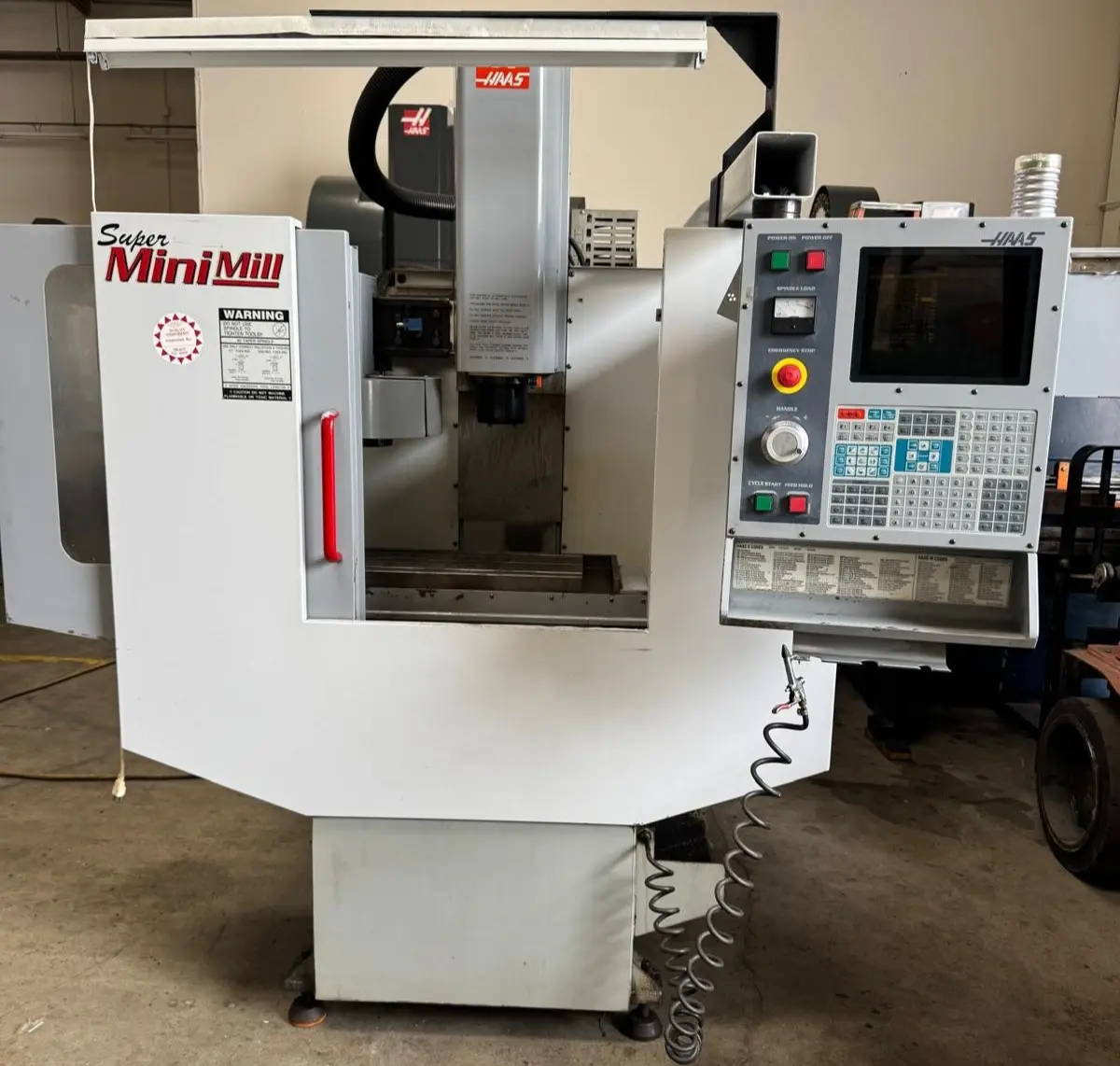
HAAS - Super Mini Mill
VIEW MACHINE -
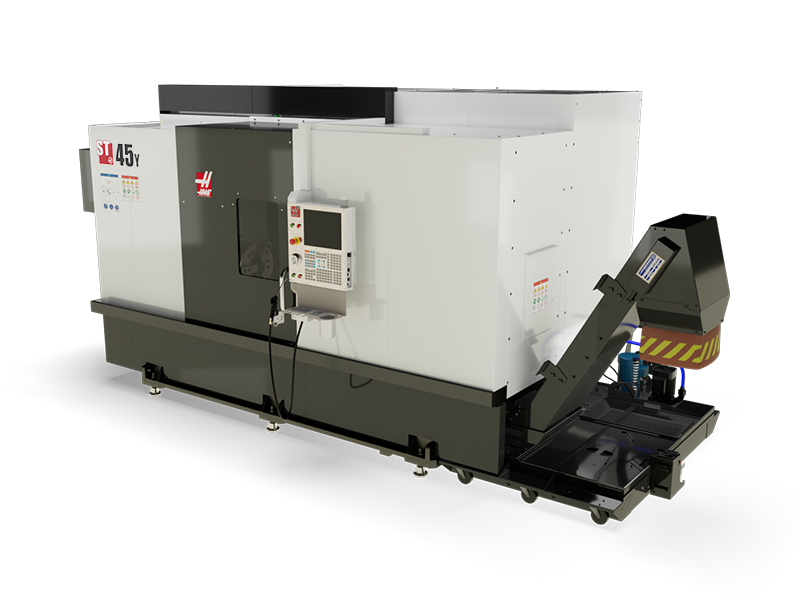
HAAS - ST45Y
VIEW MACHINE -
HAAS - TL2
VIEW MACHINE -
HAAS - VF5
VIEW MACHINE