
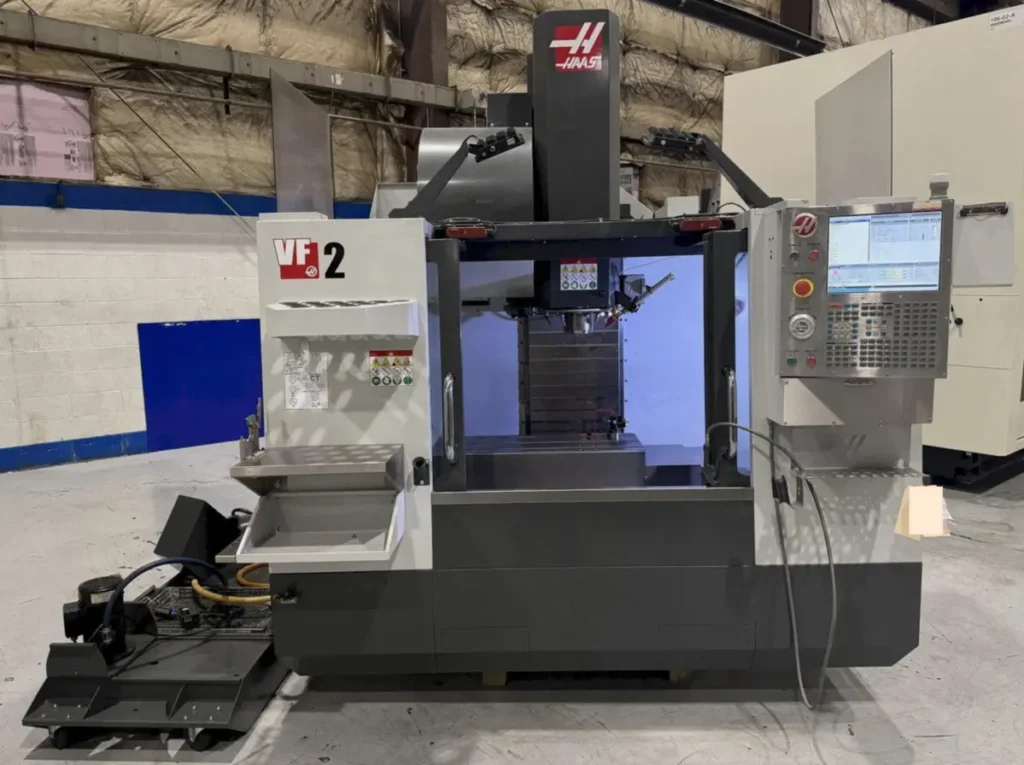
USED HAAS VF2 – 2010
The HAAS VF2 is a 3-axis vertical machining center designed for general-purpose CNC milling, production machining, prototyping, tooling, repair work, and job-shop manufacturing. The 2010 HAAS VF2 is part of the established VF-series platform and remains a popular option in the used CNC market because of its practical work envelope, 40-taper spindle, automatic tool changer, and relatively compact footprint.
The VF2 provides 30″ of X-axis travel, 16″ of Y-axis travel, and 20″ of Z-axis travel. The platform is built around a 30 HP, 8,100 RPM direct-drive spindle, with CT40 or BT40 tooling and a 20-tool carousel. Haas specifies a 36″ x 14″ table with a maximum evenly distributed load of approximately 3,000 lb.
A 2010 machine can vary considerably in configuration depending on the options originally ordered. Features such as 4th-axis wiring, probing, chip auger, programmable coolant, rigid tapping, high-speed machining, and through-spindle coolant may be present on individual machines.
For a used 2010 VF2, buyers should pay particular attention to spindle hours, power-on hours, spindle runout, ballscrew and linear-guide condition, axis backlash, machine geometry, tool changer operation, coolant system, lubrication system, control condition, and maintenance history.
HAAS VF2 – AXIS
| Specification | Details |
|---|---|
| Machine Type | Vertical Machining Center |
| Axis Configuration | 3-Axis |
| X-Axis Travel | 30″ |
| Y-Axis Travel | 16″ |
| Z-Axis Travel | 20″ |
| 4th-Axis Capability | Optional |
| 5th-Axis Capability | Available with Optional Rotary Equipment |
| CNC Interpolation | 3-Axis Standard |
HAAS VF2 – AXIS TRAVELS / WORK ENVELOPE
| Specification | Details |
|---|---|
| X-Axis Travel | 30″ |
| Y-Axis Travel | 16″ |
| Z-Axis Travel | 20″ |
| Spindle Nose to Table Maximum | Approx. 24″ |
| Spindle Nose to Table Minimum | Approx. 4″ |
| Work Envelope | Approx. 30″ x 16″ x 20″ |
| Rotary Compatibility | Available / Configuration Dependent |
The VF2’s 30″ x 16″ x 20″ travel range makes it suitable for a broad range of small- and medium-sized components.
HAAS VF2 – CAPACITY / TABLE
| Specification | Details |
|---|---|
| Table Type | Fixed T-Slot Table |
| Table Length | 36″ |
| Table Width | 14″ |
| Number of Standard T-Slots | 3 |
| T-Slot Center Distance | Approx. 4.92″ |
| T-Slot Width | Approx. 0.626″–0.630″ |
| Maximum Table Load | Approx. 3,000 lbs |
| Workholding | Vises, Fixtures, and Custom Tooling |
| Rotary Compatibility | Available / Configuration Dependent |
The 36″ x 14″ table gives the VF2 enough space for production vises, fixtures, tooling plates, and compatible rotary equipment. Haas lists approximately 3,000 lb maximum evenly distributed table load.
HAAS VF2 – SPINDLE
| Specification | Details |
|---|---|
| Spindle Type | Inline Direct-Drive |
| Spindle Taper | CT40 / BT40 |
| Spindle Motor Power | 30 HP |
| Maximum Spindle Speed | 8,100 RPM |
| Maximum Torque | Approx. 90 ft-lb @ 2,000 RPM |
| Spindle Cooling | Liquid Cooled |
| Bearing Lubrication | Air / Oil Injection |
| Rigid Tapping | Available / Configuration Dependent |
| High-Speed Machining | Available / Configuration Dependent |
| Through-Spindle Coolant | Optional |
The VF2’s standard spindle specification is 30 HP and 8,100 RPM, with inline direct-drive construction and CT40/BT40 tooling.
On a 2010 used machine, the spindle is one of the most important components to inspect. Check runout, bearing noise, vibration, heat generation, taper condition, drawbar operation, and performance at low and high RPM.
HAAS VF2 – TOOL CHANGER
| Specification | Details |
|---|---|
| Tool Changer Type | Automatic Carousel |
| Tool Capacity | 20 Tools |
| Tool Taper | CT40 / BT40 |
| Tool Selection | Automatic |
| Maximum Tool Diameter | Approx. 3.5″ Full |
| Maximum Tool Weight | Approx. 12 lbs |
| Tool-to-Tool Time | Approx. 4.2 Seconds* |
| Chip-to-Chip Time | Approx. 4.5 Seconds* |
| Automatic Tool Change | Standard |
*Current Haas specification; actual 2010 performance may differ depending on configuration and condition.
The 20-tool carousel allows the VF2 to carry multiple cutters during production cycles and is well suited to general job-shop machining.
HAAS VF2 – CONTROL SYSTEM
| Specification | Details |
|---|---|
| CNC Control | Haas CNC Control |
| Control Generation | Haas CNC Control, 2010 Era |
| Display | Color LCD / Configuration Dependent |
| Program Memory | Configuration Dependent |
| USB Connectivity | Configuration Dependent |
| Ethernet Connectivity | Configuration Dependent |
| Rigid Tapping | Available |
| High-Speed Machining | Available / Configuration Dependent |
| User-Definable Macros | Available / Configuration Dependent |
| Coordinate Rotation & Scaling | Available |
| Probing | Optional |
| 4th-Axis Control | Optional |
Control specifications can vary between individual 2010 VF2 machines. When purchasing one, verify the exact control version, memory, USB/Ethernet capability, software options, and service history.
HAAS VF2 – FEEDRATES
| Specification | Details |
|---|---|
| X-Axis Rapid Traverse | Approx. 1,000 IPM |
| Y-Axis Rapid Traverse | Approx. 1,000 IPM |
| Z-Axis Rapid Traverse | Approx. 1,000 IPM |
| Maximum Cutting Feedrate | Approx. 650 IPM |
| High-Speed Machining | Configuration Dependent |
| Rapid Traverse Metric Equivalent | Approx. 25.4 m/min |
The VF2 platform specifies approximately 1,000 IPM rapid traverse on X, Y, and Z and approximately 650 IPM maximum cutting feedrate.
HAAS VF2 – COOLANT / CHIP MANAGEMENT
| Specification | Details |
|---|---|
| Flood Coolant System | Standard |
| Coolant Capacity | Approx. 55 Gallons |
| Coolant Pump | Multi-Stage |
| Programmable Coolant Nozzle | Optional |
| Chip Auger | Optional |
| Chip Conveyor | Optional |
| Through-Spindle Coolant | Optional |
| High-Pressure Coolant | Configuration Dependent |
| Chip Washdown | Available |
| Window Air Blast | Available |
The VF2 platform uses a 55-gallon coolant system, with chip-management and advanced coolant features varying by configuration.
For a 2010 machine, inspect the coolant tank, pump, hoses, nozzle, chip auger/conveyor, and coolant concentration history.
HAAS VF2 – PROBING & AUTOMATION OPTIONS
| Specification | Details |
|---|---|
| Work Probe | Available |
| Tool Setter | Available / Configuration Dependent |
| Renishaw Probing | Available / Configuration Dependent |
| Wireless Intuitive Probing System | Configuration Dependent |
| 4th-Axis Drive | Available |
| 4th-Axis Wiring | Available |
| Rotary Table Integration | Available |
| Robotic Integration | Possible |
| Automation Compatibility | Configuration Dependent |
A VF2 equipped with probing and fourth-axis preparation can provide significantly greater flexibility for multi-sided machining and production work.
HAAS VF2 – POWER REQUIREMENTS
| Specification | Details |
|---|---|
| Electrical Configuration | 3-Phase |
| Standard Input Voltage | Approx. 220 VAC |
| Full-Load Current | Approx. 70 A |
| High-Voltage Configuration | Configuration Dependent |
| Minimum Air Pressure | Approx. 80 PSI |
| Air Consumption | Approx. 4 SCFM @ 100 PSI |
| Electrical Requirement | Machine Specific |
The current VF2 specification lists 220 VAC, 3-phase and approximately 70 A for its low-voltage configuration, with minimum air pressure of 80 PSI. Actual requirements for a 2010 machine should be confirmed from its electrical data plate.
HAAS VF2 – DIMENSIONS
| Specification | Details |
|---|---|
| Machine Construction | Vertical Machining Center |
| Approximate Dimensions | Configuration Dependent |
| Approximate Machine Weight | Approx. 7,000–8,000 lbs |
| Installation Type | Industrial Installation Recommended |
| Floor Space Requirement | Configuration Dependent |
| Chip Conveyor Space | Additional Space Required |
Exact dimensions and weight depend on accessories such as chip conveyors, rotary equipment, coolant systems, and other installed options.
HAAS VF2 – GENERAL INFORMATION
| Specification | Details |
|---|---|
| Manufacturer | Haas Automation |
| Model | VF2 |
| Year | 2010 |
| Machine Category | Vertical Machining Center |
| Axis Configuration | 3-Axis |
| Spindle Taper | CT40 / BT40 |
| Spindle Speed | 8,100 RPM |
| Spindle Power | 30 HP |
| Tool Capacity | 20 |
| X-Axis Travel | 30″ |
| Y-Axis Travel | 16″ |
| Z-Axis Travel | 20″ |
| Table Size | 36″ x 14″ |
| Maximum Table Load | Approx. 3,000 lbs |
| Primary Application | General-Purpose CNC Milling |
| Production Environment | Job Shop to Production Manufacturing |
INDUSTRIES THAT USE HAAS VF2
The HAAS VF2 is suitable for aerospace, automotive, medical, defense, electronics, industrial equipment, automation, tooling, mold and die, energy, and general contract manufacturing.
The 30″ x 16″ x 20″ work envelope makes it particularly useful for job shops that process different types of components rather than producing only one dedicated part.
Aerospace manufacturers can use the machine for brackets, fixtures, housings, and tooling. Automotive manufacturers can use it for prototypes, production components, fixtures, and replacement parts. Industrial manufacturers can use the VF2 for machine components, mounting plates, brackets, tooling, and custom parts.
TYPICAL PARTS HAAS VF2 CAN PRODUCE
The HAAS VF2 can produce:
- Aerospace brackets
- Automotive components
- Aluminum housings
- Medical components
- Electronics enclosures
- Machine components
- Tooling plates
- Production fixtures
- Mold components
- Automation parts
- Industrial brackets
- Prototype components
- Repair and replacement parts
Typical machining operations include face milling, pocketing, contouring, drilling, tapping, reaming, roughing, finishing, slotting, chamfering, and fixture machining.
WHY CHOOSE HAAS VF2
The HAAS VF2 is popular because it combines a 30 HP, 8,100 RPM spindle, 40-taper tooling, 20-tool automatic changer, and 30″ x 16″ x 20″ work envelope in a relatively compact vertical machining center.
The 2010 version can be particularly attractive to buyers who want a proven Haas VMC at a lower price than newer VF2 models.
Its 40-taper spindle supports a broad range of standard industrial tooling, while the automatic tool changer allows multiple tools to remain loaded during production.
Depending on configuration, options such as probing, fourth-axis capability, chip auger, programmable coolant, through-spindle coolant, and high-speed machining can improve productivity.
WHY BUY USED HAAS VF2
Buying a used 2010 HAAS VF2 can provide manufacturers with a capable 3-axis VMC without the capital investment associated with purchasing new equipment.
It is appropriate for job shops, contract manufacturers, aerospace suppliers, automotive suppliers, prototype shops, medical manufacturers, maintenance departments, and general industrial manufacturers.
The VF2 is also a relatively straightforward machine for shops already familiar with Haas equipment. Its 40-taper spindle accepts widely available tooling, and its work envelope covers many common small- and medium-sized machining jobs.
However, age makes condition especially important with a 2010 machine. Buyers should inspect spindle hours, power-on hours, ballscrews, linear guides, axis backlash, spindle runout, machine geometry, tool changer operation, coolant system, lubrication system, electrical cabinet, and control condition.
A used machine should ideally be tested under power before purchase. Run every axis through its complete travel, perform repeated tool changes, test the spindle at multiple speeds, and inspect the machine for crash damage or excessive wear.
HOW MUCH DOES A USED HAAS VF2 COST?
A reasonable estimated market range for a used HAAS VF2 – 2010 is approximately $22,000 to $35,000 USD, depending on machine condition, spindle hours, control configuration, options, tooling, maintenance history, and location.
The broader used Haas market shows that condition and age can have a major effect on pricing. For example, a 2006 VF2B with 20 HP spindle, 10,000 RPM, 20-tool changer, chip auger, programmable coolant, rigid tapping, and coolant system was advertised in 2025 at approximately $24,500–$26,500, illustrating how well-equipped older Haas machines can still command significant prices.
A 2010 VF2 in good mechanical condition should generally be positioned above heavily worn early-2000s examples, but its value depends heavily on its actual configuration.
For an inventory listing, $22,000–$35,000 is a practical estimated range for a functional 2010 HAAS VF2. A low-hour machine with WIPS/Renishaw probing, chip conveyor, TSC, fourth-axis wiring, premium tooling, and excellent maintenance records could potentially command more.
A machine with high spindle hours, ballscrew wear, significant backlash, spindle problems, crash damage, or control issues could fall below this range.
Before purchasing, verify power-on hours, spindle hours, spindle runout, axis accuracy, ballscrew condition, control version, tool changer operation, probing system, coolant system, chip-management equipment, maintenance records, and included tooling.
Transportation, rigging, installation, electrical work, tooling, inspection, and repairs should be considered separately from the machine purchase price.
A properly maintained 2010 HAAS VF2 remains a practical used CNC choice for manufacturers looking for a versatile 30″ x 16″ x 20″ 3-axis VMC with 40-taper tooling and 30 HP spindle capability.
HAAS VF-2 VS HAAS DT-2 – WHICH CNC MACHINE IS BETTER FOR HIGH-SPEED MACHINING?
The HAAS VF-2 and HAAS DT-2 are both CNC machining centers capable of fast production, but they are built around different priorities. The VF-2 is a general-purpose vertical machining center with a larger work envelope and stronger overall versatility, while the DT-2 is a compact drilling and tapping machine designed around rapid tool changes, high-speed positioning, and efficient production of smaller components.
The current VF-2 provides 30 inches of X-axis travel, 16 inches of Y-axis travel, and 20 inches of Z-axis travel. Haas lists the machine with a 30-hp spindle, 8,100-rpm maximum spindle speed, 40-taper tooling, and a 20-tool carousel. This makes the VF-2 suitable for a broad range of milling operations, including heavier material removal and machining of larger components.
The DT-2 is more specialized. Its compact design and high-speed machining characteristics make it particularly suitable for production environments where drilling, tapping, pocketing, and machining smaller parts are performed repeatedly. Its smaller work envelope can be an advantage when cycle time and floor-space efficiency are more important than maximum component size.
For high-speed production of small parts, the DT-2 can have an advantage because its design emphasizes rapid movement and efficient tool changes. This can make it attractive for repetitive production where non-cutting time represents a significant portion of the cycle.
The VF-2 is generally the better choice for shops that need one machine to handle many different jobs. Its larger work envelope and more general-purpose configuration allow it to accommodate larger fixtures and components while still supporting relatively fast machining.
The decision should therefore be based on the actual production mix. A shop machining small aluminum components in high volumes may benefit from the DT-2, while a job shop handling varied workpieces and heavier milling may find the VF-2 more useful.
For used-machine buyers, condition is equally important. Spindle health, axis accuracy, tool changer performance, control condition, maintenance history, and previous production use should all be inspected before choosing either model.
HAAS VF-2 COOLANT PUMP NOT WORKING – CAUSES AND SOLUTIONS
A coolant pump that stops working on a HAAS VF-2 can interrupt machining, reduce tool life, increase cutting temperatures, and make chip removal more difficult. The failure may be caused by the pump itself, an electrical issue, contamination, coolant level, a blockage, or another component in the coolant system.
Start with the coolant level and condition. If the tank is low or heavily contaminated with chips and debris, the pump may not operate correctly. Haas’s VF-2 documentation identifies the coolant system as an important machine component, and the exact arrangement can vary depending on the machine’s configuration and installed options.
Next, determine whether the pump makes any sound when coolant is commanded. If there is no sound at all, the problem may be electrical or related to the pump motor. If the pump runs but little or no coolant reaches the nozzle, the problem may instead involve a clogged pickup, hose, filter, nozzle, or other restriction.
Chip accumulation around the coolant pickup can prevent proper flow. This is particularly common when machining materials that generate large quantities of chips or when coolant maintenance has been neglected. Cleaning the tank and pickup area can restore operation when contamination is responsible.
Electrical connections should also be considered. A failed motor, damaged wiring, faulty switch, or related electrical component can prevent the pump from receiving power. Electrical troubleshooting should be performed using appropriate machine-specific procedures and safety precautions.
If the pump runs but becomes unusually noisy, overheats, or repeatedly trips protection, continued operation may damage the motor. The pump may have mechanical wear or an obstruction that is increasing its load.
Coolant quality is also important for long-term reliability. Concentration, contamination, tramp oil, and accumulated chips can affect the performance of the entire system.
When diagnosing the problem, check the coolant level, inspect the tank and pickup, look for blockages, listen for pump operation, check the machine for alarms, and inspect the appropriate electrical components. Avoid immediately replacing the pump without confirming that the pump itself has failed.
A systematic diagnosis can distinguish between a blocked coolant path, electrical fault, worn pump, or maintenance-related problem and help minimize unnecessary downtime.
HAAS VF-2 MACHINE REBUILD AND REFURBISHMENT GUIDE
Rebuilding or refurbishing a HAAS VF-2 can be an effective way to extend the useful life of an older CNC machine, but the scope of work should be determined by the machine’s actual condition rather than by age alone. A proper refurbishment can range from cleaning and preventive maintenance to major mechanical, spindle, electrical, and control repairs.
The process should begin with a complete inspection. Test the spindle, axes, automatic tool changer, coolant system, lubrication system, control, electrical functions, and machine geometry. Record existing alarms and identify dimensional or repeatability problems before removing components.
The spindle deserves particular attention. Check for unusual noise, vibration, heat, poor surface finish, and inconsistent speed. If spindle bearings or other internal components show significant wear, professional spindle rebuilding may be appropriate.
The axis system should also be evaluated throughout its travel. Inspect ballscrews, ballnuts, bearings, linear guides, couplings, motors, encoders, and lubrication. Haas identifies ballscrew wear, lubrication problems, bearing damage, misalignment, and coupling issues as possible sources of axis performance problems.
The automatic tool changer should be tested repeatedly. Refurbishment may involve cleaning, sensor replacement, mechanical adjustment, or replacement of worn components. Tool release and spindle orientation should also be verified.
Coolant and lubrication systems often benefit from thorough cleaning during refurbishment. Tanks, pumps, hoses, filters, lines, and fittings should be inspected for contamination, leaks, and deterioration.
The electrical system should be inspected for damaged cables, connectors, fans, switches, sensors, and other aging components. Control issues should be diagnosed before replacing electronic components unnecessarily.
Machine geometry should be checked after mechanical work. Table alignment, spindle alignment, axis squareness, backlash, positioning accuracy, and repeatability are important when determining whether a refurbished machine can meet production requirements.
A refurbishment should conclude with test cuts and dimensional verification. The goal is not simply to make the machine look clean; it should restore reliable operation and predictable machining performance.
For a used VF-2, a documented refurbishment can also increase confidence for future buyers by providing evidence of replaced components, completed adjustments, and machine testing.
HOW MANY TOOLS DOES THE HAAS VF-2 HOLD?
The current standard HAAS VF-2 is equipped with a 20-tool carousel as its standard tool changer configuration. Haas lists the VF-2 with a 20-tool capacity, while additional tool-management configurations may be available depending on the machine’s options.
A 20-tool capacity provides enough flexibility for many general-purpose machining jobs. A typical setup might include several end mills, drills, taps, spot drills, chamfering tools, boring tools, and other cutters required to complete a component. The ability to keep multiple tools loaded allows the machine to perform several operations automatically without requiring the operator to manually change tools between every machining step.
Tool capacity becomes particularly important when evaluating production requirements. A part requiring only six or eight tools can be machined comfortably within a 20-tool carousel. More complex parts may require careful tool management or an optional larger-capacity arrangement.
The number of tools available should not be considered separately from the automatic tool changer’s condition. On a used VF-2, the carousel should be tested for consistent indexing, correct pocket positioning, reliable tool release, and proper communication with the CNC control. Worn or contaminated tool-changer components can cause failures even when the machine’s nominal capacity is unchanged.
Toolholder compatibility is another important consideration. The exact spindle configuration should be confirmed before purchasing a large inventory of holders. The current VF-2 is offered with 40-taper and other spindle configurations depending on specification, so tooling should be matched to the individual machine.
For shops machining several different components, a 20-tool carousel can provide a useful balance between capacity and machine size. If a production job requires more tools than the available carousel can accommodate, operators may need to consolidate operations, substitute tooling, or use additional tool-management options where supported.
Used-machine buyers should verify the actual tool capacity of the specific machine being purchased because older VF-2 machines can differ in tool-changer configuration. Checking the machine’s serial information and installed options is the safest way to confirm its exact capacity.
WHY IS MY HAAS VF-2 PRODUCING EXCESSIVE MACHINING VIBRATION?
Excessive machining vibration on a HAAS VF-2 can produce poor surface finishes, accelerated tool wear, dimensional problems, excessive spindle noise, and reduced tool life. Vibration, often described as chatter, can originate from tooling, cutting parameters, workholding, spindle condition, machine geometry, or the workpiece itself.
Tooling should be checked first. Excessive tool stick-out, a dull or damaged cutter, an unsuitable tool geometry, or an improperly balanced toolholder can increase vibration. Shortening tool overhang and using an appropriate cutter for the material can often improve stability.
Cutting parameters are another major factor. Excessive depth of cut, feed rate, or spindle speed can push the cutting system beyond a stable operating range. Changing spindle speed, reducing radial or axial engagement, or adjusting feed rate can help determine whether the vibration is parameter-related.
Workholding should also be inspected. A workpiece or fixture that is not rigidly secured can move under cutting forces and create vibration. Check the vise, fixture, clamps, parallels, and workpiece seating before assuming there is a machine fault.
Spindle condition is particularly important if vibration occurs even during relatively light cuts. Worn spindle bearings, excessive runout, damaged tooling interfaces, or mechanical problems can produce vibration that cannot be corrected simply by changing cutting parameters.
Machine condition can also contribute. Haas documentation identifies issues involving spindle condition, axis backlash, tooling, workholding, feeds and speeds, and machine setup as areas that should be considered when investigating machining problems.
The location of the vibration can provide useful information. If chatter appears only at a particular axis position, mechanical wear or positioning issues may need investigation. If vibration increases with spindle speed even without cutting, spindle-related inspection becomes more important.
Start with the simplest possibilities: inspect the tool and holder, reduce tool overhang, verify workholding, and adjust cutting parameters. If vibration remains after these factors have been eliminated, check spindle runout, axis condition, machine alignment, and mechanical components.
A persistent vibration problem should not be ignored because continued chatter can accelerate wear and potentially damage tooling, spindle components, and the workpiece. A systematic inspection can determine whether the cause is cutting-related or indicates a machine condition requiring service.
Related Products
-
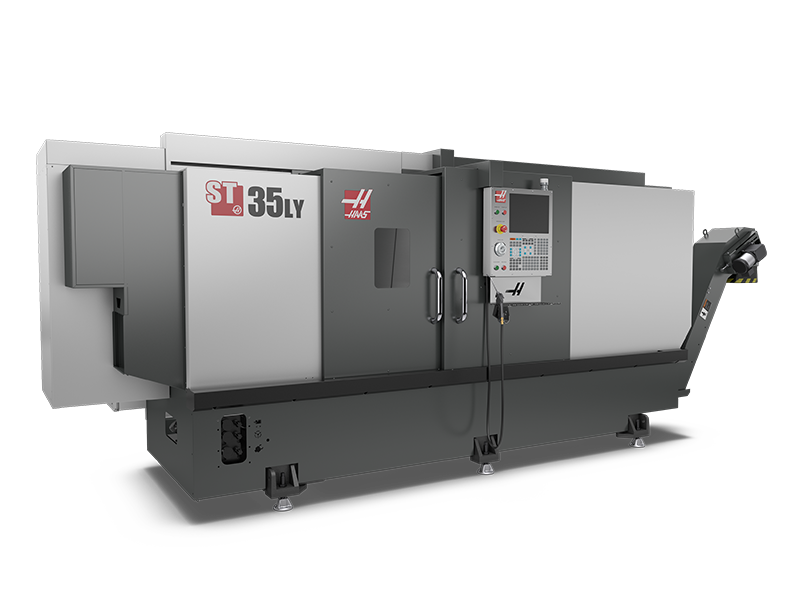
HAAS - ST35LY
VIEW MACHINE -
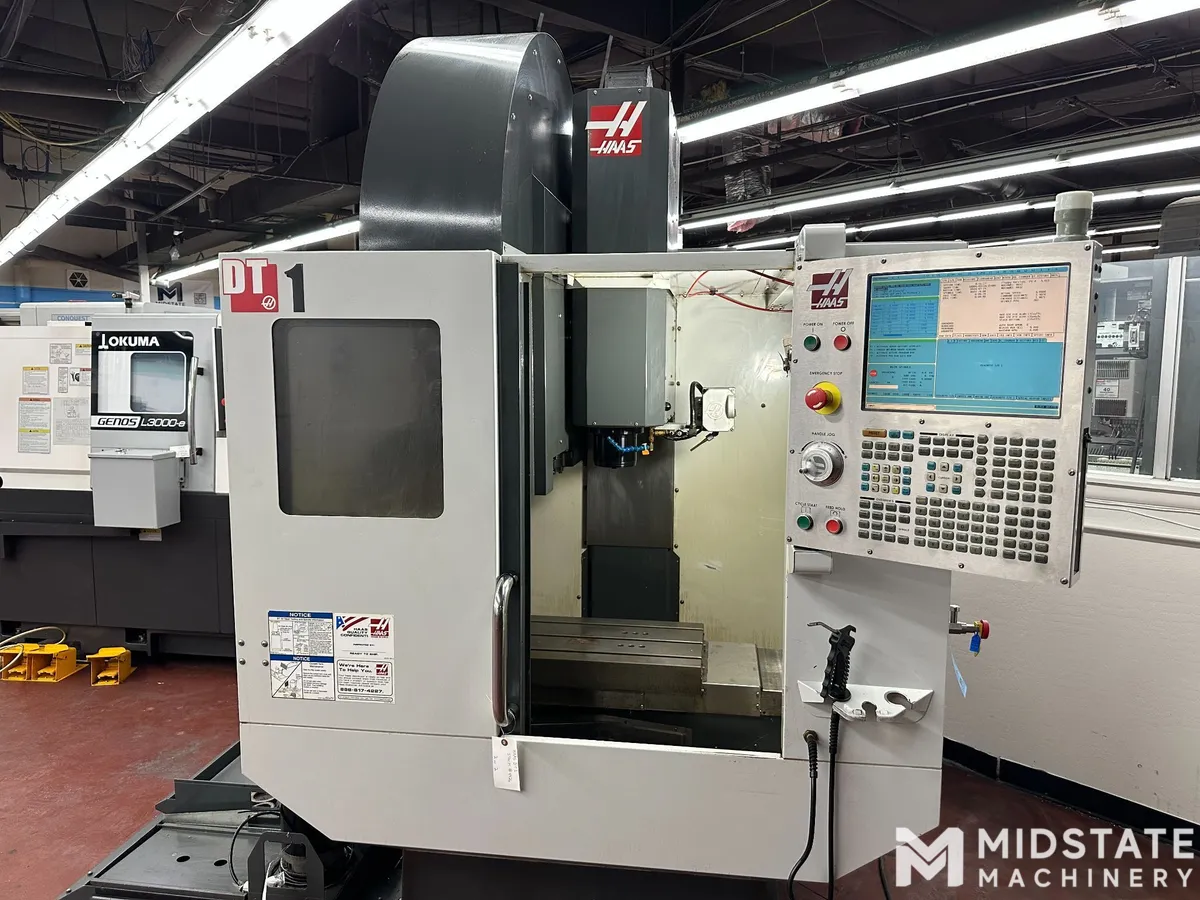
HAAS - DT1
VIEW MACHINE -
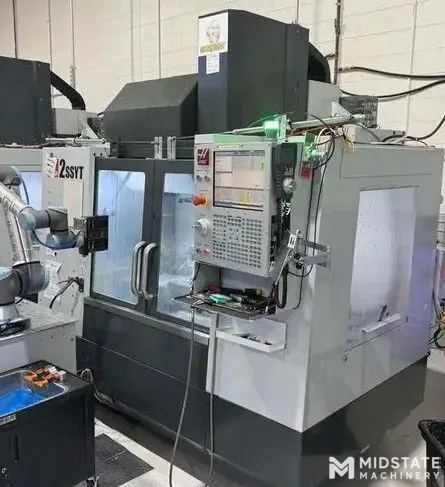
HAAS - VF2SSYT
VIEW MACHINE -
HAAS - ST40T
VIEW MACHINE